The Municipal Code of Bluffton, Indiana began in-house in 2020 with the assistance of Municipal Code Corporation. This Municipal Code shall be cited as the Bluffton City Code or “BCC” as an acronym. BCC references found within the code maintain a structure by subject matter using a decimal numbering system which identifies the chapter and section (for example: 1.01.010). This complete set of numbers is designed to aid in searching and/or referencing the City Code, and to assist in subsequent codification as new ordinances are added to the City Code.
- The first number in the sequence (1.01.010) designates the TITLE level
- The second series of numbers (1.01.010) designates the CHAPTER level
- The last series (1.01.010) designates the SECTION level
- If a fourth series exists comprising letters or numbers beyond a section level, it designates a SUBSECTION level.
To outline, give structure, and more granularly reference the legislation herein, the following list order or pattern of ascending alphanumeric characters is used: A, 1, a, (1), (A), (a). Drafting future legislation with this list order reconciles it with the online code’s list order. To forego the naming of each list item and to more granularly reference legislation that employs alphanumeric characters, use “paragraph” (always capitalized) followed by the desired alphanumeric reference(s), comma separated. For example, “paragraph B,7,d”, specifically references item “d”, of item “7”, of item “B”—whereas “paragraph B” refers more generally to any or all of paragraph B’s descendants. References herein revealing “I.C.” implies a reference to the "Indiana State Code". This complete set of numbers is designed to aid in searching the Municipal Code and to assist in subsequent codification as new ordinances are added to the Municipal Code. Vacant titles, chapters, or sections may be designed for future use and may be marked “Reserved” to ease internal expansion. The legislative history beneath a legislation’s content identifies the specific legal sources, and may be provided to substantiate the online code. This Municipal Code is supplemented from time to time with amendments and additions made by the City of Bluffton, IN. The specific legal sources that comprise this Municipal Code have been adopted during the codification process from the original formatting of the official hard copy. In the event of discrepancies between the online Municipal Code and the official hard copy, the official hard copy governs. Municipal Code Corporation, provides a searchable database of the Municipal Code for easy reference and convenience. NOTICE: THE MUNICIPAL CODE MAY NOT REFLECT ALL OR THE MOST CURRENT VERSION OF LEGISLATION ADOPTED BY THE CITY COUNCIL THAT HAS YET TO BE UPDATED ONLINE. IN THE EVENT OF CONFLICT BETWEEN THE MUNICIPAL CODE AND A WRITTEN ORDINANCE, THE ORDINANCE TYPICALLY GOVERNS. ALSO, THE MUNICIPAL CODE MAY NOT REFLECT RULES OR OTHER REGULATIONS PROMULGATED UNDER THE AUTHORITY OF THE CODE, INCLUDING TECHNICAL SPECIFICATIONS. FOR MORE INFORMATION CONTACT THE CITY CLERK/TREASURER.
CHAPTER 1.08 GENERAL PENALTY
Repealed and Replaced by Ordinance 1035, 5/13/1997
1.04.020 TITLE OF OFFICE
1.04.030 INTERPRETATION OF LANGUAGE
1.04.040 GRAMMATICAL INTERPRETATION
1.04.050 ACTS BY AGENTS
1.04.060 PROHIBITED ACTS INCLUDE CAUSING AND PERMITTING
1.04.070 COMPUTATION OF TIME
1.04.080 CONSTRUCTION
1.04.090 REPEAL SHALL NOT REVIVE ANY ORDINANCE
1.04.100 SEVERABILITY
1.04.110 ERRORS AND OMISSIONS
1.04.120 NON-CODE
The following words and phrases whenever used in the ordinances of Bluffton, Indiana, shall be construed as defined in this section unless from the context a different meaning is intended or unless a different meaning is specifically defined and more particularly directed to the use of such words or phrases.
“City" means the City of Bluffton, Indiana, or the area within the territorial limits of the outside of the City over which the City has jurisdiction or control by virtue of any constitutional or statutory provision.
"Council” means the Common Council of the City of Bluffton, Indiana.
"County" means the county of Wells.
"Law" denotes applicable federal law, the Constitution and statutes of the State of Indiana, the ordinances of the City of Bluffton, and, when appropriate, any and all rules and regulations which may be promulgated thereunder.
"May" is permissive.
"Month" means a calendar month.
"Must" and "shall" are each mandatory.
“Oath" includes an affirmation or declaration in all Cases in which, by law, an affirmation may be substituted for an oath, and in such cases the words "swear" and "sworn" shall be equivalent to the words "affirm" and "affirmed."
"Owner", applied to a building or land, includes any part owner, joint owner, tenant in common, joint tenant, tenant by the entirety, of the whole or a part of such building or land.
"Person" includes a natural person, joint venture, Joint Stock Company, partnership, association, club, company, corporation, business, trust, organization, or the manager, lessee, agent, servant, officer or employee of any of them.
"Personal Property" includes money, goods, chattels and things in action and evidences of debt.
"Preceding" and "following" mean next before and next after respectively.
"Property" includes real and personal property.
"Real Property" includes lands, tenements and hereditaments.
"Sidewalk" means that portion of a street between the curb line and the adjacent property line intended for the use of pedestrians.
"State" means the state of Indiana.
"Street" includes all streets, highways, avenues, lanes, alleys, courts, places, squares, curbs, or other public ways in the City, which have been or may hereafter be dedicated and open to public use, or such other public property so designated in any law of this state.
"Tenant" and "Occupant", applied to a building or land, include any person who occupies the whole or a part of such building or land, whether alone or with others.
"Written" includes printed, typewritten, mimeographed, multi-graphed or otherwise reproduced in permanent visible form.
"Year" means a calendar year.
Use of the title of any officer, employee, department, board of commission means that officer, employee, department, board of commission of the City.
All words and phrases shall be construed according to the common and approved usage of the language, but technical words and phrases and such others as may have acquired a peculiar and appropriate meaning in the law shall be construed and understood according to such peculiar and appropriate meaning.
The following grammatical rules shall apply in the ordinances of the City, unless it is apparent from the context that a different construction is intended:
- Gender: Each gender includes the masculine, feminine and neuter genders.
- Singular and Plural: The singular number includes the plural and plural includes the singular.
- Tenses: Words used in the present tense include the past and the future tenses and vice versa, unless manifestly inapplicable.
When an act is required by an ordinance the same being such that it may be done as well by an agent as the principal, such requirement shall be construed to include all such acts performed by an authorized agent.
Whenever in the ordinances of the City, any act or omission is made unlawful, it shall include causing, allowing, permitting, abiding, abetting, suffering, or concealing the fact of such act or omission.
Except when otherwise provided, the time within which an act is required to be done shall be computed by excluding the first day and including the last day, unless the last day is Sunday or a holiday, in which case it shall also be excluded.
The provisions of the ordinances of the City, and all proceedings under them are to be construed with a view to affect their objects and to promote justice.
The repeal of an ordinance shall not repeal the repealing clause of an ordinance or revive any ordinance, which has been repealed thereby.
If any provision of this code as now or later amended or its application to any person or circumstances is held invalid, the invalidity does not affect other provisions that can be given effect without the invalid provision or application. I.C. § 1-1-1-8.
If a manifest error be discovered consisting of the misspelling of any word or words, the omission of any word or words necessary to express the intention of the provisions affected, the use of a word or words to which no meaning can be attached or, the use of a word or words when another word or words was clearly intended to express such intent, such spelling shall be corrected, and such word or words supplied, omitted, or substituted as will conform with the manifest intention, and provision shall have the same effect as though the correct words were contained in the text as originally published. No alteration shall be made or permitted if any question exists regarding the nature or extent of such error.
All ordinances of a temporary or special nature and all other ordinances pertaining to subjects not enumerated and embraced in this code or ordinances shall remain in full force and effect unless herein repealed expressly or by necessary implication.
Amended by Ordinance 1144, 4/30/2002
Any person violating any of the provisions or failing to comply with any of the mandatory requirements of the ordinances of the City of Bluffton, Indiana shall be guilty of an offense. Each day such violation is committed or permitted to continue shall constitute a separate offense and shall be punishable as such thereunder. Except in cases where different punishment is prescribed by any ordinance of the City, any person convicted of an offense shall be punished by a fine of not more than allowable by I.C. § 36-1-3-8 as it is now written or may be amended in the future.
CHAPTER 2.08 COMPENSATION OF OFFICERS AND EMPLOYEE
CHAPTER 2.20 STATUTORY BOARDS AND COMMISSIONS
CHAPTER 2.24 CITY DEPARTMENTS ESTABLISHED
CHAPTER 2.32 WELLS COUNTY PLAN COMMISSION
CHAPTER 2.36 ELECTION DISTRICTS
Repealed and Replaced by Ordinance 1035, 5/13/2019
2.04.020 EXECUTIVE BRANCH
2.04.021 MAYOR
2.04.022 BOARD OF PUBLIC WORKS AND SAFETY
2.04.023 DEPARTMENT OF LAW
2.04.024 POWERS AND DUTIES
2.04.025 APPOINTMENT TO BOARD OF PUBLIC WORKS AND SAFETY OR DEPARTMENT HEAD
2.04.030 LEGISLATIVE BRANCH
2.04.031 CLERK OF THE COUNCIL
2.04.032 REGULAR MEETING DATE, TIME AND PLACE; SPECIAL MEETINGS
2.04.033 PRESIDING OFFICER OF THE COUNCIL
2.04.034 COMMON COUNCIL
2.04.050 FISCAL BRANCH
2.04.051 APPOINTMENT OF CITY CLERK EMPLOYEES
2.04.052 WORKING RELATIONSHIPS - CITY CLERK
2.04.053 WORKING RELATIONSHIPS - CITY UTILITIES
2.04.060 JUDICIAL BRANCH
The Government of the City of Bluffton shall consist of five (5) branches, as follows:
- Executive Branch, I.C. § 36-4-5;
- Legislative Branch, I.C. § 36-4-6;
- Fiscal Branch, I.C. § 36-4-10;
- Judicial Branch, I.C. § 33-10.1-1.3; and
- Statutory Boards and Commissions.
The City Executive Branch is hereby established and shall consist of the Mayor, the Board of Public Works and Safety, the Department of Law, and any other boards or commissions established by ordinance or resolution, each with the appropriate powers and duties as designated in this Code, the enabling ordinance or resolution, or by the State Legislature.
The Mayor is the City executive and the head of the Executive Branch. He or she shall faithfully perform the duties and responsibilities as set out in I.C. § 36-4-5 as well as all other applicable statutes of the State of Indiana.
There is hereby established a Board of Public Works and Safety within the Executive Branch. Said Board shall be the chief administrative body of the City and shall have control of the day-to-day operations of the following executive departments, which are hereby established:
- Police Department,
- Fire Department,
- Utilities Department (consisting of the acquisition of electrical power and the maintenance of a distribution system, sewage collection and disposal system, the waterworks system, and storm water maintenance and control),
- Street Department, and
- Building Department.
There is hereby established a Department of Law pursuant to I.C. § 36-4-9-11 and 12, consisting of the City Attorney. The City Attorney shall represent all departments, boards and commissions operating on behalf of the City and he or she shall be a licensed, practicing attorney, admitted to and in good standing with the Indiana Bar, and a resident of Wells County. Deputy attorneys shall be employed as needed. The appointed City Attorney may be an employee of the City or an independent contractor, as determined by the Mayor under Section 2.04.025.
Subject to the appropriation power of the Common Council, the above and foregoing departments shall have the ability to hire such employees, and purchase or contract for such materials or services, as the Board of Public Works and Safety or other governing board or commission deems necessary to perform their public functions.
The members of the Board of Public Works and Safety are the Mayor and two persons who shall be chosen by the Mayor in accordance with the law of Indiana and who shall serve at his or her pleasure. The Chiefs of Police, the Chief of the Fire Department, and the heads of the Department of Law, Utilities, Building Department, Street Department are appointed by the Mayor and serve at his or her pleasure.
The Legislative Branch of the City of Bluffton is the Common Council. The Common Council shall have exclusive authority to adopt ordinances and resolutions, appropriate tax monies received by the City, and to perform other necessary and desirable legislative functions.
The Clerk-Treasurer shall be the Clerk of the Council and shall perform the duties prescribed by I.C. § 36-4-6-9 and such other duties as the Council may direct, and shall prepare the memorandum of the Council meeting pursuant to the requirements of IC 5-14-1.5-4.
The Common Council shall hold its first meeting of the year on the first Tuesday in January. Thereafter, the regular meeting date, time and place for the Common Council shall be at 5:30 o'clock P.M. on the first and third Tuesday of each month in the Common Council Chambers in the City Building, unless proper notice of a regular meeting provides for a different time and/or location. Provided, however, if the immediately preceding meeting of the Board of Public Works and Safety is not concluded by 5:30 p.m., the regular meeting of the Common Council shall commence upon the conclusion of the meeting of the Board of Public Works and Safety. Special meetings of the Common Council shall be held when called by the Mayor or as provided by the rules of the Common Council.
The Mayor or, in the absence of the Mayor, the president pro tempore of the Council shall be the presiding officer of the Council pursuant to I.C. § 36-4:6-8 and meetings shall be conducted pursuant to the applicable statutes: I.C. §§ 36-4-6-10 through 36-4-6-17, and in accordance with the following rules:
- Order of Business: The order of business to be followed at the meeting of the Common Council shall be as follows:
- Call to order and roll call,
- Invocation,
- Reading, if not previously circulated among the Council members, and approval of minutes of the previous meeting,
- Unfinished business,
- New business, including introduction of ordinance and resolutions,
- Comments from Council members or citizens, and
- Adjournment
- Contempt and Disorder in Council Room: No person shall use violent or contemptuous language, behave in a disorderly, disrespectful or boisterous manner, or otherwise refuse to obey the orders of the Mayor or presiding officer in the Council room while the Council is in session. The Mayor or presiding officer may order the removal from the Council room anyone who disturbs the decorum of a Council meeting.
- Introduction and Adoption of Ordinances and Resolutions: 1. All proposed ordinances shall be delivered to Council members, together with a copy of the agenda for the meeting at which the ordinance is to be introduced at least seventy-two (72) hours prior to the meeting, except in situations in which an emergency exists or other circumstances prevent delivery prior to the meeting. The failure to deliver a proposed ordinance to the Council seventy two (72) hours prior to the meeting does not, by itself, void the ordinance if the Council adopts the proposed ordinance at the meeting at which the ordinance was introduced following the procedure required by the following Subsection 2. 2. A majority of all elected Council members constitutes a quorum. To be considered, all ordinances must be introduced at a meeting of the Council. If the ordinance was not presented to the Council members at least seventy-two (72) hours prior to the meeting, the ordinance must be read not less than one time before being considered for final passage. This reading must take place at the meeting at which the ordinance was introduced. A majority vote of the elected Council members at a meeting at which a quorum exists is required to pass an ordinance, unless a greater vote is required by Indiana law. An ordinance may be introduced and passed on the same day if the following procedure as provided in LC. §36-4-6-13 is followed: A quorum of the Council is present; Council members present must unanimously consent to consider the ordinance; and two-thirds (2h) of all elected Council members must vote to adopt the ordinance. 3. Resolutions shall be subject to the same rule in the method of introduction as ordinances, but may be considered and adopted at the meeting at which the resolution was introduced upon one vote receiving the approval of a majority of the Council members present at a meeting at which a quorum of Council members are present. 4. On final passage of any ordinance, the ayes and nays shall be entered in the record, and the ordinance shall be processed in accordance with LC. §§ 36-4-6- 14 through 36- 4-6-17. 5. This shall be the procedure for adoption of ordinances and resolutions by the Council unless Indiana law requires a different procedure.
- Questions of Order: The Mayor or presiding officer shall decide all questions of order pursuant to the rules set forth in this ordinance, or where this ordinance does not provide for said question of order, according to Robert Rules of Order.
- Suspension of Rules: The Presiding Officer may change the order of business from that as required in 2.04.033 A.
5. Abstentions: Abstentions from voting, except in situations where the abstention results from a Council member's determination, made and announced prior to the vote, that he or she will not vote on the question due to a conflict of interest, will be recorded as such, and will not be counted in the tallying of the vote unless it is necessary to break a tie, in which case an abstention will be considered a nay vote. Abstentions resulting from conflicts of interest will not be considered in determining the vote. Abstentions will not affect the determination of a quorum.
The Common Council shall be comprised of five (5) members, four (4) of whom are elected from distinct districts and one (1) of whom is elected by the voters of the City at large. Redistricting of council districts shall be done in 1982 and every ten (10) years thereafter in accordance with LC. §§ 36-4-6-4 and 36-4-6-5. Commencing with the election to be held in 2023 for a Common Council to be seated January I, 2024, the Common Council shall be comprised of seven (7) members, five (5) of whom are to be elected from distinct districts and two (2) of whom are to be elected by the voters of the City at large.
The Clerk-Treasurer is the fiscal officer of the City and the head of the fiscal branch. He or she shall perform the duties assigned by I.C. § 36-4-10 and such other duties as the Common Council may, by ordinance, require.
The Clerk-Treasurer is hereby authorized, pursuant to LC. § 36-4-11-4, to appoint deputies and employees as authorized by the Common Council. Such deputies or employees shall work under the exclusive direction of the Clerk-Treasurer and serve at the pleasure of the Clerk-Treasurer.
The Clerk-Treasurer shall furnish space within his or her office for the financial, administration and other records of the City. The various deputy clerks or other employees of the Clerk-Treasurer needed to manage the bookkeeping and administrative requirements of the Clerk-Treasurer's office as authorized by the Council shall be appointed by the Clerk-Treasurer. The deputy clerks serve at the pleasure of the Clerk-Treasurer.
The Director of Utilities shall furnish space within his or her office for the administration and records of the City's utility departments. The various utility clerks needed to manage the bookkeeping and administrative requirements of the utilities department shall be appointed and compensated by the Board of Public Works and Safety. The utility clerks serve at the pleasure of the Board of Public Works and Safety.
There is hereby established effective January I, 1984, a City Court of Bluffton to be headed and operated by a City Judge elected and seated pursuant to LC. § 33-10.1-1-3.
2.08.020 APPOINTIVE OFFICERS, DEPUTIES, AND OTHER CITY EMPLOYEES
2.08.030 EMPLOYEES OF BLUFFTON UTILITIES
The annual salary of all elected city officers shall be established annually by ordinance pursuant to I.C. § 36-4-7-2.
The compensation to be paid to each appointive officer, deputy and other employee of the City shall be fixed by the Mayor subject to approval, subject to the approval of the Common Council in pursuant to I.C. § 36-4-7-3.
The compensation to be paid to employees of Bluffton Utilities shall be fixed by the Board of Public Works and Safety pursuant to I.C. § 8-1.5-34.
2.20.020 DEPARTMENT OF ECONOMIC DEVELOPMENT
2.20.030 THE DEPARTMENT OF REDEVELOPMENT
2.20.040 POLICE PENSION BOARD OF TRUSTEES
2.20.050 FIREFIGHTERS PENSION BOARD OF TRUSTEES
There is hereby established a Park and Recreation Board established pursuant to I.C. § 36-10-3 and having the power, duties and responsibilities as set forth therein.
There is hereby established a Department of Economic Development consisting of the Economic Development Commission organized under LC. § 36-7-12 and having the powers, duties and responsibilities as set forth therein.
The Department of Redevelopment, as established by Ordinance No. 1248, passed August 22, 2006, is hereby confirmed. The Department of Redevelopment shall consist of a Redevelopment Commission to be organized under and shall possess the powers enumerated in LC.§ 36-7-14 and 25.
There shall be a Police Pension Board of Trustees to perform certain duties prescribed by LC. § 36-8-6 (1925 Fund) and LC. § 36-8-8 (1977 Fund) concerning the statutory pensions of city police.
There shall be a Firefighters' Pension Board of Trustees to perform certain duties prescribed by LC. § 36-5-7 (1925 Fund) and LC. § 36-8-5 (1977 Fund) concerning the statutory pensions of city firefighters.
2.24.020 POWERS AND DUTIES
The following departments are hereby established in the City of Bluffton, Indiana:
- Police Department;
- Street Department;
- Utility Department;
- Department of Law;
- Fire Department;
- Department of Parks and Recreation.
The departments established by BCC 2.24.010 shall perform the administrative functions assigned to them by statute and ordinance.
Amended by Ordinance 1147, 5/14/2002
- The Common Council hereby adopts the provisions I.C. § 36-7-4.
- Said city hereby agrees to join in and participate with the area planning department of Wells County, which was established by separate ordinance of said county and which ordinance provides for said planning department to be in existence from the date of which it is organized at its first meeting called by the President of the Board of County Commissioners.
- The membership of the Area Planning Commission of Wells County shall be as set forth in I.C. § 36-7-4-207, I.C. § 36-7-4-208, I.C. § 36-7-4-209 and I.C. § 36-7-4-211.
- A copy of this section, upon its passage and proper signature, shall be certified to the Board of County Commissioners of Wells County, Indiana, and to the respective Board of Trustees of the Town of Ossian, Indiana, the Town of Uniondale Indiana, the Town of Poneto, Indiana, the Town of Vera Cruz, Indiana and the Town of Markle, Indiana.
2.36.020 DISTRICTS DESIGNATED
2.36.030 CONFLICTS, OMISSIONS, DUPLICATIONS
2.36.040 NOTIFICATION OF WELLS COUNTY ELECTION BOARD
The City of Bluffton hereby elects to divide itself into five (5) election districts pursuant to the authority of I.C. §36-4-6-4. The Legislative body (also known as the Common Council) of the City of Bluffton, Indiana shall be composed of five (5) members elected from the districts herein established and two (2) members elected from the City at-large.
The election districts are designated as follows (descriptions include only those portions of the indicated precincts within City limits):
A. District One (1) is that portion of the City which includes the following precincts: Bluffton Lancaster III and Bluffton Lancaster East, excluding the portion of Bluffton Lancaster East bounded by the following:
Beginning at the centerline of State Road 124 at its intersection with the centerline of Westfield Drive, then no1th along the centerline of Westfield Drive to the centerline of Greenlawn Avenue, then east along the centerline of Greenlawn Avenue to the centerline of Eastmoor Drive, then north along the centerline of Eastmoor Drive to the centerline of Cari Drive, then east along the centerline of Cari Drive to the centerline of Cedar Road, then south along the centerline of Cedar Road to the centerline of North Drive, then east along the centerline of North Drive to the centerline of McA1thur Drive, then n01theasterly and southeasterly along the centerline of MacA1thur Drive to the centerline of Normandy Drive, then south and southeasterly along the centerline of Normandy Drive to the centerline of Creek Drive, then south along the centerline of Creek Drive to the centerline of State Road 124, then west along the centerline of State Road 124 to the point of beginning.
B. District Two (2) is that portion of the City which includes the following precincts: Bluffton Lancaster West and that p01tion of Bluffton 3 which is east of the centerline of Morgan Street.
C. District Three (3) is that po1tion of the City which includes the following precincts: Bluffton 4 and that portion of Bluffton 5 which is south of the centerline of Wiley Avenue. D. District Four (4) is that portion of the City which includes the following precincts: Bluffton 6, that portion of Bluffton 5 which is n01ih of the centerline of Wiley Avenue and the portion of Bluffton Lancaster East bounded by the following: Beginning at the centerline of State Road 124 at its intersection with the centerline of Westfield Drive, then n01ih along the centerline of Westfield Drive to the centerline of Greenlawn Avenue, then east along the centerline of Greenlawn Avenue to the centerline of Eastmoor Drive, then north along the centerline of Eastmoor Drive to the centerline of Cari Drive, then east along the centerline of Cari Drive to the centerline of Cedar Road, then south along the centerline of Cedar Road to the centerline of North Drive, then east along the centerline ofN01ih Drive to the centerline of McArthur Drive, then n01iheasterly and southeasterly along the centerline of MacAtthur Drive to the centerline of Normandy Drive, then south and southeasterly along the centerline of Normandy Drive to the centerline of Creek Drive, then south along the centerline of Creek Drive to the centerline of State Road 124, then west along the centerline of State Road 124 to the point of beginning.
E. District Five (5) is that portion of the City which includes the following precincts: Bluffton 2 and that p01tion of Bluffton 3 west of the centerline of Morgan Street.
Amended by Ordinance 1355, 1/22/2013
A. Attached to this Ordinance as Exhibit A are maps showing the boundaries of each Council District collectively and separately (the "Maps") which maps are incorporated herein by reference. B. If a conflict exists between the Maps and the descriptions set fotth in Section 020 of this Chapter (the "Descriptions"), in accordance with LC. §3-5-10-9, the Descriptions shall determine the boundaries of the Council District. C. If any territory in the City is not included in one of the Council districts, in accordance with LC. §3-5-10-10, the excluded territory shall be included in the Council District that: (i) is contiguous to that territory; and (ii) contains the least population of all Council districts contiguous to that territory. D. If any territory in the City is included in more than one (1) of the Council districts, in accordance with LC. §3-5-10-11, the territory shall be included in the Council district that: (i) is one (1) of the districts in which the territory is described in this Ordinance; (ii) is contiguous to that territory; and (iii) contains the least population of all Council districts contiguous to that territory. E. In accordance with LC. §36-4-6-5(p) this Ordinance must be construed, if possible, to comply with the provisions of LC §36-4-5-6. The provisions of this Ordinance are severable and if any provision is found to be invalid, the invalidity shall not affect the other provisions of this Ordinance that can be given effect without the invalid provision.
Any time this Chapter is amended the City Clerk-Treasurer shall send a certified copy of this chapter to the secretary of the Wells County election board.
CHAPTER 3.12 WARRANTS
CHAPTER 3.16 PERMISSIVE EXPENSES FOR MUNICIPAL PROMOTION
CHAPTER 3.20 JUNK VEHICLE FUND
CHAPTER 3.36 PUBLIC EMPLOYEES RETIREMENT FUND
CHAPTER 3.40 POLICE PENSION FUND
CHAPTER 3.44 PARKS AND RECREATION FUNDS
CHAPTER 3.46 EVIDENCE FUNDS
CHAPTER 3.48 OTHER FUNDS
Repealed and Replaced by Ordinance 1035, 5/13/1997
3.08.020 TAX LEVY DESIGNATED
Pursuant to I.C. § 36-8-14-2, a fund known as the Cumulative Firefighting Building and Equipment Fund is established. The fund shall be used only for the equipment. Purposes specified under I.C. § 36-8-14-2 as it now reads or may be amended in the future.
To provide for the Cumulative Firefighting Building and Equipment Fund, the Common Council of the City of Bluffton shall comply with the requirements of I.C. § 6-1.1-41 regarding the levy of an annual tax on all taxable property within the City and obtain approval of the tax by the state board of tax commissioners. The tax rate may not exceed ten cents on each one hundred dollars of assessed valuation of property in the City.
3.12.020 APPROVAL OF ORDER FOR ISSUANCE
3.12.021 VOUCHERS THAT MAY BE PAID PRIOR TO BOW ALLOWANCE
3.12.030 AUDIT AND INVESTIGATION OF CLAIMS
3.12.040 APPROVAL OF CLAIM
3.12.050 PREREQUISITES FOR APPROVAL OF CLAIM
Money may be paid out of the city treasury only on warrant of the City Clerk-Treasurer. Unless provided otherwise by state law, the Clerk-Treasurer may draw a warrant against a fund of the City only if an appropriation has been made for that purpose, the appropriation is not exhausted, and:
- The warrant is for a salary fixed by statute or ordinance;
- The warrant is for a claim allowed under BCC 3.12.040;
- The Clerk-Treasurer is ordered to issue the warrant under BCC 3.12.020;
- The warrant is for payment of a judgment that the city must pay; or
- The warrant is for interest due on City bonds.
The Board of Public Works and Safety or Common Council may order the issuance of warrants for payment of money by the City only at a meeting of the Board or Common Council. A city officer who violates this section forfeits his office pursuant to I.C. § 36-4-8-3.
- The following types of vouchers are allowed to be paid prior to Board of Works allowance:
- Utility payments or connection charges;
- General grant programs where advance funding is not prohibited and the contracting;
- party posts sufficient security to cover the amount advanced;
- Grants of state funds;
- Principal and interest on Bonds or coupon payments;
- Payroll including Direct Deposits;
- State, federal or county taxes;
- Expenses that must be paid because of emergency circumstances;
- A product or service for which the city legislative body has accepted a bid;
- Deposits for bonds for street cuts and to raze buildings made payable to and held in escrow by the city to be refunded to the payee upon satisfactory completion of construction of work associated with said deposit of bond;
- Registration fees associated with conferences, seminars, or workshops that city employees wish to attend;
- Credit Card payments;
- Insurance Premiums;
- License fees or permit fees;
- Property or services purchased or leased from the United States government; or an agency or political subdivision of the United States government or government of the State of Indiana.
- Maintenance agreement or service agreement payments;
- Lease agreements or rental agreement payments;
- Payment of the funeral benefits outlined in I.C. § 36-8-6-9.8(4) to heirs or estates of deceased retired members of the Old Police Pension.
- Payment to vendors which provided services or goods to the City and for which a delay of payment incurs penalties or late payment charges.
- Payments for the purchase of real estate; provided, that the purchase and price has been duly authorized and approved by the action of the proper council, board or commission, and the purchase was executed in compliance with I.C. § 33-24-1-10.5, I.C. 36-7, I.C. 36-9 or I.C. 35-10 and other relevant laws;
- Expenditures for temporary loans in consequences of cash flow needs, provided that the temporary loan has been duly authorized and approved by action of the Common Council;
- Each payment of expenses outlined in paragraph A must be supported by a fully itemized accounts payable voucher.
- Timely Review. The Board of Public Works and Safety shall review and allow the payment at the Board’s next regular or special meeting following the preapproved payment of the expense.
Added by Ordinance 1424, 2/2/2016
The Clerk-Treasurer may audit a claim against the City by examining under oath any officer, agent or employee of the City or any other person. When acting under this section, the Clerk-Treasurer has the same powers as the Common Council in summoning and examining witnesses.
If the Clerk-Treasurer finds that:
- The claim includes an item for which no appropriation has been made;
- There is not a sufficient balance for payment of the claim in the proper fund; or
- The claim should not be approved for any reason;
The Clerk-Treasurer may not issue warrants to pay the claim and shall notify the proper department of the reasons for is refusal to pay the claim.
The Board of Public Works and Safety or Common Council may allow a claim:
- Only at a meeting of the Board or Common Council; and
- Only if the claim was filed in the manner prescribed by I.C. § 5-11-10-2 at least five days before the meeting.
A city officer who violates this section forfeits his office pursuant to I.C. § 36-4-8-5.
A warrant for payment of a claim against the city may be issued only if the claim is:
- Itemized and certified under I.C. § 5-11-10-1;
- Approved by the officer or person receiving the goods or services;
- Filed with the Clerk-Treasurer;
- Audited and approved by the Clerk-Treasurer; and
- Allowed by the Board of Public Works and Safety or Common Council or the city board having jurisdiction over allowance of the claim.
3.16.020 PRIOR APPROVAL
The Bluffton City Council is hereby authorized to budget and appropriate funds from the general fund of the City to pay the expenses of or to reimburse City officials for expenses incurred in promoting the best interest of the City. Such expenses may include, but are not necessarily limited to, rental of meeting places, meals, decorations and expenses incurred in interviewing job applicants, in promoting industrial development and any other expenses of a civic or governmental nature deemed to be in the interest of the City.
No expenses shall be incurred under this chapter without prior authorization of the mayor and all claims for such expenses shall be approved by the Mayor and allowed in the regular manner before payment.
There is hereby created the City Junk Vehicle Fund which shall be a revolving fund, and all monies paid to the city for the cost of removal, storage, and/or disposal of abandoned vehicles shall be placed in said fund and in no other place. Said fund shall also have added to it such monies as may be appropriated by the Common Council and such monies also shall not revert but shall remain in the Junk Vehicle Fund.
3.36.080 ELIGIBLE PERSONNEL TO PARTICIPATE
The City of Bluffton elects to become a participant in the Public Employees Retirement Fund as established by the Acts of 1945; Chapter 340 and all Acts amendatory and supplemental thereto. The City of Bluffton agrees to make the required contributions under the Public Employees' Retirement Fund Act which is the Acts of 1945, Chapter 340, and all Acts amendatory thereof and supplemental thereto, including specifically the Acts of 1955, Chapter 329, commonly designated as "The Indiana Public Employees' Social Security Integration and Supplemental Retirement Benefits Act."
All appointed officers, deputies, and other employees of the City of Bluffton or Bluffton Utilities who are not compensated on a fee basis or who are not employees of an emergency nature and are not in a part-time category are declared to be covered by the fund unless otherwise covered by a Police or Firefighter's Pension Fund as set out in this Code of Ordinances or the Acts of the Indiana General Assembly. The active participating membership of the City of Bluffton, State of Indiana, shall begin on January 1, 1974.
3.40.020 ASSESSMENT
3.40.030 CITY PARTICIPATION IN FUND
Pursuant to the provisions of Chapter 51 of the Acts of the General Assembly of 1925 and subsequent amendments the Police Pension Fund is hereby re-established.
The Clerk-Treasurer is authorized and directed to withhold from the salary of those members of the police department who are also members of the 1925 Police Pension Fund, as an assessment authorized by I.C. § 36-8-64(a)(3), an amount equal to six per cent (6%) of the base salary (plus all longevity increases) of a patrolman with twenty (20) years of service. The assessment shall not be made against any of the following benefits: incentive pay, holiday pay, insurance, clothing allowance, automobile use, firearms, education, overtime or compensatory time off.
To provide for the fund, the Bluffton City Council shall levy a police pension annual tax on all taxable property within the City upon approval of the tax by the state board of tax commissioners as provided by I.C. § 36-8-14-3.
3.44.020 SOURCES
3.44.030 TAX LEVY DESIGNATED
3.44.040 LIMITATION ON FUNDS
3.44.050 DISBURSEMENTS
Pursuant to the provisions of I.C. § 36-10-3-20 the following special non-reverting funds are hereby established:
A. Wells Community Swimming Pool Equipment Improvement Fund;
B. Land Acquisition Fund;
C. Parks and Recreation Department Capital Improvement Fund;
D. Harrison Township Parks Collaboration Non-Reverting Fund;
E. Wells County Parks Collaboration Non-Reverting Fund;
F. K9 Kommons Non-Reverting Fund.
The use of the funds deposited into the above listed Funds must be specifically related to the Fund’s special purposes.
The funds shall consist of special appropriations of the Common Council and other monies as specified herein:
- The Wells Community Swimming Pool Equipment Fund may consist of monies collected by the Parks and Recreation Board and generated by the rental fees charged by said Board to individuals and groups renting the Wells Community Swimming Pool.
- The Land Acquisition Fund may consist of monies that have accumulated in the Gift Fund, the Lion's Club Park Fund, and the Ferguson Park Fund for the use and benefit of the Parks and Recreation Department.
- The Parks and Recreation Capital Improvement Fund may consist of monies collected by the Parks and Recreation Board in connection with the use and rental of baseball diamonds and from revenue generated by rental fees charged for the right to engage in concession sales conducted in connection with the baseball program.
To provide for the Park and Recreation Fund, the Bluffton City Council shall levy an annual tax on all taxable property within the City upon approval of the tax by the state board of tax commissioners as provided by I.C. § 36-8-14-3.
The monies placed in said whether by appropriation or by the funds from time to time, collection of use and rental fees, shall not be expended except for specific equipment or capital improvements of the parks system under the jurisdiction of the Parks and Recreation Board and further shall not be expended without prior appropriation therefore having been duly made by the Common Council of the City of Bluffton, Indiana.
Disbursements shall follow the normal claims procedure established by law, within the limitations established in BCC 3.44.040.
3.46.020 USE
Added by Ordinance 1428, 3/15/2016
There is hereby established an Evidence Fund to be maintained.by the Clerk-Treasurer of the City of Bluffton, Indiana.
The Evidence Fund shall receive monies received by the Bluffton Police Department in connection with the investigation of a fraudulent scheme and shall disburse monies at the direction of, an in amounts determined by, an agent of the Bluffton Police Department upon determination of rightful ownership by said Department.
Pursuant to statutory provisions all other funds that the City may elect to use are hereby re-established. Such funds shall include, but not be limited to, the following:
Animal Shelter Vet Fund
Are You OK Fund
City Bus Fund
Clerk Record Perpetuation Fund
Clerk Treasurer Petty Cash Fund
Community Development block Grant Fund
Court Fees Fund
Cumulative Capital Development Fund
D.A.R.E. Fund
Domestic Violence Abuse Fund1
Drug Task Force - Detective Grant Fund
EDC Miscellaneous Revenue Fund
Firearms Training Fund
Firemen's Pension Fund
General Fund
K-9 Donation Fund
Law Enforcement User Fee Fund
Local Law Enforcement Continuing Education Fund
Local Road and Bridge Matching Grant Fund2
Local Road and Street Fund
Motor Vehicle Highway Fund
Payroll Fund
Police Petty Cash Fund
Police Petty Cash - Informant Fund
Police Programs Fund3
Police Training Fund
Recycle Building Fund
Revenue Sharing Fund
Special Vehicle Inspection Fund
State and Federal Loan/Grant Funds
1 Adopted Ordinance 1238, 8/9/2006
2Adopted Ordinance 1451, 6/6/2017
3Adopted Ordinance 1237, 8/9/2006
CHAPTER 5.16 SIGNS
CHAPTER 5.20 JUNK DEALERS AND YARDS
Repealed and Replaced by Ordinance 1057, 4/28/1998
5.04.020 REGISTRATION BY SOLICITORS WITH POLICE DEPARTMENT
5.04.030 REGISTRATION BY TRANSIENT MERCHANTS WITH POLICE DEPARTMENT
5.04.040 EVIDENCE OF COMPLIANCE
5.04.050 DISPLAY OF PERMIT
5.04.060 EXEMPTIONS
5.04.070 DURATION OF PERMIT
5.04.080 UNLAWFUL ACTS
BCC 5.04.090 Repealed, by Ordinance 1144, 4/30/2002
For the purposes of this Chapter, the following definitions shall apply:
"Person" shall mean any individual, firm, co-partnership, corporation, company, association, or joint stock association, church, religious sect, religious denomination, society, organization, or league, and includes any trustee, receiver, assignee, agent, or other similar representative word.
"Principal Agent" shall mean the employee or agent of the Transient Merchant who is responsible for the day-to-day operations of the business within the City.
"Solicit" or "Solicitation" shall include requesting, directly or indirectly, money, credit, property, financial assistance, or other thing of value or selling, offering to sell, taking orders for sale of goods or services to be rendered at any place other than from a fixed place of business.
"Solicitor" shall include, shall mean any person, firm, limited liability company, or corporation, both as principal and agent, who sells, offers to sell, or takes orders for goods at any place other than a fixed place of business for future delivery or for services to be performed.
"Transient Merchant" shall include all persons, firms, limited liability companies, and corporations, both as principals and agents, who engage in, do, or transact any temporary or transient business in this state, either in one (1) locality or in traveling from place to place in this state, offering for sale or selling goods, wares, or merchandise, and those who, for the purpose of carrying on such business, hire, lease, or occupy any permanent or mobile building, structure, or real estate for the exhibition by means of samples, catalogues, photographs, and price lists or sale of such goods, wares, or merchandise. The term shall not include any of the following:
- any person, individual, copartner, limited liability company, or corporation, which grows the goods, wares, or merchandise that is sold or offered for sale;
- a person who makes crafts or items by hand and sells them or offers them for sale;
- an auctioneer who is licensed under I.C. 25-8.1;
- a resident of the county in which the sale takes place who conducts a sale of tangible personal property for no more than four (4) days per year;
- an organization that is exempt from the Indiana gross retail tax under I.C. § 6-2.5-26;
- a person who:
- sells merchandise;
- offers to sell merchandise; and
- provides proof that the sale is being conducted as part of an activity sponsored by an organization described in paragraph E of this definition;
- a person who:
- organizes;
- sells merchandise at; and
- offers to sell merchandise at; or
- exhibits at a trade show or convention;
- a person who holds a registered retail merchant's certificate under I.C. § 6-2-5-8.
Any Solicitor or Transient Merchant desiring to conduct business within the City of Bluffton shall first register at the office of the Bluffton Police Department; as a part of the registration process shall:
- Provide a valid driver's license, identification card or other verifiable form of picture identification, which contains the applicant's name, address, social security or driver's license number, and physical description of the Solicitor and permit an employee of the Police Department to copy the same;
- Provide a brief description of the nature of the solicitation and the dates during which the Solicitor expects to be soliciting within the City;
- Provide the name, address and telephone number of the company for whom the Solicitor is employed or whom the Solicitor represents;
- Provide a recent photograph of the Solicitor (if no such photograph is available, the Solicitor shall permit the Department to photograph the Solicitor at the time of the application);
- Provide the license plate number of any vehicle to be used in such solicitation;
- Sign a statement as to whether the Solicitor has been convicted of any felony or been found to have violated any misdemeanor or ordinance related to solicitation or the sale of goods and to describe the nature of the conviction or violation;
- Sign a statement that the permit to be issued will not be used or represented in any way as an endorsement of the Solicitor by the City or Bluffton Police Department.
Any Transient Merchant desiring to transact business within the City of Bluffton shall first register at the office of the Bluffton Police Department; said Transient Merchant shall:
- Provide the name, address and telephone number of the company for whom the Transient Merchant is employed or whom the Transient Merchant represents;
- Provide a brief description of the nature of the business and the dates during which the Transient Merchant expects to be conducting business within the City;
- Provide a valid driver's license, identification card or other verifiable form of picture identification, which contains the name, address, social security or driver's license number, and physical description of the principal agent of the Transient Merchant and permit an employee of the Police Department to copy the same;
- Provide the license plate number of any vehicle to be used in such business;
- Sign a statement as to whether the Principal Agent has been convicted of any felony or been found to have violated any misdemeanor or ordinance related to solicitation or the sale of goods and to describe the nature of the conviction or violation;
- Sign a statement that the permit to be issued will not be used or represented in any way as an endorsement of the Transient Merchant by the City or Bluffton Police Department.
As evidence of registration, the Police Department shall issue to each Solicitor or Transient Merchant who has complied with the previous section, a permit which shall include the Solicitor's or Transient Merchant's name and address and the name of the company represented and the kind of goods to be sold or offered.
The permit issued under this Chapter shall be maintained by a Solicitor or Transient Merchant upon his immediate person or premises and, upon the request of any member of the Bluffton Police Department or person with whom he or she is transacting or attempting to transact business, the Solicitor or Transient Merchant shall produce said permit for inspection.
The following shall be exempt from the requirements of this Chapter:
- An organization that is exempt from the Indiana gross retail tax under I.C. § 6-2.5-5-26;
- A person who provides proof that the business or activity is being conducted as part of an activity sponsored by an organization described in paragraph A.
A Permit issued under this Chapter shall be valid for six (6) months from the date of issue.
The following acts shall not be permitted:
- Soliciting or engaging in business as a Transient Merchant without a permit as provided in this Chapter.
- Soliciting prior to 9:00 A.M.
- Soliciting after sunset or 8:00 P.M., whichever shall occur earlier.
- Soliciting at a residence or business displaying a sign, which indicates that Solicitors are not to call on said residence, or business.
Amended by Ordinance 1336, 10/18/2011
5.16.020 NO SIGNS UNLESS SPECIFICALLY PERMITTED
5.16.030 OFF-PREMISE SIGNS NOT PERMITTED
5.16.040 VARIANCE APPLICATIONS
BCC 5.16.050 Repealed, by Ordinance 1144, 4/30/2002
As used in this Chapter, the following terms shall connote the following meanings:
"Off-premise Sign" shall mean a sign, which communicates the availability of goods, and services which are not available on the premises on which the sign is located.
"On-premise Sign" shall mean a sign, which communicates only the availability of goods, and services which are available on the premises on which the sign is located.
"Political Sign" shall mean a sign, which promotes a specific political candidate who will be on a ballot as part of an upcoming election or a specific position, which will be voted upon as part of an upcoming election or referendum.
''Sign'' shall mean a name, identification, description, is a or illustration which is affixed directly or indirectly to a building, structure, lot parcel, or tract of land, which directs attention to an object, product, place, person, institution, organization, or business, but does not include the following:
- The display of official court or public notices; or
- The flag, emblem or insignia of a nation, historical monuments, historical markers, historical signs, political units markers, school or religious markers; or
- A name, identification, description, display, or illustration located completely within a closed building; or
- The identifying name of a city, town or subdivision.
"Temporary Sign" shall mean a sign that is intended to remain at a location for less than forty five (45) days.
No sign shall be erected or maintained within the City except as specifically hereafter provided:
- On-premise signs, which meet the requirements and specifications as, set forth in Section 307.5 of the Zoning Ordinance of Wells County, Indiana as it now reads or may be amended in the future.
- Temporary signs, which meet the requirements and specifications as, set forth in Section 307.6 of the Zoning Ordinance of Wells County, Indiana as it now reads or may be amended in the future.
- Political signs may be erected not more than ninety (90) days prior, and must be removed within ten (10) days after, the election or event for which they are erected.
No off-premise signs shall be erected or maintained within the City. Any sign existing and erected prior to the passage of this Chapter which is not in compliance with the restrictions of this Chapter shall be removed or brought into compliance with this Chapter within fifteen (15) years of the date of passage of this Chapter.
The granting of a variance by the Wells County Board of Zoning Appeals with respect to the erection of a sign does not act as a waiver of the restrictions set forth in this Chapter; however, any party who receives a variance from the Board of Zoning Appeals with respect to a sign may apply to the Common Council for a variance with respect to the same sign. Any decision made by the Common Council with respect to the granting of a variance under this paragraph shall be based upon the size, location and physical properties of the sign, and the aesthetics of the area and not the written content of the sign.
5.20.012 REQUIREMENT OF FENCE
5.20.020 OPERATING JUNK YARD OR DEALING IN JUNK: LEASE
5.20.030 APPLICATION CONTENTS
5.20.040 INSPECTION OF APPLICANT: ISSUANCE OF LICENSE
5.20.050 STORING JUNK OUTSIDE OF LICENSED AREA
5.20.060 PENALTY
"Junk" shall include old or scrap ferrous or nonferrous material, including but not limited to, copper, brass, rope, rags, batteries, paper, trash, rubber debris, iron, steel and other items which have been scrapped or discarded. It shall also include automobiles, farm implements, industrial machinery, business equipment, household items, or parts thereto, which are being stored or kept for salvage purposes, or from which all usable parts have been salvaged.
"Junk Dealer" means any person, partnership, corporation, or any other business association who engages in the business of buying and selling junk and/or who maintains a junk yard, but does not include a towing operation holding wrecked vehicles while awaiting an abandoned vehicle title or disposition from an insurance company.
“Junk Yard" means a place outside enclosed buildings where junk is placed, deposited or stored in the course of conducting the junk business.
Any junk yard shall be surrounded by a neat and well-built fence constructed of materials and in a condition acceptable to the licensing body to be erected on the outer boundary of that portion of said premises used for the junk yard such that any junk stored within the yard shall not be visible from the travel portion of any public right-of-way; provided however, that no fence shall be erected under this chapter which by its location or height obstructs the view at any right-of-way or railway intersection so as to endanger lives or property of persons traveling said street. Where a building or buildings on an adjacent property from said boundary, said fence shall not exceed eight (8) feet in height, and no junk shall be stored, placed, deposited or permitted to remain in said junkyard to a height greater than the height of the fence.
No person, firm or corporation shall engage in the business of a junk dealer and maintain a junkyard in said city without having first complied with the provisions of this chapter and procured a license to do so.
Application for such license shall be made to the Common Council of the city on forms provided for such purpose, filed in the office of the clerk-treasurer thereof, and said application shall state therein the place or places wherein it is proposed to engage in said business and establish and maintain such junk yard, and describe the same by metes and bounds, or by lot number, indicating specifically the portion of said premises to be used for such purpose, which latter tract shall in no event be so near any street or railroad tracks as to obstruct the view of approaching trains so as to endanger the lives or property of persons traveling said street.
When any application has been filed under the provisions of this chapter, the Common Council shall examine the same and the premises described therein and if they find that the same complies with the provisions of this chapter they shall take action granting such license, conditioned that the applicant erect such fence and otherwise comply with the provisions of this chapter. When said applicant has done so the clerk-treasurer shall issue said license, which shall be for the period of One year.
It shall be a violation of this chapter for any such licensee or any person to deposit, place or store, or permit to be deposited, placed or stored, or to permit any junk heretofore so deposited, placed or stored, to remain within the corporate limits of the city, except as provided by this chapter.
Any person violating any provisions of this Chapter and upon conviction thereunder shall be fined as allowed by law of Indiana, to which shall be added the costs of the action. Each day said violation continues shall be deemed a separate offense, and said violation shall be deemed good and sufficient cause for the revocation of the license of the violator, which, if ordered, shall be entered as part of the judgment in the cause. The vocation may prevent the issuance of a license to said person, firm or corporation for a period of six (6) months from the date thereof.
Amended by Ordinance 1147, 5/14/2002
CHAPTER 6.05 NUISANCE ANIMALS
CHAPTER 6.08 OTHER ANIMALS
CHAPTER 6.10 COMMUNITY CAT (TRAP-NEUTER-VACCINATE-RETURN
Repealed and Replaced by Ordinance 1070, 9/1/1998
BCC 6.12.010 Repealed, by Ordinance 1144, 4/30/2002
6.04.020 ANIMALS RUNNING AT LARGE PROHIBITED
6.04.030 IMPOUNDING OF ANIMALS
6.04.040 NOTICE OF IMPOUNDING
6.04.050 RELEASE OF ANIMAL
6.04.070 ANIMAL SHELTER
6.04.080 FEES
6.04.090 BREACH OF SHELTER
6.04.100 ANIMAL CONTROL AUTHORITY
6.04.130 ANIMAL NOISES
6.04.140 ANIMAL NUISANCES
6.04.150 MAXIMUM NUMBER OF ANIMALS
6.04.154 SHELTER FROM THE ELEMENTS
6.04.160 POISONOUS ANIMALS
6.04.170 REMOVAL OF EXCREMENT
Repealed and Replaced by Ordinance 1218, 8/16/2005
“Animal Control Authority” means the animal control officer of the City of Bluffton, Indiana or his/her designee.
“At Large" means off the premises of the owner and not under the control of the owner or some member of his immediate family or other authorized person either by leash or otherwise.
"Owner" means any person, firm or corporation, organization, or dependent possessing, harboring, keeping, having an interest in, or having control or custody of an animal.
No person shall allow any animal under that person's control or authority to run at large in the City.
The Animal Control Authority shall impound any animal found running at large and shall keep it until redeemed or otherwise disposed of. The police or animal warden shall have the right to go upon private property to carry out the purpose of this chapter and to deputize others to assist.
The Animal Control Authority shall immediately give notice of impounding of any such animal to the owner, if known and if the owner can be found. A registry of impounded animals shall be kept with a general description of each animal. A copy of such registry shall be available at the animal shelter. Such shelter shall be open to inspection at reasonable times for owners to search for and to reclaim animals.
Any impounded animal may be redeemed by the owner thereof by payment to the Clerk-Treasurer of the fees hereinafter established provided, however, that no animal shall be released from the shelter unless the owner thereof shall present proof that such animal has been immunized for rabies within the twelve (12) months preceding its impoundment. When such proof is not available, the owner may advance the cost of immunization and any expense incidental thereto, for such immunization by the Animal Control Authority or its designee. After such immunization has been accomplished, the animal may be redeemed and released up payment of the fees. Any dog impounded shall bear current Indiana Dog License tags or such shall be purchased for said dog by the owner prior to being redeemed by the owner. After an animal has been held unredeemed at the shelter for a period of five (5) days, it may be disposed of by the Animal Control Authority or by surrendering it to some person who will provide the animal a suitable home, or by destroying it.
The City shall maintain a suitable shelter for the safekeeping of animals taken up. The Board of Public Works and Safety may contract with any person for the keeping, feeding and caring of such animals on such terms as they shall deem proper, or such duty may be delegated to the police or the Animal Control Authority.
Fees to be collected for impounding of animals shall be fixed from time to time by the Board of Public Works and Safety. To such fees may be added the reasonable cost of feeding and caring for such animal during the period of impoundment, as may be determined by the Board of Public Works and Safety.
No person other than the Animal Control Authority shall liberate any impounded animal. No person shall commit any breach of such shelter or interfere with the taking of animals by the Animal Control Authority.
The Mayor shall appoint an Animal Control Officer who shall be the supervising office for the Animal Control Authority.
No person shall keep within the City any animal, which by loud and frequent barking, howling, yelping or other animal noises disturbs, the peace and quiet or annoys any citizens.
The following conditions are hereby declared to be nuisances within the meaning of this title, and no person having ownership or custody of any animal described herein shall:
- Fail to prohibit any animal from chasing people, automobiles or bicycles on streets or sidewalks.
- Fail to prohibit any animal from destroying, defacing or damaging shrubbery, lawns, flowers, gardens or other property.
- Fail to confine any female animal in heat in a closed building so that such animal cannot come into contact with another animal except for planned and supervised breeding.
Not more than five (5) total dogs and/or cats, in any combination, over the age of six (6) months shall be kept in any home located on less than 14,520 square feet of real estate (1/3 acre) per dwelling in any area of the City zoned as residential.
Dogs kept in kennels for breeding, boarding, or training purposes, or for sale shall not be counted for the purposes of this section so long as the owner is in compliance with all state and/or federal regulations regarding the keeping of such dogs and the licensing of the kennel.
No person shall leave an animal outside and exposed to the elements for any amount of time that said exposure would become dangerous to the animal’s health, whether or not tethered, without providing for the animal proper shelter. Proper shelter shall mean a structure of at least three (3) sides and a roof within which an animal can seek refuge from the sun, wind and precipitation, which shelter is located on dry ground that is mud free and which shelter is maintained in a sanitary condition to prevent odor and health problems for the animal.
Adopted by Ordinance 1341, 5/15/2012
No person shall keep or possess within the City any poisonous animal, reptile, amphibian, fish, insect or any other animal that poses a threat to the public health and safety. Such animal may be impounded by the Animal Control Authority and disposed of in the manner determined to be in the best interest of the public health and safety and of the animal.
Persons exercising control of an animal, or the owner if the animal is running at large, shall immediately remove any excrement deposited by the animal on any public lands, including but not limited to streets, sidewalks, and parks. This section shall not apply to blind persons who are the owners, or in control of, a guide dog.
6.05.020 DETERMINATION OF A POTENTIALLY NUISANCE ANIMAL
6.05.030 DETERMINATION OF A NUISANCE ANIMAL
6.05.040 EXCEPTIONS
6.05.050 CONTENT OF ORDERS WITH RESPECT TO POTENTIALLY NUISANCE ANIMALS
6.05.060 CONTENT OF ORDERS WITH RESPECT TO NUISANCE ANIMALS
6.05.065 DURATION OF ORDERS
6.05.070 UNLAWFUL ACTS
Replaced by Ordinance 1454, 8/1/2017
For the purposes of this chapter, the term:
“Animal Control Authority” means the animal control officer of the City of Bluffton, Indiana or his/her designee.
“Impound” means taken into the custody by the City of Bluffton.
“Nuisance Animal” means any animal that:
- Causes an injury to a person or domestic animal; or
- Has been determined to be a Potentially Nuisance Animal and engages in behavior that poses a threat to public safety as described in this section.
“Owner” means any person, firm, corporation, organization, or department possessing, harboring, keeping, having an interest in, or having control or custody of an animal.
“Potentially Nuisance Animal” means an animal that may reasonably be assumed to pose a threat to public safety as demonstrated by any of the following behaviors:
- Causing an injury to a person or domestic animal that is less severe than a serious injury;
- Without provocation, chasing or menacing a person or domestic animal in an aggressive manner;
- Running at large or impounded, or owners cited by the Animal Control Authority two (2) or more times within any 12-month period.
- Acts in an aggressive manner within a fenced yard/enclosure and appears to a reasonable person able to escape.
“Proper Enclosure” means a secure confinement indoors or, if outdoors, a secure confinement in a locked pen, fenced yard, or structure measuring at least 6 feet in width, 12 feet in length, and 6 feet in height, capped if there is a dog house inside or if the animal can climb a fence, with secure sides, which provide proper protection from the elements for the animal, is suitable to prevent the entry of young children, and is designed to prevent the animal from escaping from the owner’s property.
“Responsible Person” means a person at least 18 years old who is familiar with the animal and has the physical ability and experience to keep the animal under complete control at all times.
“Serious Injury” means any physical injury that results in broken bones or lacerations that require multiple sutures or cosmetic surgery.
Upon receiving a complaint that an animal has engaged in conduct described in BCC 6.05.010, the Animal Control Authority shall within five (5) days make a determination whether the animal is a Potentially Nuisance Animal as described in BCC 6.05.010. If the Animal Control Authority determines that the animal is a Potentially Nuisance Animal, the Animal Control Authority shall issue to the owner of the animal an Order in accordance with BCC 6.05.060 which shall be complied with by the owner within thirty (30) days of the date of the Order, subject to review by the Board of Public Works and Safety.
Upon receiving an Order from the Animal Control Authority, the owner of the animal may, within five (5) business days after the date of the Order, petition the Board of Public Works and Safety seeking review of the determination and Order. The Board shall convene a hearing on the petition within ten (10) days of the receipt thereof and shall at said hearing either confirm, modify, or rescind the Order. A decision to rescind the Order of the Animal Control Officer shall not affect the authority of the Animal Control Officer to issue subsequent Orders to the owner of the animal based upon the animal’s subsequent behavior.
If the Animal Control Authority has probable cause to believe that an animal is a Potentially Nuisance Animal and probable cause to believe that the animal poses a threat to public safety unless immediately impounded, the Animal Control Authority shall impound the animal until such time as the owner complies with the terms of the Order.
If the owner refuses to allow the animal to be impounded, the Animal Control Authority may request a warrant for the purpose of taking custody of the animal and impounding the animal pending disposition of the case or until the owner has complied with the terms of the Order. The Animal Control Authority shall have the authority to humanely euthanize the impounded animal if the owner fails to comply with the Order within the time provided in this Ordinance or by a decision of the Board of Public Works and Safety. The owner of the animal shall be liable for the costs and expenses of keeping the animal.
If any animal previously determined to be a Potentially Nuisance Animal, or a Potentially Dangerous Animal prior to the effective date of this Ordinance, has not exhibited any of the behaviors specified in BCC 6.05.010 within the thirty-six (36) months of the date of the Order determining the animal to be a Potentially Nuisance Animal, the owner may request the Animal Control Authority to review the determination; provided, however, even if the Animal Control Authority rescinds the determination, the same animal may again be declared a Nuisance Animal or Potentially Nuisance Animal for behavior exhibited subsequent to the determination.
Upon receiving a complaint that an animal has engaged in conduct described in BCC 6.05.010, the Animal Control Authority shall within five (5) days make a determination whether the animal is a Nuisance Animal. If the Animal Control Authority determines that the animal is a Nuisance Animal, the Animal Control Authority shall issue to the owner of the animal an Order in accordance with BCC 6.05.060 which shall be complied with by the owner within thirty (30) days of the date of the Order, subject to review by the Board of Public Works and Safety.
Upon receiving an Order from the Animal Control Authority, the owner of the animal may, within five (5) business days after the date of the Order, petition the Board of Public Works and Safety seeking review of the determination and Order. The Board shall convene a hearing on the petition within ten (10) days of the receipt thereof and shall at said hearing either confirm, modify, or rescind the Order. A decision to rescind the Order of the Animal Control Officer shall not affect the authority of the Animal Control Officer to issue subsequent Orders to the owner of the animal based upon the animal’s subsequent behavior.
If the Animal Control Authority has probable cause to believe that an animal is a Nuisance Animal and probable cause to believe that the animal poses a threat to public safety unless immediately impounded, the Animal Control Authority shall impound the animal until such time as the owner complies with the terms of the Order.
If the owner refuses to allow the animal to be impounded, the Animal Control Authority may request a warrant for the purpose of taking custody of the animal and impounding the animal pending disposition of the case or until the owner has complied with the terms of the Order. The Animal Control Authority has the authority to humanely euthanize the impounded animal if the owner fails to comply with the Order within the time provided in this Ordinance or by a decision of the Board of Public Works and Safety. The owner of the animal is liable for the costs and expenses of keeping the animal.
No animal shall be declared a Nuisance Animal or Potentially Nuisance Animal if:
- The animal was used by a law enforcement official for legitimate law enforcement purposes;
- The threat, injury, or damage was sustained by a person:
- Who was committing, at the time, a willful trespass or other tort upon the premises lawfully occupied by the owner of the animal;
- Who was provoking, tormenting, abusing, or assaulting the animal or who can be shown to have repeatedly, in the past, provoked, tormented, abused, or assaulted the animal; or
- Who was committing or attempting to commit a crime; or
- The animal was:
- Responding to pain or injury, or was protecting itself, its offspring; or
- Protecting or defending a human being within the immediate vicinity of the animal from an actual or threatened attack or assault.
If the Animal Control Authority determines that an animal is a Potentially Nuisance Animal under BCC 6.05.020, the Animal Control Authority shall issue an Order to the owner of the animal requiring the owner to do any one or more of the following:
- Show evidence that the owner of the potentially nuisance animal is 18 years of age or older;
- Obtain a valid license for the potentially nuisance animal pursuant to Indiana law;
- Show evidence that the animal has a current rabies vaccination;
- Provide a proper enclosure (as defined in this Chapter) for the animal;
- Require the owner to register the animal as a Potentially Nuisance Animal and pay an annual fee for such registration as determined by the Board;
- Spay or neuter the animal;
- Implant a microchip into the animal which is registered with the Animal Control Authority; or
- Require the owner to enter the animal in a socialization and/or behavior program approved by the Animal Control Authority.
- Require the owner to provide the Animal Control Authority with the name and address of the new owner if the ownership or physical custody of the animal is transferred.
If the Animal Control Authority determines that an animal is a Nuisance Animal under BCC 6.05.030, the Animal Control Authority shall issue an Order to the owner of the animal requiring the owner to do any one or more of the following:
- Show evidence that the owner of the Nuisance Animal is 18 years of age or older;
- Obtain a valid license for the Nuisance Animal pursuant to Indiana law;
- Show evidence that the animal has a current rabies vaccination;
- Provide a proper enclosure (as defined in this Chapter) for the animal;
- Require the owner to register the animal as a Nuisance Animal and pay an annual fee for such registration as determined by the Board.
- Spay or neuter the animal;
- Implant a microchip into the animal which is registered with the Animal Control Authority; or
- Require the owner to enter the animal in a socialization and/or behavior program approved by the Animal Control Authority.
- Require the owner to provide the Animal Control Authority with the name and address of the new owner if the ownership or physical custody of the animal is transferred.
- Show that he or she has written permission of the property owner or homeowner’s association where the Nuisance Animal will be kept, if applicable;
- Maintain the animal exclusively on the owner’s property except when transporting is necessary for medical treatment or examination; and
- Post on the premises a clearly visible written warning sign that there is a Nuisance Animal on the property with a conspicuous warning symbol that informs children of the presence of a Nuisance Animal. The sign shall be visible from the public roadway or 50 feet, whichever is less.
Except for the declassification of an animal as a Potentially Nuisance Animal under BCC 6.05.020, any Order issued by the Animal Control Authority, as modified by the Board of Public Works and Safety, if applicable, shall remain in effect for the life of the animal. The Order shall apply to the animal even if the ownership of the animal is transferred after the issuance of an Order.
It shall be unlawful to:
- Keep a Nuisance Animal or Potentially Nuisance Animal contrary to the terms of an Order issued by the Animal Control Authority;
- Permit a Potentially Nuisance Animal to be outside a proper enclosure unless it is under the control of a responsible person as defined in BCC 6.05.010, muzzled and restrained by a lead not exceeding four (4) feet in length. The muzzle shall be made in a manner that will not cause injury to the animal or interfere with its vision or respiration but shall prevent it from biting a person or an animal;
- Fail to maintain a Nuisance Animal exclusively on the owner’s property as required except for medical treatment or examination. When removed from the owner’s property for medical treatment of examination, the Nuisance Animal shall be caged or under the control of a responsible person as defined in BCC 6.05.010, muzzled and restrained with a lead not exceeding four (4) feet in length. The muzzle shall be made in a manner that will not cause injury to the animal or interfere with its vision or respiration but shall prevent it from biting any human being or animal;
- Fail to notify the Animal Control Authority immediately upon the happening of any of the following:
- A Nuisance Animal is outside of its Proper Enclosure, except when under control of a Responsible Person;
- A Nuisance Animal or Potentially Nuisance Animal has attacked another domestic animal; or
- A Nuisance Animal or Potentially Nuisance Animal has attacked a person.
- Fail to notify the Animal Control Authority immediately upon the happening of any of the following:
- The death of a Nuisance Animal or Potentially Nuisance Animal, other than by natural causes; or
- The transfer of ownership or physical custody of a Nuisance Animal or Potentially Nuisance Animal.
- Fail to advise the potential owner of a Nuisance Animal or Potentially Nuisance Animal if the owner intends to transfer ownership of the animal.
- Fail to comply with any special security or care requirements for a Nuisance or Potentially Nuisance Animal the Animal Control Authority may have established pursuant to the finding that the animal is a Nuisance Animal or Potentially Nuisance Animal.
6.08.020 STABLES AND KENNELS
6.08.030 REMOVAL OF DEAD ANIMALS
6.08.040 SALES BARNS
6.08.050 SALE OF YOUNG ANIMALS
6.08.060 SHOD ANIMALS PROHIBITED OF WALKWAYS
No person shall keep, feed, or maintain any cattle, horses, or swine of any kind within the City, except swine or cattle temporarily in shipping pens for shipment to market or elsewhere, or horses kept on tracts of land of five (5) acres or greater.
No person shall keep within the City any pig sty, kennel, stable or other animal pen or shelter in such a manner as to create or cause any offensive or noxious smell or condition, or maintain or use any such animal pen or shelter constructed in such manner as to permit the contents of filth therein to run or wash upon the premises owned or occupied by another or upon any street or other public place.
Any person who becomes apprised of the death of any animal owned by him or her within the City shall, within six (6) hours thereafter, cause the same to be removed outside the limits of the City and buried, or disposed of so as not to become a nuisance. When such animal is killed by any other person than its owner, if the person so killing it is known, the owner shall not be compelled to remove it as provided above, but it shall be removed by the person killing it.
It is unlawful for any owner or operator of any sales barn within the City to keep within such sales barn any livestock or poultry before 6:00 a.m. or later than 11:00 p.m. of the day on which said stock is delivered at such sales barn, except that when weather conditions are such that to remove the livestock would be dangerous to the lives of the stock, the livestock may remain in such sales barn until the weather permits their removal.
A sales barn, for the purpose of this section, is a place where livestock is taken and held for sale at public auction.
- It shall be unlawful for any person to sell or offer for sale, raffle, offer or give as a prize, premium, or advertising device or display in any store, shop, carnival, or other place, any chick, duckling, gosling, or rabbit that has been dyed or otherwise colored artificially.
- It shall be unlawful for any person to sell or offer for sale, raffle, or offer or give as a prize, premium, or advertising device, any chicks, ducklings, or goslings younger than four weeks of age in quantities of less than twelve birds to each individual person.
- All stores, shops, vendors, and other offering chicks, ducklings, or goslings for sale, or raffle, or as a prize, premium, or advertising device, or displaying chicks, ducklings, or goslings to the public, shall provide and operate brooders or other heating devices that may be necessary to maintain the chicks, ducklings, or goslings in good health, and shall keep adequate food and water available to the birds at all times.
No person shall permit a shod animal to travel on the asphalt, concrete or stone apron, on or along the sidewalk, pedestrian walkway, hiking, biking, or jogging path (including but not limited to the Rivergreenway Trail) or on any publicly owned property on which signs prohibited the travel of shod animals are displayed.
6.10.020 COMMUNITY CAT PROGRAM ESTABLISHED
6.10.030 RETURN OF COMMUNITY CATS; EXEMPTION FROM HOLD PERIOD
6.10.040 COMMUNITY CAT PROVIDER REQUIREMENTS
6.10.050 FEEDING OF FREE-ROAMING CATS
6.10.060 NO OWNERSHIP OR LIABILITY CREATED
6.10.070 PENALTY
6.10.010 DEFINITIONS - For purposes of this Chapter, the following definitions shall apply:
A. COMMUNITY CAT. Any free-roaming cat without an identifiable owner that has been evaluated and surgically sterilized by a licensed veterinarian, vaccinated against rabies, ear-tipped, and, where practicable, microchipped, and returned to the outdoor location from which it was trapped. A community cat is not the property of, nor the responsibility of, the City of Bluffton.
B. COMMUNITY CAT PROVIDER (CARETAKER). A person who provides food, water, shelter, or other care to one or more Community Cats and who complies with the requirements of this Chapter 6.10 and any administrative rules issued by the Animal Control Authority. A Community Cat Provider shall not be deemed the owner, keeper, or harborer of a Community Cat by reason of providing such care.
C. EAR-TIPPING. The straight-line surgical removal of approximately the top one-quarter (¼) inch to one-third (⅓) of a cat’s left ear, performed by or under the supervision of a licensed veterinarian while the cat is anesthetized for the purpose of visually identifying the cat as a Community Cat.
D. FREE-ROAMING CAT. Any cat found off the premises of its owner and not under restraint, and lacking acceptable identification such as a collar tag, microchip, or ear-tip.
E. TRAP-NEUTER-VACCINATE-RETURN (TNVR). The process of humanely trapping a free-roaming cat, having it surgically sterilized, vaccinated against rabies, and ear-tipped by a licensed veterinarian, and returning it to the location from which it was trapped. Also known in national practice as Trap-Neuter-Return (TNR) or Trap-Vaccinate-Neuter-Return (TVNR); all such references shall be construed as equivalent to TNVR under this Chapter 6.10.
F. ANIMAL WELFARE ORGANIZATION. Any nonprofit organization, humane society, spay/neuter clinic, or rescue organization engaged in animal sterilization, vaccination, sheltering, or placement, recognized by the Animal Control Department as a program partner.
A. The Bluffton Animal Control Department (the “Department”) is authorized to establish and administer a Community Cat Program based on the Trap-Neuter-Vaccinate-Return (TNVR) model, in order to stabilize and reduce the free-roaming cat population, reduce shelter intake and euthanasia, reduce nuisance complaints, and protect public health.
B. The Department, or its designee, may: (a) humanely trap any free-roaming cat; (b) cause the cat to be surgically sterilized, ear-tipped, and vaccinated against rabies by a licensed veterinarian; and (c) return the cat to the location from which it was trapped, transfer it to an animal welfare organization for adoption or barn-cat placement, or otherwise dispose of the cat in accordance with applicable law.
C. The Department may coordinate with partnering animal welfare organizations and licensed veterinarians to provide resource information regarding the Community Cat Program, Community Cat Providers, humane deterrents, and resolution of Community Cat nuisances.
D. The Department and partnering animal welfare organizations are authorized to apply for and accept grant funds, donations, and other non-City funding to support sterilization, vaccination, and related program services. Nothing in this Chapter shall be construed to require the appropriation of City funds.
A. Any cat bearing an ear-tip that is trapped or impounded by the Department may, at the discretion of the Department, be immediately returned to the location from which it was trapped and shall be exempt from any stray hold period otherwise applicable under Title 6 of the City Code, unless the cat is injured, ill, or presents an imminent danger to public health or safety.
B. Free-roaming cats without acceptable identification that are trapped or impounded may be deemed potential Community Cats by the Department based on age, health, and behavior, and may be processed through the Community Cat Program or transferred to a partnering animal welfare organization.
C. The Department may impound and dispose of, in accordance with Title 6 of the City Code, any Community Cat that is a public nuisance, is diseased, or is not thriving due to loss of resources.
A Community Cat Provider shall:
A. Make reasonable, ongoing efforts to trap, or arrange for the trapping of, all unaltered free-roaming cats receiving care from the provider, and to have each such cat surgically sterilized, ear-tipped, and vaccinated against rabies by a licensed veterinarian prior to return;
B. Provide food and water on a regular basis, in a sanitary manner that does not create a nuisance, attract wildlife or vermin, or accumulate on neighboring property without permission;
C. Maintain records of sterilization, vaccination, and veterinary treatment for cats under the provider’s care, and make such records available to the Department upon request;
D. Seek veterinary care, or assistance from the Department or an animal welfare organization, for any Community Cat that appears to require medical attention for serious illness or injury;
E. Make reasonable efforts to remove kittens young enough to be socialized, and friendly adoptable cats, from the community for placement in adoption programs; and
F. Cooperate with the Department to resolve nuisance complaints through humane deterrents and, where necessary, removal or relocation of a Community Cat identified as a public nuisance.
A Community Cat Provider found in violation of this Chapter 6.10 shall first be issued a written warning and afforded a reasonable period, not less than thirty (30) days, to come into compliance or to demonstrate a good-faith effort toward compliance. Continued noncompliance shall constitute a violation of the City Code, and the Department may revoke the person’s Community Cat Provider designation.
It shall be unlawful for any person to provide food, water, or shelter to free-roaming cats for a period exceeding sixty (60) days unless the person complies with the Community Cat Provider requirements of Section 6.10.040 or presents acceptable documentation demonstrating implementation of those requirements.
A. Neither the City of Bluffton, the Department, a partnering animal welfare organization, a participating veterinarian, nor a Community Cat Provider shall be deemed the owner, keeper, or harborer of any Community Cat, nor liable for the acts of any Community Cat, by reason of participation in the Community Cat Program in good faith and in compliance with this Chapter 6.10.
B. Nothing in this Chapter 6.10 limits the rights of a property owner to exclude cats from the owner’s property through lawful and humane means, or to request the Department’s assistance regarding nuisance cats.
Any person who continues to violate this Chapter 6.10 after written warning and an opportunity to comply as provided in Section 6.10.040 shall be subject to a fine of not less than Twenty-Five Dollars ($25.00) nor more than Two Hundred Fifty Dollars ($250.00) for each violation, with each day a violation continues constituting a separate offense, enforceable in accordance with Section 1.08.010, the general penalty provisions of the Municipal Code of the City of Bluffton, Indiana.
7.04.020 ANNEXATIONS
Indiana official map is hereby adopted by reference and made a part of this chapter as fully as if the same were attached hereto and incorporated herein, and is on public display in the City Hall of Bluffton, Indiana; and filed with the offices of the Wells County Auditor and Recorder. The corporation boundaries set forth therein shall constitute the official corporation boundaries of the City of Bluffton, Indiana.
Annexations and disannexations are hereby adopted by reference and made a part of this chapter as fully as if the same were attached hereto and incorporated herein, and as filed in the offices of the Wells County Auditor and Recorder, and in the City Hall of Bluffton, Indiana. Two (2) copies of the said references are on file in the office of the Clerk-Treasurer for public inspection.
CHAPTER 8.10 RESTRICTIONS ON USE OF CONSUMER FIREWORKS
CHAPTER 8.12 WEED CONTROL
CHAPTER 8.16 ABANDONED VEHICLES AND JUNK
CHAPTER 8.20 MISCELLANEOUS NUISANCES
CHAPTER 8.24 GARBAGE AND RUBBISH
CHAPTER 8.36 MASSAGE AND NUDE MODELING ESTABLISHMENTS
CHAPTER 8.50 TREE MANAGEMENT AND ADVISORY BOARD
Repealed Chapter 32, 5/14/2002
8.08.020 NEGLIGENTLY THROWING OR TOSSING FIREWORKS
8.08.030 OPEN BURNING
8.08.040 PENALTY
Amended by Ordinance 1145, 5/14/2002
The regulations contained in I.C. § 22-11-14 as they now read or may be from time to time amended or decodified, are hereby incorporated into this ordinance, as though fully set forth herein.
It shall be unlawful at any time to carelessly or purposely throw any firecracker, as that term is defined in I.C. § 22-11-14-1 as it now reads or may be from time to time be amended or decodified, or to discharge any kind of firework in or into any vehicle which is at the time occupied by any person or to purposely or negligently throw or place the same where it will detonate in close proximity to any person.
The administrative regulations contained in Title 326, Indiana Administrative Article 4, as they now read or may be from time to time amended or decodified, are hereby incorporated into this ordinance, as though fully set forth herein.
No person, firm or corporation shall engage in the open burning of any materials except as provided in 326 I.A.C. 4-1-3 or 326 I.A.C. 4-1-4.
The Bluffton Police Department and the Bluffton Fire Department shall have the authority to enforce this ordinance by going upon public property extinguishing any fires, which violate the terms of this Chapter.
Whoever violates any provisions of this Chapter shall be subject to penalty as provided by the law of Indiana and each day said violation continues shall be considered a separate offense.
8.10.020 PROHIBITED CONDUCT
8.10.030 NO CONFLICT WITH STATE LAW
8.10.040 PENALTY
Adopted by Ordinance 1266, 6/12/2007
“Consumer Firework” shall have the meaning as set forth in I.C. § 22-11-14-1 as it now reads or may be amended in the future.
It shall be unlawful to use, ignite or discharge consumer fireworks within the corporate limits of the City of Bluffton except as follows:
- Between the hours of 5:00 p.m. and two (2) hours after sunset on June 29, June 30, July 1, July 2, July 3, July 4, July 5, July 6, July 7, July 8 and July 9
- Between hours of 10:00 a.m. and 12:00 midnight on July 4; and
- Between the hours of 10:00 a.m. on December 31, and 1:00 a.m. on January 1.
Nothing in this Chapter is intended to conflict with any of the criminal or civil restrictions set forth in I.C. § 22-11-14-1 et seq. (or elsewhere in the State Code, if applicable) nor it is intended to grant fireworks use rights where such are restricted by State or Federal Law.
Any person who violates the provisions of this Chapter shall be subject to a fine in accordance with the Law of Indiana.
8.12.020 NOTICE TO REMOVE
8.12.030 PENALTY
8.12.040 REMOVAL COSTS
8.12.050 ENFORCEMENT
8.12.060 APPEAL PROCEDURE
8.12.070 CONTINUOUS ABATEMENT NOTICE
8.12.080 HANDLING YARD WASTE
Repealed and Replaced by Ordinance 1360, 5/28/2013
“Nuisance Vegetation” shall not include agricultural crops such as hay and/or pasture, but shall include the following:
- Grasses or weeds that have reached a height of eight (8”) inches or higher;
- Any growth of vegetation (even if it has died) which is neglected or disregarded; which is detrimental to health; or which acts as a haven for mosquitoes, flies, bees, mice, snakes, rats, or other insects or animals that pose a hazard to the public health; and
- Any vegetation that obscures the visual clearance at a street intersection.
- "Yard Waste" shall mean grass clippings, leaves, tree limbs, shrubbery clippings or other debris or waste produced in conjunction with yard maintenance or gardening.
“Property Owner” shall mean any person, entity, or organization who is responsible for the payment of real estate taxes on a particular tract of real estate as reflected by the most current records in the office of the Auditor of Wells County.
Any property owner determined by the City to have Nuisance Vegetation on his property shall receive written notice from the city that said vegetation must be removed within five (5) days of the date of the notice. The City shall cause the notice to be served upon the property owner by first class mail, addressed to the property owner as reflected by the most current records in the office of the Auditor of Wells County and shall be posted in a prominent place on the premises where the violation is occurring.
Any property owner who fails to remove nuisance vegetation after notice as required by this Chapter shall be subject to a fine as permitted by Indiana Law. Each day that an owner fails to remove vegetation shall be considered a separate violation of this chapter.
If a property owner fails to remove the nuisance vegetation within the time set forth in the notice, in addition to a fine, the City may remove the nuisance vegetation by hiring independent labor or by employing its own agents. The Clerk-Treasurer shall make a certified statement of the actual cost incurred by the City in the removal of said vegetation. The statement of costs shall be delivered to the property owner by first class mail addressed to the property owner as reflected by the most current records in the office of the Auditor of Wells County and said property owner shall pay the amount to the Clerk Treasurer within thirty (30) days after receiving said statement. In the event of the failure of the property owner to pay the amount within the prescribed time, a certified copy of the statement of costs shall be filed in the office of the Auditor of Wells County. The Auditor of Wells County shall then place the amount claimed by the City on the tax duplicate against the property affected by the work and said amount shall be collected as taxes and shall be disbursed to the general fund of the City.
It shall be the duty of the Board of Public Works and Safety to establish policies and regulations concerning the enforcement of this ordinance, including but not limited to the methods and rates of pay to be allowed to those individuals who perform services on behalf of the City under the terms of this ordinance.
Any owner who has received a bill for vegetation removal through the provisions of this ordinance may appeal such bill to the Board of Public Works and Safety by filing a written notice of such appeal with Clerk Treasurer of the City within thirty (30) days of the date of bill. Upon the filing of such appeal, the Municipal Clerk-Treasurer shall schedule the owner to appear before the Board at a meeting to occur within thirty (30) days after the filing of the appeal. No statement of costs shall be filed with the County Auditor until such appeal has been resolved.
If an initial notice of the violation of this Chapter was provided be certified or first class mail as provided for herein, a continuous abatement notice may be posted at the property at the time of abatement instead of by certified mail. A continuous abatement notice serves as notice to the property owner that each subsequent violation during the year for which the initial notice of the violation was provided may be abated by the City as set forth herein.
It shall be It shall be unlawful for any person to knowingly or intentionally cause the discharge of Yard Waste onto any streets, alleys, and other public roads within the boundaries of the City or into any City storm water culvert. A Property Owner is responsible to ensure that any persons hired to cut grass or maintain a yard of a Property Owner complies with this Section. Any Yard Waste which inadvertently is caused to enter the street or alleys of the city shall be promptly removed. Because this is a safety and drainage concern, no grace period shall be given to remove any Yard Waste which is a violation of this Section. Tree leaves shall be excluded from this prohibited activity in the fall during any period in which the City is conducting residential tree leaf collection activities and the leaves are collected and placed according to the City Street Departments directives.
8.16.020 DEFINITIONS - ABANDONED VEHICLES AND JUNK
8.16.030 RESPONSIBILITY AND LIABILITY OF OWNER ABANDONED VEHICLE OR PARTS
8.16.040 TAGGING ABANDONED VEHICLE OR PARTS
8.16.050 ABANDONED VEHICLE REPORT
8.16.060 DISPOSAL OF VEHICLE OR PARTS
8.16.070 TOWING AND STORAGE OF VEHICLE OR PARTS
8.16.080 NON-LIABILITY FOR LOSS OR DAMAGE
8.16.090 SEARCH BY INDIANA BUREAU OF MOTOR VEHICLES FOR OWNER OR LIEN HOLDER
8.16.100 CHARGES ALLOWED FOR TOWING AND STORAGE
8.16.110 ABANDONED VEHICLE FUND
8.16.120 OTHER ORDINANCES OR STATUTES
Amended by Ordinance 1145, 5/14/2002
This ordinance specifically adopts the provisions of I.C. §§ 9-22-1-1 through 9-22-1-32 inclusive as they now read or may be amended.
“Abandoned Vehicle” means a vehicle which has been tagged in accordance with BCC 8.16.040 and is one or more of the following:
- Located on public property illegally;
- Left on public property without being moved for seventy-two (72) hours;
- Located on public property in such a manner as to constitute a hazard or obstruction to the movement of pedestrian or vehicular traffic on a public right-of-way;
- Left on private property without the consent of the owner or person in control of that property for more than seventy-two (72) hours;
- Void of an engine, transmission, or differential or that is otherwise partially dismantled or inoperable and left on public property;
- A vehicle that has been removed by a towing service or public agency upon request of an officer enforcing a statute or an ordinance if the impounded vehicle is not claimed or redeemed by the owner or the owner’s agent within twenty (20) days after the vehicle’s removal; or
- At least three (3) model years old, mechanically inoperable, and left on private property continuously in a location visible from public property for more than twenty (20) days.
A vehicle otherwise filling the definition of an abandoned vehicle shall not be considered an abandoned vehicle if it is:
- Stored as the property of a member of the armed forces of the United States who is on active duty assignment;
- Located on a vehicle sale lot or at a commercial vehicle servicing or leasing facility;
- Located upon property licensed or zoned as an automobile salvage yard;
- Registered and licensed under I.C. § 9-18-12 as an antique vehicle; or
- Stored in a garage or other building or within a fenced area, which blocks the vehicle from public view.
“Owner" means any person, firm or corporation owning an abandoned vehicle or parts as defined in this section.
“Parts” shall mean all components of a vehicle that as assembled do not constitute a complete vehicle.
"Vehicle” refers to an automobile, a motorcycle, a truck, a trailer, a semi-trailer, a tractor, a bus, a school bus, a recreational vehicle, or a motorized bicycle.
Amended by Ordinance 1249, 10/3/2006
No owner shall allow any vehicle or parts to be abandoned within the City as described in BCC 8.16.020. A person who owns an abandoned vehicle or parts is responsible for the abandonment and liable for all of the costs incidental to the removal, storage, and disposal of the vehicle or the parts. All costs incurred shall constitute a lien against the vehicle or parts, and the vehicle or parts shall not be released until all such costs are paid.
An officer who finds or is notified of a vehicle or parts believed to be abandoned shall attach in a prominent place a notice tag containing the following information:
- The date, time, officer’s name, public agency, and address and telephone number to contact for information;
- That the vehicle or parts are considered abandoned;
- That the vehicle or parts will be removed after seventy-two (72) hours;
- That the person who owns the vehicle will be held responsible for all costs incidental to the removal, storage and disposal of the vehicle; and
- That the person who owns the vehicle may avoid costs be removal of the vehicle or parts within seventy-two (72) hours.
If a vehicle or part tagged under BCC 8.16.040 is not removed within the seventy-two (72) hour period, the officer shall declare the vehicle to be abandoned and shall prepare a written abandoned vehicle report of the vehicle or parts, including information on the condition, missing parts and other facts that might substantiate the estimated market value of the vehicle or parts. Photographs shall be taken to describe the condition of the vehicle or parts.
If, in the opinion of the officer, the market value of an abandoned vehicle or parts determined to be abandoned under BCC 8.16.040 is less than five hundred dollars ($500.00), after the expiration of the seventy-two (72) period required under BCC 8.16.040, the office immediately dispose of the vehicle to an automobile salvage yard. A copy of the abandoned vehicle report and photographs relating to the abandoned vehicle shall be forwarded to the Indiana Bureau of Motor Vehicles. The city shall retain the original records and photographs for at least two (2) years.
If, in the opinion of the officer, the market value of the abandoned vehicle or parts determined to be abandoned under BCC 8.16.040 is at least five hundred dollars ($500.00), the office shall, immediately before placing a notice tag on the vehicle or parts, make a reasonable effort to ascertain the person who owns the vehicle or parts or who may be in control of the vehicle or parts. After seventy-two (72) hours, the officer shall require the vehicle or parts to be towed to a storage area.
The City shall not be liable for the loss or damage to a vehicle or parts occurring during the removal, storage or disposition of a vehicle or parts under this Chapter.
Within seventy-two (72) hours after removal of an abandoned vehicle to a storage area under BCC 8.16.070, the officer or storage lot shall prepare and forward to the Indiana Bureau of Motor Vehicles an abandoned vehicle report containing a description of the vehicle, including the following information concerning the vehicle:
- The make;
- The model;
- The identification number;
- The number of the license plate; and
A request that the bureau make a search, and if available, advise the officer or storage lot of the name and most recent address of the person who owns or holds a lien on the vehicle.
The owner of an abandoned vehicle, which is not removed within the seventy-two (72) hour period, is responsible for the towing and storage charges incurred by the City. The towing charge shall be the amount actually incurred by the city, but not less than one hundred dollars ($100.00). The storage charge shall be the amount actually incurred by the city. All costs described herein must be paid before the vehicle or parts will be released.
The proceeds from the sale of an abandoned vehicle or parts by the Indiana Bureau of Motor Vehicles shall be credited against the cost of the removal, storage, and disposal of the vehicle.
Should the proceeds from the sale of an abandoned vehicle or parts be insufficient to meet the total costs incurred for the removal, storage, and disposal of a vehicle or parts, the city may file suit in a court of competent jurisdiction against the person owning the abandoned vehicle or parts to collect the balance due.
An abandoned Vehicle Fund is hereby established. The fund shall be used to pay for the costs for removal and storage of abandoned vehicles or parts not claimed by the person who owns or holds a lien on the vehicle or parts.
The costs incurred by the city in administering this ordinance shall be paid from the abandoned vehicle fund.
The Common Council shall annually appropriate sufficient money to the fund to carry out this ordinance. Money remaining in the fund at the end of a year remains in the fund and does not revert to the general fund.
This ordinance shall not limit the authority of the City from towing a vehicle prior to the seventy-two (72) hour period if authorized by another ordinance or statute.
The owner of any vehicle, which has been determined under the terms of this Chapter to be an abandoned vehicle as defined herein, shall be fined as allowed by law. Each day such violation is committed or permitted to continue shall constitute a separate offense and shall be punishable as such thereunder.
8.20.020 DISCHARGING WATER
8.20.030 OBJECTS IN THE CITY RIGHT OF WAY
8.20.040 STORAGE OF JUNK
8.20.050 PENALTY
Amended by Ordinance 1145, 5/14/2002
No person shall attach or permit to be attached, any item to any pole, cross arm or other part of the distribution system owned by Bluffton Utilities of the electric light and power plant of the city, or pole to which any part of said system is attached.
This section shall not apply to the employees of said plant engaged in the work of the power plant or to the employees of any company under the terms of any agreement with the City.
No person, firm or corporation, having a substantial interest in real estate within the City of Bluffton, shall permit the discharge of water from said real estate onto any sidewalk, street or alley in any manner which creates a hazard to vehicular or pedestrian traffic; results in degradation of the sidewalk, street or alley; or results in standing water which might be a haven for mosquitoes or other insects.
Amended by Ordinance 1309, 7/28/2009
- No person shall place or permit any object to remain the public right of way or City utility easement for more that 24 hours without the written consent of the Board of Public Works and Safety of the City of Bluffton, Indiana.
- The preceding shall not apply to the following:
- Household garbage or rubbish, properly bagged or in proper containers, or recycling containers when placed and removed as provided in BCC 8.24;
- Vehicles, except as prohibited in BCC 8.16;
- Items displayed for sale by a registered retail merchant, if displayed on the merchant’s premises and displayed for not more than 72 hours in a 90-day period;
- Signs offering the real estate upon which the sign is placed for sale or rent, if placed on the real estate; and
- Signs placed by a unit of federal, state, or local government.
- The Board of Public Works and Safety may grant written permission for the placement of an object that would otherwise be in violation of this Chapter upon application which sets forth the following:
- The name and address of the person wishing to place an object;
- The location of the requested placement of the object;
- The purpose of the placement of the object; and
- The duration of the placement of the object; provided however, the Board may determine the duration of the placement of the object as a term of its consent.
- The City may remove any item placed on the right of way or in the utility easement which is placed or permitted to remain in violation of this Chapter, and if the City removes an object that is in violation of this Chapter:
- The person who places the item is liable for all of the costs incidental to its removal, storage, and/or disposal. The item shall not be released to its owner until all such costs are paid.
- The City shall not be liable for any loss or damage to any object removed by the City under the terms of this Chapter.
Any person, firm, corporation, partnership, or other association placing or permitting the placement of scrap copper; brass; rope; rags; batteries; trash; rubber; debris; waste; junked, dismantled, or wrecked automobiles or automobile parts; discarded household or business items; iron; steel’ lumber; and/or other scrap ferrous or nonferrous material such that is unsightly and in such a manner that it is visible from any public street, alleyway, or neighboring property shall be notified by a law enforcement office of the City of Bluffton that such material must be removed within 5 days of the date of the notice. Said notice shall be served by a law enforcement officer upon the landowner of the real estate upon which the material has been placed by in person or by registered mail and by placing said notice in a conspicuous location on the premises where the material has been placed.
It shall be a violation of this chapter for any person to permit such material to remain beyond 5 days after said notice has been served.
Whoever violates any provision of this Chapter shall be fined as allowed by law. Each day a violation continues or is permitted to continue is considered a separate offense and may be prosecuted as such.
8.24.020 PROHIBITION
8.24.030 NUISANCES DESCRIBED
8.24.040 AUTHORITY TO MAKE INSPECTIONS
8.24.050 ABATEMENT NOTICE
8.24.060 WHEN ABATEMENT NOTICE NOT REQUIRED
8.24.070 HEARINGS
8.24.080 COMPLIANCE WITH ABATEMENT NOTICE
8.24.090 FAILURE TO COMPLY WITH NOTICE
8.24.100 ABATEMENT BY THE CITY
8.24.110 ACCUMULATION OF GARBAGE AND RUBBISH, AND UNSANITARY DISPOSAL
8.24.120 TYPE OF CONTAINERS: PLACE OF COLLECTION
8.24.130 PLACING FOR COLLECTION WITHIN THE CENTRAL CITY
8.24.140 COLLECTION; EQUIPMENT
8.24.150 PRIVATE CONTRACTORS; MUNICIPAL COLLECTION AGENCY
8.24.160 SERVICE CHARGES
8.24.165 FEES FOR THE COLLECTION OF RUBBISH, GARBAGE AND RECYCLABLE MATERIALS WITH THE CITY
8.24.170 REGULATION USAGE OF REFUSE CONTAINERS AT PUBLIC PARKS AND IN PUBLIC PLACES
8.24.180 PROHIBITED ACTIVITIES
Repealed and replaced by Ordinance 1198, 10/26/2004
A. "BOARD" means the City of Bluffton Board of Public Works and Safety.
B. "CENTRAL CITY" means the area of the City enclosed by the centerlines of Washington Street, Scott Street, Marion Street, and Wabash Street.
C. "CITY" means those areas inside the corporate limits of the City of Bluffton, Indiana.
D. "ENFORCEMENT AUTHORITY" as designated by the Board.
E. "GARBAGE" means food waste, including every waste accumulation of animal, fruit or vegetable matter intended for food or that results from the preparation, use, cooking, dealing in or storing of meat, fish, fowl, fruit or vegetables.
F. "HAZARDOUS MATERIAL" includes, but is not limited to, explosives, pathological wastes, radioactive materials and chemicals.
G. "LITTER or RUBBISH" includes any man-made or man-used waste, which, if deposited within the City otherwise than in a litter receptacle, tends to create a danger to public health, safety, and welfare or tends to impair the environment of aesthetic well-being of the community. "LITTER" includes, but is not limited to, Garbage, trash, refuse, debris, grass clippings or other lawn or garden waste, paper products, glass, metal, plastic or paper containers, motor vehicle parts, furniture, appliances, carcasses of dead animals, or other waste material of an unsightly, unsanitary, nauseous or offensive nature.
H. "LAND" means real estate or real property, and all improvements and appurtenances thereto.
I. "NUISANCE" is defined in IC 32-30-6-6, to wit: whatever is injurious to health, indecent, offensive to the senses, or an obstruction to the free use of property, so as essentially to interfere with the comfortable enjoyment of life and property.
J. "OF RECORD' means filed in the records of Wells County, Indiana.
K. "PERSON" means any individual, firm, corporation, association or other recognized legal entity.
L. "PRIVATE PREMISES" means all real property, including, but not limited to, vacant land and land upon which is located one or more buildings or other structures designated or used for residential, commercial, business, industrial, institutional, or religious purposes, together with any yards, grounds, walks, driveways, fences, porches, or other structures or improvements appurtenant to the land, excluding any public property.
M. "SUBSTANTIAL PROPERTY INTEREST" means any right to the enjoyment of Land, now or in the future, that may be adversely affected by action authorized by this chapter, including a fee interest, a life estate interest, a future interest, a present possessory interest, or an equitable interest of a contract purchaser.
N. "PERSONAL PROPERTY" means property that is not Land or an intangible.
0. "PROPERTY" means any Land or Personal Property.
A. No owner, occupant, tenant, or any person having a substantial property interest in any Property within the City, or any agent thereof, shall maintain, create, cause, place, deposit, leave, or permit a nuisance to remain on the Property, or upon any public place abutting the Property.
B. No owner, occupant, tenant, or any person having a substantial property interest in any Property within the City, or any agent thereof, shall own, rent, lease or operate a continuing nuisance on or with the Property.
For the purpose of this chapter, and in addition to IC 32-30-6-6, the following list includes, but is not limited to, conditions which constitute a nuisance:
A. Litter.
B. Accumulation of Rubbish, trash, refuse, junk, or other abandon materials, metals, and lumber.
C. Fallen trees, stumps, dead trees, cut brush, fallen or cut limbs except stacked firewood.
D. Boxes, appliances, household items and tires.
E. Demolition remains.
F. Open excavations, uncovered or improperly covered holes, whether lined or unlined, and dirt piles on any open or unfenced Land within the City.
G. Automobile parts, disassembled automobiles, automobiles without engines, inoperable automobiles, plumbing and piping materials and parts, scrap metal, unseaworthy or inoperable boats or watercraft, dilapidated, deteriorated, or non-operable jet skis, snowmobiles, bicycles, trailers, or mopeds.
H. Structures defaced with paint, graffiti, or wording.
I. Any wastewater, filth, offal, Garbage, Rubbish, animal waste, human excrement, which is deposited, allowed or caused to be upon any public or private Property.
J. Any water or any other substance which is caused or permitted to flow onto or be deposited upon any private or public right of way, except natural surface storm water drainage.
K. Any dead animal or animal parts.
L. The construction of a dam or any other obstruction which prevents the natural flow of water and causes it to collect upon public Land.
M. Any Property which is infected with a contagious disease or is likely to cause an immediate health hazard.
N. The placing or accumulating on or within any Property, or the permitting of the same, of any matter which attracts rodents, insects, domestic or wild animals creating a health hazard or unsanitary or dangerous condition.
0. Any Property, used as a place of residence or habitation or for sleeping, that is dangerous or detrimental to life or health due to lack of or defects in the supply of water, drainage, heat, electricity, plumbing, ventilation, or Garbage and trash removal. P. The storage of any explosive, combustible or other material which creates a safety or health hazard.
Q. Trees, shrubbery, weeds, or other matter obstructing public rights of way, or causing visual barriers which create vehicular traffic or pedestrian hazards.
R. Any furniture not within an enclosed structure which was not originally designed or manufactured for outdoor use or furniture which was originally designed or manufactured for outdoor use which is now dilapidated or deteriorated.
S. Accumulation of stagnant water in an amount to cause a heath concern.
T. Any Property infested with insects, rats, vermin, or wild or domestic animals to a degree that prevents the reasonable use and enjoyment of the Property and any adjoining and surrounding Property.
U. Fences and partition walls that are in a state of disrepair and/or a danger to the public.
All officers and employees of the City are to report the existence of nuisances to the Enforcement Authority. Upon reasonable notice or an attempt to provide notice, the Enforcement Authority, or any other municipal employees so designated by the Board, shall be authorized to visit and enter upon any lot, grounds, or premises within the limits of the City for the purpose of investigating any complaint of or ascertaining the existence of an alleged Nuisance and to make examination thereof. With consent of the person holding a Substantial Property Interest in Property upon which a Nuisance is alleged to exist or the then current occupant of the Property, with a Warrant or with a Court Order, the Enforcement Authority may enter a building on the Property to investigate a complaint of a Nuisance.
- Abatement notice. If the results of an inspection establish reasonable cause to believe that a Nuisance exists on Property, the Enforcement Authority shall issue a written notice under Subparagraph B.
- To whom the notice is given. Abatement notices are to be served upon all holders of substantial property interests in the Land upon which the nuisance is alleged to exist. If the resident or occupant of the Land is not the owner of record, the Enforcement Authority shall serve the resident or occupant and the owner of record of the Land as shown in the records of the Wells County at the address shown for property tax statements in addition to other known holders of a Substantial Property Interest.
- Content of notice. The abatement notice must contain: 1. The name of the person to whom the order is issued. 2. The legal description or street address of the Land where the nuisance is located. 3. The action that the notice requires. The ordered action must be reasonably related to the abatement of the conditions constituting the Nuisance. 4. The period of time within which the action ordered is required to be accomplished, measured from the date of the abatement order, which shall be not less than 48 hours. If the notice allows more than 30 days to complete the abatement, the notice may require a specific percentage of the abatement be completed within the initial 30-day period. 5. A statement that the order becomes final ten (10) calendar days after the date notice is served, unless the owner of record, the tenant, occupant, or a person holding a substantial property interest in the Property files a request for a hearing with the Board. A copy of the request for a hearing must be served upon the Enforcement Authority prior to the expiration of the aforementioned ten (10) calendar day period. 6. A statement indicating what action the City may take if there is non-compliance with the abatement order. 7. The name, business address, and business telephone number of the Enforcement Authority.
- Manner of giving notice. Service of an abatement notice is to be made by any of the following means: 1. Sending a copy of the notice by registered or certified mail to the residence, place of business or employment of the person to be notified, with return receipt requested. A failure of the person to accept delivery of the notice sent to the address for property taxes shall not defeat the notice. 2. Delivering a copy of the notice personally to the person to be notified. 3. Leaving a copy of the notice at the Property or residence of the person to be notified. 4. Posting a copy of the notice in a prominent place upon the Property where the Nuisance is located. 5. If service cannot be verified by any of the means described in subdivisions D 1. through 4., service may be made by publishing the notice once in a newspaper of general circulation in the county in which the Property subject to the notice is located.
- Proof of service. When service is made by any of the means described in this section, except by mailing or by publication, the person making service must make an affidavit stating that he has made service, the manner in which service was made, to whom the service was made, attach a copy of the order, and the date of the service. Where service is made by mailing, proof of service will be evidenced by postal service return receipt signed by a person receiving the notice. Where service is by publication, service shall be evidenced by publisher's certificate.
- Effective date of notice. The date when notice is considered given is as follows:
I. If notice is delivered personally or left at the Property, notice is considered given on the day when the order or statement is delivered to the person or left at the Property.
2. If notice is mailed, notice is considered given on the date shown on the return receipt, or, if no date is shown, on the date when the return receipt is received by the Enforcement Authority.
3. Notice by publication is considered given on the date of publication.
Where, in the opinion of the Enforcement Authority, a nuisance exists which creates a substantial and imminent health or safety hazard requiring immediate abatement in order to protect health and safety, the Enforcement Authority shall abate the nuisance without the necessity of issuing an abatement notice as set forth in Section 8.24.050, but only after notifying the Board and the Bluffton Police Department. The Enforcement Authority shall then present its actions to the Board at the Board's next meeting following the abatement.
- Any owner, tenant, occupant, or person holding a Substantial Property Interest in Property upon which a Nuisance is alleged to exist and disputes the existence of the Nuisance or the abatement action ordered, may, within ten (10) calendar days of service of the abatement notice, serve upon the Enforcement Authority and the Board a written request for a hearing as permitted in Section 8.24.050.C.5.
- Upon conclusion of the presentation of evidence and arguments, if any, the Board shall deliberate and render a decision either confirming, modifying and confirming, or rescinding the abatement notice. The decision of the Board shall be final.
It is the intent of this Chapter to promote the timely abatement of Nuisances within the City to the satisfaction of the Enforcement Authority, and, if applicable, the Board after a hearing. The Enforcement Authority or the Board may extend the time periods stated in the abatement order for completion of the required abatement. The Enforcement Authority shall make written note of the compliance and the enforcement file shall be closed.
Failure, neglect, or refusal by the record owner, the record owner's agent, tenant or occupant, to comply with the abatement order within the required time period, or within any extended time period agreed to by the Enforcement Authority or the Board, shall constitute a violation of this chapter and shall render the record owner and the individual causing the Nuisance liable for a fine not to exceed the amount as set forth in Section 1.08.010. Each day after the time period allowed for abatement that the Nuisance is not abated shall be considered a separate offense subject to a separate fine under this Chapter. Any unpaid fine assessed under this Chapter shall be a lien against the Property on which the Nuisance exists.
A. In addition to fines imposed under Section 8.24.090, in non-emergency situations when the abatement is not timely completed, the Enforcement Authority may request authorization from the Board to abate the Nuisance. Where authorization is given, the Enforcement Authority must file a copy of the abatement notice/order with the Recorder of Wells County, Indiana, as notice to subsequent purchasers that the Property is subject to the costs associated with the abatement. The Abatement may be accomplished with the City crews if the abatement is within their capacity to accomplish, or the abatement may be advertised for public bid and awarded to the lowest responsible and responsive bidder. An accurate accounting shall be kept of all costs incurred in abating the Nuisance. Upon completion of the abatement, a statement for costs incurred shall be forwarded to the record owner of the Property by certified mail. Should such costs remain unpaid ten (10) calendar days after receipt by owner of record, or upon return of certified mail as undeliverable, legal action may be taken to collect the costs incurred and any judgment obtained shall be filed as a judgment lien against the Land upon which the Nuisance was abated.
B. In an emergency, the Enforcement Authority may proceed to abate the Nuisance without prior notice to the record owner of the Property on which the Nuisance exists. However, the Enforcement Authority must attempt notice upon the record owner of the Property as soon as possible.
C. In the alternative, where there has been non-compliance with the abatement notice, the City is also authorized to seek equitable relief in a court of competent jurisdiction to compel compliance with the orders set out in the abatement notice.
The owner, occupant or lessee of any premises in the City of Bluffton, Indiana, shall cause to be removed from the premises all Garbage and Rubbish, and shall keep the premises at all times free and clear of any accumulation of Garbage and Rubbish. No person shall deposit or place any Garbage or Rubbish in any alley, street, river or other public place within the City, except as authorized in this Chapter 24. No person shall deposit or place any Garbage or Rubbish upon private property, whether owned by the person or not, within the limits of the City, unless the Garbage or Rubbish is enclosed in an authorized container.
The Board shall have the authority to establish the specifications for authorized containers for Garbage and Rubbish. The City, or its duly authorized agent shall collect all Garbage and Rubbish provided the Garbage and Rubbish is deposited in authorized containers and placed in a location and at a time as designated by the collecting agency. Garbage shall be carefully drained before depositing in authorized containers. Trees, limbs, boxes and other articles of unwieldy size or shape will only be acceptable for collection if they are broken or cut down to a size suitable for handling and transportation. The Board shall have authority to designate the maximum size and weight of trees, limbs, boxes and other articles. No authorized containers of Garbage or Rubbish shall be placed for collection on the public right of way more than 24 hours prior to the regularly scheduled time for pickup and all authorized containers shall be removed from the curb within 24 hours after the Garbage or Rubbish has been removed by the City or its designated agent.
The City shall permit authorized containers to be placed at specified locations within the Central City into which persons owning or leasing premises located within the Central City may place for collection the Garbage, Rubbish and recyclable fiber generated solely at such premises. No authorized containers, bags of Garbage or Rubbish, or other trash receptacles shall be placed or maintained in a public right of way in the Central City any time except as otherwise set forth in this Section and Section 8.24.170.
The City or its duly authorized agency shall collect all Garbage and Rubbish not less than once each week. The Garbage and Rubbish shall be collected only when it has been properly deposited in an authorized container at the proper place for collection as determined and set forth by the Board. Equipment used for the collection of Garbage and Rubbish shall be constructed of a suitably sanitary type, with an all-enclosed body and watertight beds. All equipment used for the collection of Garbage and Rubbish shall be sufficiently covered and so constructed that Garbage and Rubbish shall not be blown or scattered on the streets or area adjacent to the streets over which the hauling is performed. All hauling equipment is subject to the approval of the Board.
The person or firm contracting to provide the service of collecting and disposing of Garbage and Rubbish shall give a good and sufficient bond to the City. The contractor shall be directly responsible to the Board, whose duty it shall be to see that the collection and disposal of Garbage and Rubbish is carried out according to the agreement between the contractor and the City.
The Council shall adopt an Ordinance periodically to establish regulations and fees for the collection of Rubbish, Garbage, and recyclable materials within the City. The fees shall be payable at the same time and in the same manner as the City's electric, water, and wastewater fees. The receipt and disbursement of all fees for the collection of Garbage, Rubbish and recyclable materials shall be accounted separately through the Bluffton Wastewater Utility Fund.
“Residential Unit”: Is a single-family dwelling. Each residential unit in a multi-family structure consisting of three (3) or less residential units (such as a condominium, apartment or other grouped housing structure) shall be treated as a separate Residential Unit. A multi-family structure consisting of four (4) or more residential units must contract for a waste dumpster for the collection of rubbish, garbage and recyclable materials.
“Downtown Food Business”: a business conducted in a permanent structure in the Downtown and serves food and/or beverages to the public.
“Downtown Business”: a business conducted in a permanent structure in the Downtown and which is not a Downtown Food Business.
Service Charges for the collection of rubbish, garbage and recyclable materials within the City of Bluffton, Indiana shall be collected in accordance with 8.24.160 SERVICE CHARGES and shall be in an amount per household as follows:
Monthly Fees Per Residential Unit for the
Year | 2025 | 2026 | 2027 | 2028 |
Monthly Fee | $20.86 | $21.90 | $22.99 | $24.15 |
Monthly Fees Per each Downtown Food Business for the Collection of Rubbish, Garbage, and recyclable materials:
Year | 2025 | 2026 | 2027 | 2028 |
Monthly Fee | $50.25 | $52.64 | $55.14 | $57.78 |
Monthly Fees Per each Downtown Business for the Collection of Rubbish, Garbage, and recyclable materials:
Year | 2025 | 2026 | 2027 | 2028 |
Monthly Fee | $23.77 | $24.90 | $26.08 | $27.33 |
Year | 2025 | 2026 | 2027 | 2028 |
Monthly Fee | $240.71 | $252.16 | $264.16 | $276.79 |
Administrative Fee: Ordinance No. 1641 established an Administrative Fee equal to 15% of monthly trash fees to be included in each user’s monthly fees for Rubbish, Garbage, and recyclable materials. The administrative fee portion of monthly trash fees shall be transferred to the City’s General Fund on a quarterly basis. | ||||
Adopted by Ord. 1641 on 12/3/2024
Amended by Ord. 1650 on 1/21/2025
Amended by Ord. 1678 on 1/20/2026
The refuse containers maintained by the City at the City's parks are intended only for the disposal of Garbage and Rubbish generated at the parks; therefore, it is unlawful for any Person to place into any refuse container located in a public park and marked "Park Use Only" any Garbage or Rubbish, other than Garbage or Rubbish that has been generated by that Person normal use of the park. The open street side refuse containers maintained by the City at various locations in the Central City and as may be added during special events are intended for the deposit of incidental and normal amounts of trash for the convenience of persons shopping or doing business in the downtown district. No person shall use these containers for the deposit of large amounts of household or business Garbage or Rubbish.
A. No person shall place for collection any building materials, carcasses of dead animals, Hazardous Waste or other material that will require the labor of more than the normal sanitary truck complement or require special collection equipment.
B. No person shall tamper with locks placed on refuse containers within the Central City or permit the unauthorized use of the refuse containers within the Central City.
8.36.020 EXEMPTIONS
8.36.030 ESTABLISHMENT LICENSE REQUIRED
8.36.040 APPLICATION FOR ESTABLISHMENT LICENSE
8.36.050 ISSUANCE OF LICENSES
8.36.060 HEARINGS AND APPEALS
8.36.070 DISPLAY OF LICENSE
8.36.080 ANNUAL TERM; RENEWAL
8.36.090 TRANSFER OF LICENSE
8.36.100 SUSPENSION OR REVOCATION OF LICENSE
8.36.110 NAME AND PLACE OF BUSINESS
8.36.120 STANDARDS OF OPERATION
8.36.130 HOURS WHEN ESTABLISHMENT ALLOWED TO REMAIN OPEN
8.36.140 INSPECTION REQUIRED
8.36.150 CERTAIN ACTIVITIES PROHIBITED
8.36.160 MAINTAINING A PUBLIC NUISANCE
8.36.170 PENALTY
CHAPTER 8.40 CURFEWS
Adopted Ordinance 1059, 5/26/1998
For purposes of this Chapter, the following definitions shall apply unless the context clearly indicates or requires an alternative meaning:
“Bodywork Practitioner” shall mean any person who:
- Submits a certificate by a licensed physician, chiropractor, or osteopath who practices in the county that the person is competent and efficient as a body work practitioner; or
- Who holds a diploma or other certificate of graduation from a recognized school of massage.
“Employee” shall mean any person who renders any service in connection with the operation of a massage or nude modeling business and receives compensation from the operator of the business patrons. “Massage” shall mean any method of pressure on or friction against, or stroking, kneading, rubbing, tapping, pounding, vibrating, or stimulating of the external parts of the human body with the hands or with any portion of the body or with the aid of any mechanical, electrical or other apparatus or appliance, with or without such supplementary aids as rubbing alcohol, liniments, antiseptics, oils, powder, creams, lotions, ointment or other such similar preparations commonly used in the practice of massage, under such circumstances that it is reasonably expected that the person to whom the treatment is provided or some third person on his or her behalf will pay money or give any other consideration or any gratuity therefore. Massage shall also mean the giving, receiving or administering of a bath to any person or the application of body paint or other colorant to any person. “Massage Establishment” shall mean any establishment having a source of income or compensation derived from the practice of massage, as defined above, and which has a fixed or temporary place of business where any person, firm, association or corporation engages in or carries on any of the activities as defined above. A massage establishment includes any establishment which would come under the above description, whether the establishment is called a nude modeling and conversation studio, massage parlor, health club, bookstore or by any other name. “Massagist” shall mean any person who, for any consideration whatever, engages in the practice of massage as defined above.
“Nude Model” shall mean any person who, for any consideration whatsoever, engages in nude modeling. “Nude Modeling” shall mean the exposing by any person of his or her sexual or genital areas. However, nude modeling at or on behalf of any properly accredited institution of higher learning shall not fall within this definition.
“Nude Modeling Establishment” shall mean any establishment having a source of income or compensation derived from the practice of nude modeling. A nude modeling establishment includes any establishment which could come under the above description, whether the establishment is called a nude modeling and conversation studio, massage parlor, health club, bookstore or any other name. However, any properly accredited institution of higher learning shall not fall within this definition.
“Patron” shall mean any person who receives a massage or uses the services of a nude model under such circumstances that it is reasonably expected that such person will pay money or give other consideration therefore.
“Person” shall mean any individual, partnership, firm, association, joint stock company, corporation or combination of individuals of whatever form or character.
"Recognized School of Massage” shall mean any properly accredited school or institution of learning which has for its purpose the teaching of the theory, ethics, practice, method, profession or work of a massage technician and has a program which requires a resident course of study of not less than Five hundred (500) hours to be given in not less than six calendar months before the student shall be furnished with a diploma or certificate of graduation from such school or institution of learning showing the successful completion of said course. Schools offering a correspondence course not requiring actual attendance at class shall not be deemed a recognized school.
“Sexual or Genital Area” shall mean genitals, pubic area, buttocks, anus, or perineum of any person or the vulva or breasts of a female.
This Chapter shall not apply to the following establishments:
- Hospitals, nursing homes, sanitariums or other health care facilities licensed under the laws of the State of Indiana.
- Barbershops and beauty parlors, licensed under the laws of the State of Indiana and employing licensed barbers or beauty culturists, provided that such massage as is practiced is limited to the head and scalp of the customer or client.
- Accredited schools and colleges and not for-profit corporations organized for educational, literary, scientific, religious or charitable purposes that are exempt from federal taxation under the Internal Revenue Code, and any organization that exclusively provides models for said schools, colleges and not for-profit corporations.
- Establishments owned and operated by body work practitioners and which employ only body work practitioners as massagists.
It shall be unlawful for any person to engage in or carry out the business of massage or nude modeling unless that person has a valid establishment license issued by the City pursuant to the provisions of this Chapter for each and every separate office or place of business conducted by such person. A person who has a communicable disease or infectious disease shall not work in any establishment licensed under this Chapter.
Every applicant for an establishment license shall file an application under oath with the City upon a form provided by the city executive and pay a non-refundable annual license fee, which shall be One Thousand Dollars ($1, 000.00) per year. Copies of the application shall, within five (5) days be referred to the Area Plan Commission, County Board of Health and the Fire Department. These departments shall, within thirty (30) days after receipt of such application, inspect the premises proposed to be operated as a massage or nude modeling establishment and shall make written verification to the city executive concerning compliance with the city, county, or state codes that they administer. The application shall further be referred to the Police Department for investigation of the applicant’s character and qualifications. Each applicant shall provide on the application the following information:
- A thorough description of the services to be provided.
- The location, mailing address and all telephone numbers where business is to be conducted.
- The name and residence address of each applicant (hereinafter all provisions which refer to “applicant” include an applicant which may be a corporation, partnership or other business entity).
- If the applicant is a corporation, the names and residence addresses of each of the officers and directors of said corporation and each stockholder owning more than ten percent (10%) of the stock of the corporation, and the address of the corporation itself, if different from the address of the massage or nude modeling establishment.
- If the applicant is a partnership, the names and residence addresses of each partner, including any limited partners, and the address of the partnership itself, if different from the address of the massage or nude modeling establishment.
- The two (2) immediately preceding addresses of the applicant.
- Proof that the applicant is at least twenty one (21) years old.
- The height, weight, eye color, hair color, and sex of all individual applicants or partners of a partnership applicant.
- Identification, such as driver’s license, state identification card, or social security card, of all individual applicants or partners of a partnership applicant.
- Two color photographs, taken less than one (1) year prior to the time of the application and at least three inches (3”) by three inches (3”), of the individual applicant, all partners of a partnership applicant, or all officers and/or managing agents of a corporate applicant.
- The business, occupation or employment of the applicant for the three (3) years immediately preceding the date of the application.
- The massage, nude modeling or similar business license history of the applicant; whether such person, in previously operating in this or another city or state, has ever had a business license revoked or suspended in the last five (5) years, the reason therefore, and the business activity or occupation subsequent so such action of suspension or revocation.
- A listing of all criminal convictions other than misdemeanor traffic violations, within the immediately preceding five (5) years, of each individual applicant, each partner of a partnership applicant, and each director, officer, and stockholder owning more than ten percent (10%) of a corporate applicant.
- The name and address of any massage or nude modeling business or other establishment owned or operated by any person whose name is required to be given in accordance with this Section wherein the business of massage or nude modeling is carried on.
- A description of any other business to be operated on the same premises and a description of any other business to be operated on adjoining premises, owned or controlled by the applicant.
- A list of all employees of the establishment, including all massagists, nude models and any and all other employees, with the address, social security number, date of birth, next of kin, and two color portrait photographs taken not less than one (1) year prior to the date of the application at least three inches (3”) inches by three inches (3”) of each and every employee.
- Authorization to the City, its agents and employees to seek information and conduct an investigation into the truth of the statements set forth in the application and the qualifications of the applicant of the permit.
Upon the completion of the provided form and the furnishing of all foregoing information and fees, the city executive shall accept the application for the necessary investigations. The holder of an establishment license shall notify the city executive and the city Police Department of each change in any of the data required to be furnished by this section within ten (10) days after such change occurs.
Not less than thirty (30) days after accepting an application pursuant to this Chapter, the city executive shall forward such application to the Board of Public Works and Safety (hereinafter Board) for action. The Board shall act to approve or deny such application within ninety (90) days after receipt and shall issue a license unless the Board finds for denial of such license. Good cause for license denial shall be any of the following reasons:
- The correct license fee has not been tendered to the City.
- The applicant for, or holder of, a license, if an individual; or any of the stockholders with more than ten percent (10%) of the stock of the corporation, any of the officers and directors, if the applicant or partners, including limited partners, if the applicant or license holder is a partnership; of the manager or any other person principally in charge of the massage or nude modeling establishment, has been convicted of any of the following offenses or convicted of an offense without the state that would have constituted any of the following offenses if committed within the state in the immediately preceding five (5) years:
- An offense involving the use of force or violence upon the another that amounts to a felony pursuant to the laws of Indiana.
- An offense involving sexual misconduct, which constitutes a felony or misdemeanor under the laws of Indiana.
- The applicant for or holder of a license has knowingly made any false, misleading or fraudulent statements of fact in the license application or in any document required by the city in connection with this chapter.
- The applicant or license holder has had an establishment, Massagist, or other similar permit or license denied, revoked or suspended by the City or any other state or local agency within the five (5) years immediately preceding the date of the application.
- The applicant, if an individual, or any of the officers and directors, if the applicant is a corporation; or any of the partners, including limited partners, if the applicant is a partnership; and the manager or other person principally in charge of the operation of the business, is not over the age of 21 years.
- The application was not completely filled out or the application was not correctly filled out.
- The establishment would not comply with all applicable laws, including but not limited to building, zoning, and health regulations, and within this chapter.
- Any person has committed, on the premises of the establishment, an act that would constitute prostitution pursuant to state laws, or any offense involving narcotics, dangerous drugs, or gambling whether or not such person has been convinced of such prostitution, narcotics, dangerous drugs, or gambling offenses under state laws.
- The establishment or any employee of the establishment has not complied with the provisions of this chapter.
An applicant shall be entitled to an appeal and a review hearing whenever an application is denied or the Board receives information indicating that any licensee has violated the provisions of this Chapter and determines that the license should be revoked or suspended. Said hearing shall occur under the following conditions and pursuant to the following procedures:
- Upon the determination by the Board that a license applied for ought not be issued, a notice shall be sent to the applicant by certified mail stating the reason for the denial, and advising the applicant of the right to a hearing to appeal the denial and the right to correct any defect in the application or premises.
- When a hearing is requested by an applicant on denial of a license, not less than ten (10) days written notice of such hearing shall be given to the applicant, which notice shall designate the time and place where the hearing will be held.
- My license issued under this Chapter may be revoked or suspended by the Board for the causes listed in this Chapter after notice and hearing.
- When a hearing is set by the Board in a revocation or suspension procedure the Board shall give not less than twenty (20) days written notice, which notice shall contain the charges made, as well as time and place where the hearing will be held.
- At a hearing conducted pertaining to this section, the applicant or license shall have the right to be represented by counsel, to present witnesses, to testify and cross examine any other witnesses and to subpoena witnesses. Proceedings shall be conducted under oath.
- The city executive shall preside at the hearing and the Board shall make the final determination regarding the revocation, suspension, or denial of a license.
- If any decision adverse to the applicant or licensee is made by the Board after a hearing as provided above, the Board shall provide the applicant or licensee with a written reason for such decision, as well as a notice of the applicant’s or licensee’s right to appeal to the courts of the State of Indiana.
All establishments licensed under this chapter shall display their licenses in a location easily visible to patrons or potential patrons at or near the entrance of the establishment for which the license was issued.
Licenses shall be granted for an initial term ending December 31st following the issuance of the license, unless sooner suspended or revoked. Such license must be renewed annually, and any renewal shall be for a term of one (1) calendar year. Applicants for renewals of licenses must be filed not more than sixty (60) days or less than thirty (30) days prior to termination of an existing license.
A licensed establishment may be moved to another location providing:
- The location meets all the requirements of this Chapter; and
- The city executive is notified in writing a minimum of thirty (30) days in advance of the move.
Any license issued pursuant to this Chapter shall be subject to revocation or suspension if any applicant, employee or agent of an applicant, partner of a partnership applicant, or officer, director, or managing agent of a corporate applicant violates any provision of this Chapter.
No person granted a license pursuant to this Chapter shall operate the massage or nude modeling establishment under a name not specified in the license, nor shall business be conducted under any designation or location not specified in the license.
All nude modeling or massage establishments shall be operated under the following standards of operation:
- Every portion of the massage or nude modeling establishment, including appliances and apparatus, shall be kept clean and operated in a sanitary condition.
- Price rates for all services shall be prominently posted in the reception area in a location available to all prospective customers.
- All employees of massage establishments shall be clean and wear non-transparent outer garments, the use of which is restricted to the massage establishment. A separate dressing room for each sex must be available on the premises with individual lockers for each employee. Doors to each dressing room shall open inward and shall be self-closing.
- All massage establishments shall be provided with clean, laundered sheets and towels in sufficient quantity, and shall be laundered after each use thereof and stored in a sanitary manner.
- No massage or nude modeling establishment granted a license under the provisions of this chapter shall place, publish, or distribute or cause to be placed, published or distributed any advertisement, picture, or statement which is known or through the exercise of reasonable care should be known to be false, deceptive or misleading in order to induce any person to purchase or utilize any professional massage services.
No massage or nude modeling establishment shall be kept open for any purpose between the hours of 10:00 p.m. and 8:00 a.m. and no person shall allow a massage or nude modeling establishment to remain open for any purpose between the hours of 10:00 p.m. and 8:00 p.m.
It shall be the duty of the city executive, through duly authorized representatives, to inspect massage or nude modeling establishments from time to time to determine compliance with this chapter.
- Inspections are to be made at reasonable times, with due regard to the nature of the business to be inspected.
- Upon showing the proper credentials1 the representatives of the city executive, including police officers, shall be entitled to inspect portions of the massage or nude modeling establishment open to the public to determine compliance with this chapter.
The following acts are prohibited:
- It shall be unlawful for any person, in a massage or nude modeling establishment, to place his or her hand or hands upon, to touch with any part of his or her body, to fondle in any manner, or to massage a sexual or genital part of any other person.
- It shall be unlawful for any person, in a massage establishment, to expose his or her sexual or genital parts or any portion thereof, to any other person.
- It shall be unlawful for any person to allow the sexual or genital parts of patrons of establishments required to be licensed under this chapter to be exposed when in the presence of an employee, Massagist or nude model.
- It shall be unlawful for any person owning, operating or managing a massage or nude modeling establishment to cause, allow or permit on the premises of such establishment, any person to perform such act prohibited in paragraph A, B, or C.
- It shall be unlawful for any massage service or nude modeling to be carried on within a massage or nude modeling establishment which is fitted with a door capable of being locked.
- No person shall permit any person under the age of twenty-one (21) years to come to or remain on the premises of any massage or nude modeling establishment, as Massagist, employee, or patron.
Any building used as a massage or nude modeling establishment in violation of this chapter, with the actual or constructive knowledge of the owner thereof, or of the agent of the owner managing such building, together with all fixtures and other property used in conjunction with the operation of said building, are hereby declared to be a public nuisance.
Any person who violates any provision of this chapter shall be subject to a fine of not less than $500. Each day such violation is committed or permitted to continue shall constitute a separate violation.
8.40.020 CHILDREN FIFTEEN THROUGH SEVENTEEN YEARS OF AGE
8.40.030 CHILDREN LESS THAN FIFTEEN YEARS OF AGE
8.40.040 PENALTY
Adopted by Ordinance 1115, 8/1/2000
This chapter shall not apply to a child who is:
- Accompanied by the child’s parent, guardian, or custodian;
- Accompanied by an adult specified by the child’s parent, guardian or custodian;
- Engaged in a bona fide exercise of their rights under the First Amendment of the United States Constitution such as the free exercise of religion, freedom of speech and the right of assembly;
- Participation in, going to or returning home from:
- Lawful employment;
- A school sanctioned activity;
- A religious event;
- An activity sponsored by a governmental entity, civic organization or similar entity that takes responsibility for the child; or
- Any specific business or activity at the request of the child’s parent, guardian or custodian.
It shall be unlawful for a child fifteen (15), sixteen (16) or seventeen (17) years of age to be in a public place:
- Between 1:00 AM and 5:00 AM on Saturday or Sunday;
- After 11:00 PM on Sunday, Monday, Tuesday, Wednesday or Thursday; or
- Before 5:00 AM on Monday, Tuesday, Wednesday, Thursday or Friday.
It shall be unlawful for a child less than fifteen (15) years of age to be in a public place after 11:00 PM or before 5:00 AM on any day.
Any person who violates the provisions of this Chapter shall be subject to a fine as provided by the Law of Indiana for ordinance violations.
8.50.020 DEFINITIONS
8.50.030 AUTHORITY AND POWER
8.05.40 TREE ADVISORY BOARD
8.50.050 TREE PLANTING AND CARE STANDARDS
8.50.060 PROHIBITION AGAINST HARMING PUBLIC TREES
8.50.070 ADJACENT OWNER RESPONSIBILITY
8.50.080 CERTAIN TREES DECLARED A NUISANCE
8.50.090 VIOLATIONS, PROCEDURES AND PENALTY
The purpose of this Chapter is to enhance the quality of life and the present and future health, safety, and welfare of all residents of the City; to enhance property values; and to ensure proper planting and care of trees on public property. In this Chapter, the Council delegates the authority and responsibility for managing Public Trees, creates a Tree Advisory Board, establishes practices governing the planting and care of trees on Public Property, and makes provision for the emergency removal of trees on private property under certain conditions.
As used in this Chapter, the following words and phrases shall have the meanings indicated:
A. BCC – the Bluffton City Code: Municipal Code for the City of Bluffton, Indiana.
B. Board – Tree Advisory Board.
C. BOW – the City of Bluffton Board of Public Works & Safety.
D. Council – the Common Council for the City of Bluffton, Indiana.
E. Damage – any injury to or destruction of a tree, including but not limited to: uprooting; severance of all or part of the root system or main trunk; storage of material on or compaction of the soil surrounding a tree; a substantial change in the natural grade above a root system or around a trunk of a tree; surrounding the tree with impervious paving materials; or any trauma caused to a tree by an accident, collision or act of God.
F. Director – as defined in Section 8.50.030.A.
G. Notice – written notice of a violation under this Chapter.
H. Nuisance – any tree, or limb thereof, that has an infectious disease or insect; is dead or dying; obstructs the view of traffic signs or the free passage of pedestrians, or vehicles; threatens public health, safety, and welfare; or is determined by the Director after consultation with a representative of the Indiana Department of Natural Resources, Division of Forestry, or similar authority, to be unsafe.
I. Parkway Area –the unpaved portion of the area between the street right-of-way line and the paved portion of the street or alley.
J. Person – a Person includes an individual, corporation, limited liability company, partnership or any other legal entity.
K. Public Property – all land and rights-of-way (ROW) owned or maintained by the City.
L. Public Tree – any tree or woody vegetation, the trunk of which is located on Public Property. For a tree or woody vegetation located on private property, only that portion which overhangs Public Property shall be subject to this Chapter as a Public Tree.
M. Top or Topping – the non-standard practice of cutting back of limbs to stubs within a tree’s crown to such a degree so as to remove the normal canopy and disfigure the tree.
A. Delegation of authority and responsibility. The Director of Utilities, hereinafter referred to as the “Director,” and in the absence of a Director, an appointee of the Mayor, and/or his/her designee(s), shall have full authority and responsibility to plant, prune, maintain, remove and trim trees and woody plants growing in or upon, or overhang municipal streets, rights-of-way, city parks, and other Public Property. The Director shall administer the requirements of this Chapter and make technical determinations required under this Chapter. Formal enforcement actions shall be handled pursuant to BCC 8.24 and other applicable provisions of the BCC. The authority shall include the removal or trimming of trees that may threaten electrical, telephone, gas, or municipal water or sewer line, any tree that is affected by fungus, insect, or other pest disease, or any tree that is determined under this Chapter to be a Nuisance.
B. Coordination among City departments. All City departments are to coordinate as necessary with the Director and must provide services as required by the Director to ensure compliance with this Ordinance as relates to streets, alleys, rights-of-way, drainage, easements, and other Public Properties not under direct jurisdiction of the Director.
C. Interference. No Person shall hinder, prevent, delay, or interfere with the Director or the Director’s designees while engaged in carrying out the execution or enforcement of this Ordinance.
A. Creation. A “Tree Advisory Board” is hereby created and is hereinafter referred to as the “Board.”
B. Duties. The Board shall act in an advisory capacity to the Director and shall:
1. Coordinate and promote Arbor Day activities; 2. Review and update a five-year plan to plant and maintain trees on Public Property; 3. Support public awareness and education programs relating to trees; 4. Review City department concerns relating to tree care; 5. Submit an annual report of the Board’s activities to the Council; 6. Assist with the annual application to renew the City’s Tree City USA designation; 7. Recommend a list of tree species for planting on Public Property, and a list of tree species prohibited on Public Property; and 8. Perform other duties as assigned by the Council or as requested by the Director.
C. Membership. The Board shall consist of five (5) members appointed and approved by the Council. Members shall serve without compensation.
D. Term of office. Each Member shall serve a three-year term. The terms shall be staggered. Initial appointments are to be staggered to ensure continuity, with the staggered terms determined by the Council in the initial appointments as follows: two three-year terms; two two-year terms; and one one-year term. A vacancy on the Board shall be filled by a Council appointment for the remainder of the unexpired term. A Member may serve an unlimited number of terms.
E. Officers. The Board must annually select a chair and a secretary, and may select a vice-chair.
F. Meetings. The Board must meet at least four (4) times per year. All meetings must be open to the public in compliance with Indiana’s open-door law. The Board chair may schedule additional meetings as needed.
G. Bylaws. The Board must adopt a Code of Bylaws which are to provide the procedures for the conduct of the meetings and the elections and responsibilities of the officers.
A. Standards. All planting and maintenance of public trees shall conform to the American National Standards Institute (ANSI) A-300 "Standards for Tree Care Operations" and shall follow all tree care Best Management Practices (BMPs) published by the International Society of Arboriculture.
B. Requirements of franchise utility companies. The maintenance of Public Trees for utility clearance shall conform to all applicable utility industry standards. If no applicable standards exist, the Board shall recommend standards to the Director and the Director shall determine the standards to be applied in utility rights of way or easements.
C. Preferred species list for Public Property. The Director shall maintain an official list of desirable tree species for planting on Public Property in two classes: Ornamental (20 feet or less in height at maturity) and Shade (greater than 20 feet at maturity). Trees from this approved list may be planted without special permission; other species may be planted with written approval from the Director.
D. Planting distances. The Director shall develop and maintain an official set of spacing requirements for the planting of trees on Public Property. No tree may be planted within the visibility triangle of a street intersection as determined under the applicable sections of the Wells County Zoning Ordinance or the Wells County Subdivision Control Ordinance, or within 10 feet of a fire hydrant.
E. Planting trees under electric utility lines. Only trees listed as Ornamental trees on the official city tree species list may be planted under or within 15 lateral feet of any overhead utility wire.
A. It shall be a violation of this Chapter for any Person to damage, remove, or cause the damage or removal of a Public Tree without written permission from the Director.
B. It shall be a violation of this Chapter for any Person to attach any cable, wire, sign, or any other object to a Public Tree without written permission from the Director.
C. It shall be a violation of this Chapter for any Person to “top” any Public Tree. Public Trees severely damaged by storms or other causes, where best pruning practices are impractical, may be exempted from this provision at the determination of the Director.
D. Any Person or City department performing construction near any Public Tree shall consult with the Director and shall employ appropriate measures to protect the Public Tree, according to procedures contained in the Best Management Practices for “Managing Trees During Construction” published by the International Society of Arboriculture.
A. The owner of land adjacent to any Parkway Area, when acting within the provisions of this Ordinance, may plant and maintain trees in the adjacent Parkway Area.
B. It shall be a violation of this Chapter for any property owner to allow a tree or other plant growing on his/her property to obstruct or interfere with pedestrians or the view of motor vehicle drivers, thereby creating a hazard. If an obstruction persists, the Director shall notify the record owner of the property to prune or remove the tree or plant and specify a time period in which compliance is required. If the owner fails to comply with the notice, the City may undertake the necessary work. All expenses and costs incurred by the City shall be payable by the property owner. Any expenses and not paid may be collected as provided in the BCC, or, if applicable, the City may file a copy of the notice of charges in the Wells County Records as a lien against the property pursuant to IC 36-1-6-2.
A. Any tree, or limb thereof, on private property determined by the Director to have contracted a lethal, communicable disease or insect; to be dead or dying; to obstruct the view of traffic signs or the free passage of pedestrians or vehicles; or that threatens public health, safety, and welfare, is declared a Nuisance under BCC 8.24.030, and the City may require the treatment or removal of the Nuisance.
B. Private property owners have the duty, at their own expense, to abate a Nuisance on their property. The City may remove the Nuisance at the property owner's expense if the owner does not complete the abatement as specified in the Notice from the Director or the City’s Code Enforcement Officer within the period provided in the Notice. Any expenses or costs incurred by the City may be collected from the property owner as provided in the BCC, or, if applicable, by following the procedures provided in IC 36-1-6-2 as a lien against the property.
C. Any person may notify the Director of a tree which is a possible Nuisance. The Director shall determine if the Nuisance exists and, if so, then proceed as provided in this Chapter. A complaining person may request review of the Director’s decision by the BOW. The BOW may, in its discretion, place the matter on its agenda for review. Nothing in this subsection creates a right of appeal for a complaining person.
A. Each violation of this Chapter shall constitute a separate violation, punishable by penalties under BCC 1.08.010, in addition to the mitigation values determined by the BOW on any Public Tree removed or damaged in violation of this Chapter. The procedures provided in BCC 8.24 to address a nuisance shall be followed to enforce this Chapter.
B. The BOW shall adopt an administrative policy and procedure for tree removal. The policy and procedure shall be published on the City’s website. The Director shall determine the responsible party under the policy and procedure for removal of a tree. If the designated responsible party disagrees with the Director’s decision, the designated responsible party may appeal the Director’s decision to the BOW. The appeal must be submitted in writing to the BOW and must include a statement for the basis of the appeal. The appeal must be filed with the City Clerk/Treasurer as Secretary to the BOW not later than seven days from the date the Director notifies the responsible party to remove the tree. The BOW shall hear the appeal at the next regular meeting of the BOW following the submission of the appeal.
CHAPTER 9.02 LOUD NOISE
CHAPTER 9.04 DISCHARGING FIREARMS
CHAPTER 9.20 PARK REGULATIONS
9.01.020 PROHIBITED CONDUCT
9.01.030 NOTICE
9.01.040 DEFENSES
Adopted by Ordinance 997, 2/20/1996
BCC 9.01.050 Repealed, by Ordinance 1144, 4/30/2002
An Ordinance regulating the Manufacture, Sale, Delivery and use of Controlled Substances on tenementary property within the limits of the City of Bluffton and providing for the enforcement thereof and fixing penalties for violations thereof.
No person having a legal or equitable interest in real estate situate within the corporation limits of the City of Bluffton, Indiana, shall knowingly permit the manufacture, sale, delivery or use of controlled substances (as the term is defined at I.C. § 35-48-1-9) on the premises by the occupants thereof or their guests.
The owner shall be deemed to have knowledge of such activity, and therefore be subject to prosecution under this Ordinance, upon the receipt of written notice given in accordance with I.C. § 36-7-9-25, from an officer or agent of the Bluffton Police Department who has reasonable belief based on the facts and circumstances known to him or her that such activity is occurring on the premises.
- It shall be a defense to a charge made under this ordinance that within thirty (30) days of receipt of notice as described in BCC 9.01.020, the owner commences eviction proceedings against the occupants of the real estate where such activity is occurring and that said owner makes a good faith effort to complete such proceedings within One Hundred and Twenty (120) days of the notice heretofore described, or as soon thereafter as possible.
- In the event that the activity is occurring at real estate where a multiple-unit dwelling exists, in regard to the evictions described under paragraph A, the owner need only name the occupants of the unit or units where the activity is occurring.
9.02.020 VIOLATION
9.02.030 PROHIBITED
Adopted by Ordinance 1014, 9/3/1996
BCC 9.02.040 Repealed, by Ordinance 1144, 4/30/2002
An Ordinance regulating the production of unreasonably loud noise within the City of Bluffton.
It shall be a violation of this Chapter to produce or cause to be produced any noise that by the manner of its production or its volume disturbs the peace or quiet enjoyment of any person and is audible at a distance of thirty (30) feet or greater.
The following shall be exempted from the prohibitions set forth in this chapter:
- Sounds produced by sirens of authorized emergency vehicles;
- Sounds produced by lawn mowers, garden tractors and similar home power tools when properly muffled and produced between the hours of 7:00 a.m. and 9:00 p.m.;
- Sounds produced by burglar alarms or other warning devices when properly installed on publicly or privately owned property, provided that the cause of such alarm or warning device sound is investigated and turned off within a reasonable period of time;
- Sounds produced in connection with celebrations on legal holidays;
- Sounds produced in connection with permitted parades, festivals or concerts between the hours of 7:00 a.m. and 12:00 midnight;1
- Sounds produced in connection with the actual performance of athletic events and practices related to them;
- Sounds produced in connection with the performance of practice of a band, orchestra, or choir organized and maintained as part of the curriculum of a publicly or privately-operated educational institution;
- Sounds produced for the purpose of alerting persons to the existence of an emergency, or for the performance of emergency work;
- Sounds produced in connection with normal conduction of a legally established non-transient business when such sounds are customary, incidental and within the normal range appropriate for such use;
- Sounds produced in connection with a religious practice, function or celebration.2
1Amended by Ordinance 1016, 10/1/1996 2Amended by Ordinance 1016, 0/1/1996
9.04.020 SHOOTING OF FIREARMS PROHIBITED
9.04.030 EXCEPTIONS
Adopted by Ordinance 484, 6/20/1972
BCC 9.04.100 Repealed, by Ordinance 1144, 4/30/2002
“Firearm” means any weapon which is capable of or designed to or which may readily be converted to expel a projectile with deadly force by means of an explosion. Such weapons include any gun, air rifle, revolver, pistol, cannon or other instrument producing like effects.
It shall be unlawful for any person to discharge, or assist in discharging any firearm within the corporate limits of the City of Bluffton, Indiana.
This chapter shall not apply to the discharge of firearms by proper officials engaged in their official duties, or by members of the armed forces of the United States, or the State of Indiana. Or by persons on the premises of a licensed shooting gallery or any firearms dealer having a regular place of business and facilities for the testing and sighting in of guns, nor any shooting or gun club using suitable facilities for either indoor or outdoor shooting. Nor any private individual using suitable facilities for indoor shooting on his property or the discharge of firearms or cannon with the permission of the Mayor, in public commemoration of an important event, or in the salute of any deceased person, or any duly organized veterans groups in conducting any portion of a deceased veteran’s funeral. This chapter shall not prohibit a person from hand loading ammunition in his residence.
9.20.012 PARK HOURS
9.20.020 ALCOHOL PROHIBITED IN CITY PARKS/EXCEPTIONS
9.20.030 USE OF TOBACCO
9.20.040 REMOVAL OR EXCLUSION FROM A CITY PARK
9.20.050 REGISTERED SEX OFFENDERS PROHIBITED FROM USING CITY PARKS
9.20.060 PENALTY
Adopted by Ordinance 1399, 2/17/2015
For the purpose of this Chapter, the following definitions shall apply unless the context clearly indicates or requires a different meaning:
"Alcohol Beverage" shall mean a liquid or solid that:
- is, or contains, one-half percent (0.5%) or more alcohol by volume;
- is fit for human consumption; and
- is reasonably likely, or intended, to be used as a beverage.
“Baseball Diamond” shall mean that area of a City Park where baseball or softball is played and shall include all of the area within the fences defining the playing surface including the foul territory and the dugouts.
“City Park” shall mean any land, building, structure, and/or other property under the control of the City of Bluffton and the Bluffton Parks and Recreation Department and which is specifically set aside for public recreation or which is generally used by the public for recreational purposes. City park shall not include the area known and designated as the River Greenway.
“Container” shall mean a receptacle in which an alcoholic beverage in it is in immediate contact.
“E-cigarette” shall mean any electronic device or nicotine delivery device, such as one composed of a heating element, battery, and/or electronic circuit which provides a vapor of nicotine of any other substance, and the use of inhalation of which simulates smoking.
“Use Tobacco” shall mean to smoke, chew, or dip tobacco in any form.
Unless otherwise posted, all City Parks shall be closed for use between the hours of 11:00 PM and 5:00 AM. No one other than an employee or agent of the Department of Parks and Recreation acting within the scope of its duties as such employee or agent shall be permitted to enter or to remain in a City Park during the hours that it is closed except to participate in or view an event sanctioned by the Department of Parks and Recreation.
Except for beer and/or wine at selected events hosted or sanctioned by the Bluffton Department of Parks & Recreation to be held at City Parks, in accordance with rules and regulations adopted by the Department Parks & Recreation and approved by a Resolution adopted by the Common Council of the City of Bluffton, it shall be unlawful to consume an alcoholic beverage in a City Park or to possess in a City Park an alcohol container that has been opened, that has a broken seal, or from which some of the contents have been removed.
Amended by Ordinance 1447, 5/9/2017
It shall be unlawful to use tobacco or e-cigarettes:
- Within fifty feet (50’) of any baseball diamond located within a City Park;
- Within fifty feet (50’) of the “splash pad”;
- Within the confines of the fenced area of the City Swimming Pool; or
- At Kehoe Park during any event sanctioned by the Department of Parks and Recreation at Kehoe Park.
The Department of Parks and Recreation, its agent or designee (specifically including but not necessarily limited to any member of the Bluffton Police Department) shall have the right to remove and exclude from a City Park any person whom the Department, its agent or designee believes in its sole discretion to be acting in such a way as to endanger the health or safety of any other park user or to be acting in such a way as to prevent the use and enjoyment of the park by another park user. No person who is removed or excluded from a City Park shall reenter the City Park within twenty-four (24) hours after the original removal or exclusion.
It shall be unlawful to refuse to obey the commands of an agent or designee of the Department of Parks and Recreation when removed or excluded from a City Park.
No person who is required to register as a sexual offender by the State of Indiana or any other state or who is listed on the State of Indiana Sex Offender Registry shall be permitted to enter or to remain in a City Park.
Any person who violates the provisions of this Chapter shall be subject to a fine in accordance with the Law of Indiana and as provided in BCC 1.08.101.
CHAPTER 10.02 DEFINITIONS - BLUFFTON TRAFFIC CODE
CHAPTER 10.03 AUTHORITY OF POLICE
CHAPTER 10.04 TRAFFIC CONTROL DEVICES
CHAPTER 10.05 STOP YIELD AND SIGNALIZED INTERSECTIONS
CHAPTER 10.06 ONE WAY STREETS
CHAPTER 10.07 TURN RESTRICTIONS
CHAPTER 10.08 SPEED REGULATIONS
CHAPTER 10.09 TRUCK REGULATIONS
CHAPTER 10.10 PARKING CONTROLS
CHAPTER 10.11 TRAFFIC REGULATION
CHAPTER 10.12 MISCELLANEOUS DRIVING RULES
CHAPTER 10.13 SNOW CONTROL ROUTE
CHAPTER 10.14 OPERATION OF GOLF CARTS And UTILITY TASK VEHICLES
CHAPTER 10.19 PENALTIES
CHAPTER 10.20 REPEALER AND SEVERABILITY
Repealed and Replaced by Ordinance 1032, 3/11/1997
10.01.020 DEFINITIONS - TRAFFIC CODE
10.01.030 CITY OF BLUFFTON INDIANA MOTOR VEHICLE AND TRAFFIC CODE
The provisions codified in this title may be known and cited us the Bluffton Traffic Code of 1997.
The words and phrases used in the traffic code shall have the same meaning and definition as defined in I.C. §§ 9-4-1-2 through 9-4-1-21.
The terms and provisions established in the City of Bluffton, Indiana Motor Vehicle and Traffic Code (bound copy) are hereby adopted by reference as if fully set out herein.
Two (2) copies of the said references are on file in the office of the Clerk-Treasurer for public inspection.
The following words and phrases when used in this title shall, for the purpose of the title, have the meanings prescribed to them in this chapter:
"Alley" means a street or highway which is twenty-two (22) feet or less in width.
"City" means the City of Bluffton, Indiana.
"Council" means the Common Council of the City of Bluffton.
"County" means the County of Wells.
"Driver" means every person who drives or is in actual physical control of a vehicle.
"Ordinances" mean the ordinances of the City of Bluffton and all amendments thereto.
"Pedestrian" means any person a foot.
"Person" means any natural individual, firm, trust, partnership, association, or corporation. Whenever the word "person" is used in any section of this traffic code prescribing a penalty or fine as applied to partnerships or associations, the word includes the partners, or members thereof, and as applied to corporations includes officers, agents or employees thereof who are responsible for any violations of the section. The singular includes the plural. The masculine gender includes the feminine and neuter genders.
"Police Officer" means every officer of the City of Bluffton and any other duly constituted law officer who may be aiding the police force of said City at any time, including State and County officers.
"Private Road or Driveway" means every way or place privately owned and used for vehicular travel by the owner and those having express or implied permission from the owner but not by other persons.
"Reference to Streets" means any reference in this traffic code to a specific street, Avenue or drive shall be deemed to be a reference to the exact and correct name of such street so long as the first part of the name before the word street, Avenue or drive, as the case may be is correctly stated.
"Sidewalk" means that portion of a street between the curb lines or the lateral lines of a street or highway and the adjacent property lines intended for the use of pedestrians.
"State" means the State of Indiana.
"Street or Highway" means the entire width between the boundary lines of every way publicly maintained when any part thereof is open to the public for purposes of vehicular travel.
"Time Standard" means all reference to time contained in this Traffic Code shall be the time standard that is used by said City at any given time and which may change periodically.
"Traffic Code" shall mean the BLUFFTON TRAFFIC CODE.
"Vehicle" means every device in, upon or by which any person or property is or may be transported or drawn upon a highway, except devices used exclusively upon stationary rails or tracks.
It is the duty of the Police Department to enforce the provisions of this Traffic Code. Officers of the Police Department are hereby authorized to direct all traffic either in person or by means of visible or audible signal in conformance with the provisions of this Code, provided that in the event of a fire or other emergency or to expedite traffic or to safeguard pedestrians, officers of the Police or Fire Departments may direct traffic as conditions may require, notwithstanding the provisions of this chapter.
The Police Department is hereby empowered to make and enforce regulations necessary to make effective the provisions of this traffic code and to make and enforce temporary regulations to cover emergencies.
It shall be unlawful for any person to refuse or fail to comply with any lawful order, signal or direction of a police officer.
10.04.020 MANUAL AND SPECIFICATIONS FOR TRAFFIC CONTROL DEVICES
10.04.030 OBEDIENCE TO OFFICIAL TRAFFIC CONTROL DEVICES
10.04.040 TRAFFIC LANES
The City shall place and maintain official traffic control devices when and as required under the traffic code of this city to make effective the provisions of said ordinances, and may place and maintain such additional official traffic control devices as it may deem necessary to regulate, warn, or guide traffic under the traffic ordinances of this City or Indiana Motor Vehicle Laws.
All traffic control signs, signals and devices shall conform to the INDIANA MANUAL on UNIFORM TRAFFIC CONTROL DEVICES for STREETS AND HIGHWAYS as approved by the Indiana Department of Highways. All signs and signals required hereunder for the particular purpose shall so far as practicable be uniform as to type and location throughout the city. All traffic control devices so erected and not inconsistent with the provisions of State law or this ordinance shall be official traffic control devices.
The driver of any vehicle shall obey the instructions of any official traffic control device applicable thereto placed in accordance with the provisions of this ordinance, unless otherwise directed by a police officer, subject to the exceptions granted the driver of an authorized emergency vehicle.
The city is hereby authorized to mark traffic lanes upon the roadway of any street or highway where a regular alignment of traffic is necessary.
10.05.020 MULTI-STOP INTERSECTIONS
10.05.040 SIGNALIZED INTERSECTIONS
10.05.050 EMERGING FROM ALLEY
10.05.060 FUTURE DESIGNATION OF INTERSECTIONS FOR STOP AND YIELD SIGNS
The intersections described in Schedule A, attached hereto and made a part hereof, are designated STOP intersections. When appropriate signs conforming to the requirements of this traffic code are erected at the entrances to such intersections, the operator of a vehicle approaching any of the streets where a sign has been erected shall bring such vehicle to a full and complete stop before entering the intersection, except when directed by a police officer to do otherwise.
SCHEDULE A STOP INTERSECTIONS1
(A Part of BCC 10.05.010)
| Traffic On | Shall Stop For Traffic On |
| A | |
| Abbey Lane2 | Autumn Court |
| Abbey Lane3 | Lamar Street |
| Adams Street4 | Angel Street |
| Arnold Street | Clark Street |
| Arnold Street | Jersey Street |
| Arnold Street | Johnson Street |
| Arnold Street | Marion Street |
| Arnold Street | Oak Street |
| Arnold Street | Scott Street |
| Arnold Street | Wayne Street |
| Arnold Street | Williams Street |
| B | |
| Baker Place | Sutton Circle Drive N. |
| Baker Place | Sutton Circle Drive S. |
| Baldwin Street | Cherry Street |
| Baldwin Street | Lancaster Street |
| Baldwin Street | Market Street |
| Baldwin Street | South Street |
| Baldwin Street | Washington Street |
| Baldwin Street | Wiley Avenue |
| Beechwood Drive | Greenbriar Drive |
| Bellbrook Boulevard5 | Dustman Road |
| Bennett Street | Silver Street |
| Bennett Street | South Street |
| Bennett Street6 | Spring Street |
| Bennett Street | Wiley Avenue |
| Beth Avenue | Central Avenue |
| Beth Avenue | Washington Street |
| Bond Street | N & S Railroad |
| Briarcrest Place | Willowbrook Trail |
| Brookhaven Drive7 | Ridgewood Lane |
| C | |
| Capri8 | Terminus ? |
| Central Avenue | Baldwin Street |
| Central Avenue | Bennett Street |
| Central Avenue | Bond Street |
| Central Avenue | Johnson Street |
| Central Avenue | Liberty Street |
| Central Avenue | Merchants Street |
| Central Avenue | Marion Street |
| Central Avenue | Midway Street |
| Central Avenue | Mulberry Street |
| Central Avenue | Oak Street |
| Central Avenue | Reid Street |
| Central Avenue | Scott Street |
| Central Avenue | Wayne Street |
| Central Avenue | Williams Street |
| Cherry Street | Beth Avenue |
| Cherry Street | Bond Street |
| Cherry Street | Jersey Street |
| Cherry Street | Midway Street |
| Cherry Street | N &W Railroad |
| Cherry Street | Wayne Street |
| Chestnut Court9 | Red Oak Court |
| Columbian Avenue10 | Lancaster Street |
| Columbian Avenue | Washington Street |
| Commerce Drive11 | Monroe Street |
| Commerce Drive12 | Main Street |
| Compromise Lane | Elm Grove Road |
| Crestwood Court13 | Stillwater Drive |
| Cricketeer Drive14 | Bell Brook Boulevard |
| D | |
| Deerbrook Court15 | Ridgewood Lane |
| Dogwood Court16 | Topaz Court |
| Dougherty Street | Central Avenue |
| Dougherty Street | Wiley Avenue |
| Dougherty Street | Jefferson Street |
| Drummond Street | Marion Street |
| Drummond Street | Morgan Street |
| Drummond Street | Oak Street |
| Drummond Street | Williams Street |
| E | |
| Echo Lane (Southbound) | Echo Lane (Southwestbound) |
| Echo Lane | McCoy Road |
| Echo Lane | Parkway Drive |
| Echo Lane17 | Spring Street |
| Echo Lane | Stogdill Road |
| Ellingham Pike | Clark Avenue |
| Elm Drive | Riverview Drive |
| Elm Drive18 | Spring Street |
| Elm Street | Bennett Street |
| Elm Street | Johnson Street |
| Elm Street | Liberty Street |
| Elm Street | Marion Street |
| Elm Street | Mulberry Street |
| Elm Street | Scott Street |
| Ethel Street | Clark Avenue |
| F | |
| 4-H Road | Spring Street |
| Farmington Drive19 | Ellingham Pike |
| Fawncrest Court20 | Ridgewood Drive |
| Fieldcrest Court21 | Monroe Street |
| Forest Glen Court22 | Oak Forest Drive |
| Forester Dr23 | Kensington Drive |
| G | |
| Garr Street | Hillcrest Road |
| Goldenrod Court24 | Fieldcrest Drive |
| Granary Court25 | Greenfield Lane |
| Grassland Court26 | Fieldcrest Drive |
| Greenbriar Drive | Hickory Knoll Drive |
| Greenbriar Drive | Willowbrook Trail |
| Greenfield Lane27 | Farmington Drive |
| Greenfield Lane28 | Clark Avenue |
| H | |
| Hale Street | N &W Railroad |
| Hale Street | Oak Street |
| High Point Court29 | Dustman Road |
| Highland Court30 | Old Creek Avenue |
| Highland Park Circle | Riverview Drive |
| Highland Park Circle (East and West Bound)31 | Sycamore Lane |
| Hillcrest Road | Hunter Road |
| Hi-Lo Drive | Westgate Drive |
| Hi-Lo Drive | Woodlawn Street |
| Hollendale Drive32 | Cricketeer Court |
| Hollendale Drive33 | Dustman Road |
| Hollyhock Lane | Stogdill Road |
| Home Street | Ethel Street |
| Home Street | Silver Street |
| Homestead Court34 | Fieldcrest Drive |
| Honeysuckle Lane | Stogdill Road |
| Horton Street | Clark Avenue |
| Horton Street | Jersey Street |
| Horton Street | Morgan Street |
| Horton Street | Oak Street |
| Horton Street | Scott Street |
| Horton Street | Wayne Street |
| Horton Street | Williams Street |
| I | |
| Indiana Street | Clark Avenue |
| Indiana Street | Market Street |
| Indiana Street | South Street |
| Indiana Street | Washington Street |
| Indiana Street | Wiley Avenue |
| J | |
| Jefferson Street | Beth Avenue |
| Jefferson Street | Bond Street |
| Jersey Street | Silver Street |
| Jersey Street | Spring Street |
| Jersey Street | Washington Street |
| Johnson Street | Cherry Street |
| Johnson Street | Silver Street |
| Johnson Street | Spring Street |
| Johnson Street35 | Wabash Street |
| Johnson Street36 | Water Street |
| Johnson Street | Wiley Avenue |
| K | |
| Kathryn Drive | Clark Avenue |
| Kenwood Drive37 | Sherwood Drive |
| Kingston Court38 | Truxton Court |
| Knights Court39 | Abbey Lane |
| L | |
| Lakeview Court40 | Dustman Road |
| Lancaster Street | Marion Street |
| Lancaster Street | Morgan Street |
| Lancaster Street | N & S Railroad |
| Lancaster Street | Oak Street |
| Lancaster Street | Williams Street |
| Liberty Street | Arnold Street |
| Liberty Street | Cherry Street |
| Liberty Street | Horton Street |
| Liberty Street | Ohio Street |
| Liberty Street | Silver Street |
| Liberty Street | South Street |
| Liberty Street41 | Spring Street |
| Liberty Street | Townley Street |
| Liberty Street | Washington Street |
| Liberty Street | Wiley Avenue |
| Lindenwood Drive | Willowbrook Trail |
| Lindenwood Drive42 | Hunter Road |
| M | |
| Manor Drive (Westbound) | Manor Drive (North & Southbound) |
| Manor Drive | Clark Street |
| Maple Road | Elm Drive |
| Maple Road | Ranch Road |
| Marion Street | Horton Street |
| Marion Street | Silver Street |
| Marion Street | Wiley Street |
| Market Street | N & S Railroad |
| McConnell Drive | Clark Avenue |
| Meadow Lane43 | Lancaster Street |
| Memory Lane44 | Lancaster Street |
| Merchant Street | Cherry Street |
| Merchant Street | Western Avenue |
| Midway Street | Washington Street |
| Miller Street | Marion Street |
| Miller Street | Morgan Street |
| Miller Street | Oak Street |
| Miller Street | Williams Street |
| Misty Bay Court45 | Cricketeer Court |
| Mobile Street | Ethel Street |
| Mobile Street | Silver St |
| Morgan Street | Market Street |
| Morgan Street | N & S Railroad |
| Morgan Street | Silver Street |
| Morgan Street | South Street |
| Morgan Street | Spring Street |
| Morgan Street | Washington Street |
| Morgan Street | Wiley Street |
| Mulberry Street | Cherry Street |
| Mulberry Street46 | Market Street |
| Mulberry Street | Silver Street |
| Mulberry Street | South Street |
| Mulberry Street47 | Spring Street |
| Mulberry Street | Washington Street |
| Mulberry Street | Wiley Street |
| Myra Lane | Sutton Circle Drive N. |
| Myra Lane | Sutton Circle Drive S. |
| N | |
| North Shore Drive48 | Dustman Road |
| O | |
| Oak Forest Drive49 | Main Street |
| Oak Street | Market Street |
| Oak Street | N & S Railroad |
| Oak Street | Silver Street |
| Oak Street | Spring Street |
| Oak Street | Wiley Street |
| Ohio Street | Indiana Street |
| Ohio Street | Johnson Street |
| Ohio Street | Marion Street |
| Ohio Street | Morgan Street |
| Ohio Street | Oak Street |
| Ohio Street | Scott Street |
| Ohio Street | Wayne Street |
| Old Creek Avenue50 | Stogdill Road |
| Orchard Circle51 | Sherwood Drive |
| Orchard Ridge Drive52 | River Road |
| Orchard Ridge Drive | Riverview Drive |
| Orchard View Drive | Dustman Road |
| Orchard View Drive | Northwood Drive |
| P | |
| Parkway Drive | Highland Park Circle |
| Parkway Drive | Spring Street |
| Parlor City Drive53 | Ridgewood Lane |
| Perry Street | Bennett Street |
| Perry Street | Johnson Street |
| Perry Street | Marion Street |
| Perry Street | Morgan Street |
| Perry Street | Scott Street |
| Perry Street | Wabash Street |
| Perry Street | Williams Street |
| Plaza Street54 | Harrison Street |
| Plaza Street55 | State Street |
| Popular Street | Bennett Street |
| Poplar Street | Johnson Street |
| Poplar Street | Liberty Street |
| Poplar Street | Marion Street |
| Poplar Street | Mulberry Street |
| Poplar Street | Scott Street |
| R | |
| Ranch Road | Parkway Drive |
| Ranch Road | Sycamore Lane |
| Red Oak Court56 | Oak Forest Drive |
| Reid Street | Silver Street |
| Ridgewood Lane57 | Sherwood Drive |
| Ridgewood Lane58 | Old Creek Avenue |
| Ridgeview Place | Willowbrook Trail |
| Riverview Drive59 | River Road |
| Riley Street | Bennett Street |
| Riley Street | Johnson Street |
| Riley Street | Liberty Street |
| Riley Street | Marion Street |
| Riley Street | Mulberry Street |
| Riley Street | Scott Street |
| S | |
| Scott Street | Silver Street |
| Scott Street | Wabash Street |
| Scott Street | Wiley Avenue |
| Shadow Run Trail60 | Channing Way |
| Shadow Run Trail61 | Kensington Drive |
| Sherwood Drive62 | Stogdill Road |
| Silver Street | N & S Railroad |
| Silver Street | Wayne Street |
| Songbird Lane63 | Goldenrod Court |
| Songbird Lane64 | Topaz Drive |
| South Street | Beth Avenue |
| South Street | Merchants Street |
| South Street | Midway Street |
| South Street | N & S Railroad |
| South Street | Scott Street |
| South Street | Wayne Street |
| Spring Street | Clark Avenue |
| Stillwater Drive65 | Oak Forest Drive |
| Stillwater Drive66 | Topaz Drive |
| Stogdill Road67 | River Road |
| Stogdill Road68 | State Road 116 |
| Stoney Creek69 | William Wells Circle |
| Summerwood Court70 | Oak Forest Drive |
| Summit Avenue | Spring Street |
| Summit Avenue | Stogdill Road |
| Sunnyglen Court71 | Columbian Avenue |
| Sunrise Way | Dustman Road |
| Sunset Drive | Dustman Road |
| Sycamore Lane | Elm Drive |
| Sycamore Lane | Stogdill Road |
| T | |
| Toll Circle | Garr Street |
| Toll Circle | Hunter Road |
| Townley Street | Clark Avenue |
| Townley Street | Jersey Street |
| Townley Street | Johnson Street |
| Townley Street | Marion Street |
| Townley Street | Morgan Street |
| Townley Street | Oak Street |
| Townley Street | Scott Street |
| Townley Street | Wayne Street |
| Townley Street | Williams Street |
| Treyburn Court72 | Channing Way |
| Truxton Court73 | Cricketeer |
| U | |
| Union Street | Cherry Street |
| Union Street | Lancaster Street |
| Union Street | Market Street |
| Union Street | South Street |
| Union Street | Washington Street |
| V | |
| Virginia Court74 | Lancaster Street |
| W | |
| Wabash Street75 | Market Street |
| Walmer Street | Central Avenue |
| Walmer Street | Cherry Street |
| Walmer Street | South Street |
| Walmer Street | Washington Street |
| Walnut Street | Bennett Street |
| Walnut Street | Johnson Street |
| Walnut Street | Liberty Street |
| Walnut Street | Marion Street |
| Walnut Street | Morgan Street |
| Walnut Street | Mulberry Street |
| Walnut Street | Oak Street |
| Walnut Street | Scott Street |
| Walnut Street | Williams Street |
| Washington Street | N & S Railroad |
| Washington Street | Scott Street |
| Washington Street | Wayne Street |
| Water Street | Marion Street |
| Water Street | Morgan Street |
| Water Street | Oak Street |
| Water Street | Williams Street |
| Wausau Court | Hale Street |
| Wausau Court | Oak Street |
| Wayne Street76 | Market Street |
| Westgate Road77 | Lancaster Street |
| Westgate Drive | Washington Street |
| Wexford Court78 | Forester Drive |
| Wheatfield Court79 | Greenfield Lane |
| White Bridge Court80 | Compromise Lane |
| Wildwood Lane | Elm Grove Road |
| Wiley Avenue | Beth Avenue |
| Wiley Avenue | Bond Street |
| Wiley Avenue | Western Avenue |
| Wiley Avenue | N & S Railroad |
| Willowbrook Trail (Westbound) | Hickory Knoll Drive |
| William Wells Circle81 | Madison Avenue |
| Williams Street | Cherry Street |
| Williams Street | Market Street |
| Williams Street | Silver Street |
| Williams Street | South Street |
| Williams Street | Spring Street |
| Williams Street | Washington Street |
| Williams Street | Wiley Avenue |
| Windsor Lane82 | Ridgewood Lane |
| Windsor Lane83 | Stogdill Road |
| Woodlawn Street | Columbia Avenue |
| Woodlawn Street | Westgate Drive |
1Amended by Ordinance 1329, 7/26/2011 (*added previously missed stop intersections)
2Adopted by Ordinance 1213, 8/30/2005
3Adopted by Ordinance 1213, 8/30/2005
4Adopted by Ordinance 1329, 7/26/2011
5Adopted by Ordinance 1329, 7/26/2011
6Adopted by Ordinance 1329, 7/26/2011
7Adopted by Ordinance 1329, 7/26/2011
8Adopted by Ordinance 1329, 7/26/2011
9Adopted by Ordinance 1268, 10/3/2007
10Adopted by Ordinance 1329, 7/26/2011
11Adopted by Ordinance 1139, 2/19/2002
12Adopted by Ordinance 1139, 2/19/2002
13Adopted by Ordinance 1268, 10/3/2007
14Adopted by Ordinance 1213, 8/30/2005
15Adopted by Ordinance 1329, 7/26/2011
16Adopted by Ordinance 1362, 6/25/2013
17Adopted by Ordinance 1329, 7/26/2011
18Adopted by Ordinance 1329, 7/26/2011
19Adopted by Ordinance 1329, 7/26/2011
20Adopted by Ordinance 1139, 2/19/2002
21Adopted by Ordinance 1139, 2/19/2002
22Adopted by Ordinance 1268, 10/3/2007
23Adopted by Ordinance 1213, 8/30/2005
24Adopted by Ordinance 1268, 10/3/2007
25Adopted by Ordinance 1329, 7/26/2011
26Adopted by Ordinance 1268, 10/3/2007
27Adopted by Ordinance 1329, 7/26/2011
28Adopted by Ordinance 1329, 7/26/2011
29Adopted by Ordinance 1329, 7/26/2011
30Adopted by Ordinance 1329, 7/26/2011
31Adopted by Ordinance 1329, 7/26/2011
32Adopted by Ordinance 1213, 8/30/2005
33Adopted by Ordinance 1213, 8/30/2005
34Adopted by Ordinance 1268, 10/3/2007
35Adopted by Ordinance 1329, 7/26/2011
36Amended by Ordinance 1147, 5/14/2002
37Adopted by Ordinance 1329, 7/26/2011
38Adopted by Ordinance 1213, 8/30/2005
39Adopted by Ordinance 1213, 8/30/2005
40Adopted by Ordinance 1329, 7/26/2011
41Adopted by Ordinance 1329, 7/26/2011
42Adopted by Ordinance 1213, 8/30/2005
43Adopted by Ordinance 1329, 7/26/2011
44Adopted by Ordinance 1329, 7/26/2011
45Adopted by Ordinance 1213, 8/30/2005
46Adopted by Ordinance 1213, 8/30/2005
47Adopted by Ordinance 1329, 7/26/2011
48Adopted by Ordinance 1329, 7/26/2011
49Adopted by Ordinance 1268, 10/3/2007
50Adopted by Ordinance 1329, 7/26/2011
51Adopted by Ordinance 1329, 7/26/2011
52Adopted by Ordinance 1329, 7/26/2011
53Adopted by Ordinance 1329, 7/26/2011
54Adopted by Ordinance 1329, 7/26/2011
55Adopted by Ordinance 1329, 7/26/2011
56Adopted by Ordinance 1268, 10/3/2007
57Adopted by Ordinance 1329, 7/26/2011
58Adopted by Ordinance 1329, 7/26/2011
59Adopted by Ordinance 1329, 7/26/2011
60Adopted by Ordinance 1329, 7/26/2011
61Adopted by Ordinance 1213, 8/30/2005
62Adopted by Ordinance 1329, 7/26/2011
63Adopted by Ordinance 1362, 6/25/2013
64Adopted by Ordinance 1362, 6/25/2013
65Adopted by Ordinance 1362, 6/25/2013
66Adopted by Ordinance 1362, 6/25/2013
67Adopted by Ordinance 1329, 7/26/2011
68Adopted by Ordinance 1329, 7/26/2011
69Amended by Ordinance 1183, 3/16/2004
70Adopted by Ordinance 1268, 10/3/2007
71Adopted by Ordinance 1139, 2/19/2002
72Adopted by Ordinance 1329, 7/26/2011
73Adopted by Ordinance 1213, 8/30/2005
74Adopted by Ordinance 1329, 7/26/2011
75Adopted by Ordinance 1213, 8/30/2005
76Adopted by Ordinance 1213, 8/30/2005
77Adopted by Ordinance 1329, 7/26/2011
78Adopted by Ordinance 1213, 8/30/2005
79Adopted by Ordinance 1329, 7/26/2011
80Adopted by Ordinance 1139, 2/19/2002
81Adopted by Ordinance 1329, 7/26/2011
82Adopted by Ordinance 1329, 7/26/2011
83Adopted by Ordinance 1329, 7/26/2011
The intersections described in Schedule B, attached hereto and made a part hereof are designated as Multi-Stop intersections and which may be a four-way stop, a three-way stop or an all-way stop. When appropriate signs conforming to the requirements of this traffic code are erected at the entrance to such intersections, the operator of a vehicle entering any of the streets shall bring such vehicle to a full and complete stop before entering the intersection, except when directed by a police officer to do otherwise.
The intersections described in C, attached hereto and made a part the requirements of this traffic code are erected at the entrance to such, the operator of a vehicle approaching any a sign has been shall slow down and yield the right-of-way to any vehicle on the cross street, except when directed by a police officer to do otherwise.
SCHEDULE B MULTI-STOP INTERSECTIONS1
(A Part of BCC 10.05.020)
| Adams Street & Western Avenue2 | All Way |
| Arnold Street & Bennett Street | All Way |
| Arnold Street & Mulberry Street | All Way |
| Bennett Street & Cherry Street | |
| Bennett Street & Horton Street | All Way |
| Bennett Street & Townley Street | All Way |
| Bennett Street & Washington Street | All Way |
| Bond Street & Market Street | All Way |
| Bond Street & South Street3 | All Way |
| Bond Street & Wabash Street4 | All Way |
| Bond Street & Washington Street5 | All Way |
| Bond Street & Lancaster Street | All Way |
| Bell Brook Boulevard & Bell Brook Court6 | All Way |
| Bell Brook Boulevard & Kensington Drive7 | All Way |
| Central Avenue & Morgan Street | All Way |
| Cherry Street & Marion Street | All Way |
| Cherry Street & Morgan Street | All Way |
| Cherry Street & Oak Street | All Way |
| Cherry Street & Washington Street8 | All Way |
| Clark Avenue, Jersey Street & Ohio Street | All Way |
| Clark Avenue & Silver Street | All Way |
| Echo Lane & Summit Avenue9 | All Way |
| Fieldcrest Drive & Oak Forest Drive & Red Oak Court & Topaz Drive10 | All Way |
| Hickory Knoll & Greenbriar | All Way |
| Horton Street & Mulberry Street | All Way |
| Hunter Road & Lamar Street11 | All Way |
| Jersey Street & Wiley Avenue | All Way |
| Johnson Street & Horton Street | All Way |
| Johnson Street & Market Street | All Way |
| Johnson Street & South Street | All Way |
| Kenwood Drive & Windsor Drive12 | All Way |
| Marion Street & South Street | All Way |
| Marion Street & Market Street | All Way |
| Mulberry Street & Ohio Street | All Way |
| Mulberry Street & Townley Street | All Way |
| Oak Forest Drive & Red Oak Court13 | All Way |
| Oak Street & South Street | All Way |
| Oak Street & Washington Street | All Way |
| Old Creek Drive and Ridgewood Lane | All Way |
| Riverview Drive, Wayne Street & Wiley Avenue | All Way |
| Scott Street & Cherry Street | All Way |
| South Street & Jersey | All Way |
| Spring Street & Stogdill Road | All Way |
| Sunrise and Garden Lane | All Way |
| Sunset and Garden Lane14 | All Way |
| Washington Street & Johnson Street15 | All Way |
| Washington Street & Marion Street16 | All Way |
| Wayne Street & Spring Street17 | All Way |
| Williams Street & South Street | All Way |
| Willowbrook Trail & Hickory Knoll | All Way |
1Amended by Ordinance 1120, 8/29/2000
2Adopted by Ordinance 1213, 8/30/2005
3Adopted by Ordinance 1280, 4/1/2008
4Adopted by Ordinance 1280, 4/1/2008
5Adopted by Ordinance 1280, 4/1/2008
6Adopted by Ordinance 1213, 8/30/2005
7Adopted by Ordinance 1213, 8/30/2005
8Adopted by Ordinance 1213, 8/30/2005
9Adopted by Ordinance 1268, 10/3/2007
10Adopted by Ordinance 1362, 6/25/2013
11Adopted by Ordinance 1213, 8/30/2005
12Adopted by Ordinance 1139, 2/19/2002
13Adopted by Ordinance 1362, 6/25/2013
14Amended by Ordinance 1150, 6/11/2002
15Amended by Ordinance 1184, 4/13/2004
16Amended by Ordinance 1184, 4/13/2004
17Adopted by Ordinance 1329, 7/26/2011
The intersections described in Schedule D, attached hereto and made a part hereof, are designated as SIGNALIZED intersections. When appropriate traffic control signals conforming to the requirements of this traffic code are installed at each intersection, the operator of a vehicle entering the intersections shall obey the signal displayed as the driver approaches the intersection, except when directed by a police officer to do otherwise.
The driver of a vehicle emerging from an alley, driveway or building shall stop such vehicle immediately prior to exiting the alley, driveway or building or driving onto a sidewalk or into a sidewalk area extending across any alley or private driveway.
The Common Council may, by resolution or ordinance from time to time designate additional intersections where stop signs or yield the right of way signs shall be placed, or intersections from which stop signs or yield the right of way signs, as hereinabove set forth, shall be removed. Said resolution or ordinance shall be in full force and effect from the time of erection or removal of said stop signs or yield the right of way signs, and as long as said signs are maintained.
10.06.020 AUTHORITY TO DISREGARD BY EMERGENCY VEHICLES
Upon those streets and parts of streets and in those alleys described in Schedule E, attached hereto and made a part hereof, vehicular traffic shall move only in the indicated direction when signs indicating the direction of traffic are erected and maintained at every intersection where movement in the opposite direction is prohibited.
SCHEDULE E ONE WAY STREETS
(A Part of BCC 10.06.010)
| STREET | FROM | TO | DIRECTION OF TRAVEL |
| Arnold Street | Main Street | 1st Alley E. of Johnson Street | West |
| Bennett Street | Wabash Street | Perry Street | South |
| Cherry Street | Jersey Street | Main Street | West |
| Johnson Street1 | Wabash Street | Silver Street | South |
| Perry Street | Oak Street | Wabash Street | East |
| Scott Street | Wabash Street | Spring Street | North |
| Walnut Street2 | Market Street | Mulberry Street | West |
| Walnut Street3 | Scott Street | Oak Street | West |
| Washington Street4 | Main Street | Bennett Street | East |
1Amended by Ordinance 1139, 2/19/2002
2Adopted by Ordinance 1213, 8/30/2005
3Adopted by Ordinance 1213, 8/30/2005
4Amended by Ordinance 1184, 4/13/2004
The driver of an authorized emergency vehicle, when responding to an emergency call or when in the pursuit of an actual suspected violator of the law or when responding to but not upon returning from a fire alarm, may disregard regulations governing direction of movement or turning in specified directions as required by this section.
The exemption herein granted to the driver of an authorized emergency vehicle shall apply only when the driver of the vehicle while in motion sounds an audible signal by bell, siren, or exhaust whistle as may be reasonably necessary, and when the vehicle is equipped with at least one lighted lamp displaying a red light visible under normal atmospheric conditions from a distance of 500 feet to the front of such vehicle, except that an authorized emergency vehicle operated as a police vehicle need not be equipped with or display a red light visible from in front of the vehicle.
The foregoing provisions shall not relieve the driver of an authorized emergency vehicle from the duty to drive with due regard for the safety of all persons, nor shall such provisions protect the driver from the consequences of his reckless disregard for the safety of others.
10.07.020 RESTRICTED TURNS ON RED AT SIGNALIZED INTERSECTIONS
The intersections described in Schedule F, attached hereto and made a part hereof, shall have certain turning movements restricted. When appropriate signs conforming to the requirements of this Traffic Code are erected that no right or left or U turn is permitted, no driver of a vehicle shall disobey the direction of any such sign.
SCHEDULE F RESTRICTED TURN INTERSECTIONS
(A Part of BCC 10.07.010)
| PROHIBITED TURNS | |
| FROM | ONTO |
| Wabash Street, Northbound | Perry Street, Westbound |
| Water Street, Eastbound | Main Street, Northbound |
Amended by Ordinance 1197, 10/26/2004
The intersections described in Schedule G, attached hereto and made a part hereof, shall restrict turns on red at signalized intersections. When appropriate signs conforming to the requirements of this Traffic Code are erected that no turn on red may be made at signalized intersections, no driver of a vehicle shall disobey the sign.
10.08.020 INCREASING OR DECREASING STATE SPEED LIMITS
10.08.030 SCHOOL SPEED ZONES
10.08.040 PARK AND PLAYGROUND SPEED ZONES
The Indiana motor vehicle laws regulating the speed of vehicles shall be applicable upon the streets within this city, except as this Traffic Code, as authorized by Indiana motor vehicle law, hereby declares and determines upon the basis of an engineering and traffic investigation that certain speed regulations shall be applicable upon specified streets or in certain areas, in which event it shall be unlawful for any person to drive a vehicle at a speed in excess of any speed so declared in this ordinance when signs are in place giving notice thereof.
It is hereby determined upon the basis of an engineering and traffic investigation that the speed permitted by the Indiana Motor Vehicle Laws upon the streets listed in Schedule H, attached hereto and made part hereof, is greater or less, as specified in the schedule, than is necessary for the reasonable or safe operation of vehicles thereon and is hereby declared that the maximum speed limit shall be as herein designated when signs are erected giving notice thereof.
SCHEDULE H INCREASED OR DECREASED STATE SPEED LIMITS1
(A Part of BCC 10.08.020)
| STREET | FROM | TO | POSTED SPEED |
| Angel Street2 | City Limits | City Limits | 40 MPH |
| Adams Street3 | Angel Street | Lancaster Street | 45 MPH |
| Capri Court | Main Street | Its Terminus | 20 MPH |
| Clark Avenue | Ellingham Pike | City Limit | 35 MPH |
| Columbian Avenue | Lancaster Street | Washington Street | 20 MPH |
| Crescent Drive | Reid St | Kathryn Drive | 20 MPH |
| Dustman Road | Sunrise Drive | City Limit | 45 MPH |
| Ethel Street | Clark Avenue | Reid Street | 20 MPH |
| Hi-Lo Street | Westgate Road | Woodlawn Street | 20 MPH |
| Jackson Street4 | Main Street | Eastern City Limit | 30 MPH |
| Kathryn Drive | Crescent Drive | Clark Avenue | 20 MPH |
| Lancaster Street | Adams Street | North Oak Street | 30 MPH |
| Madison Avenue | Main Street | City Limit | 45 MPH |
| Manor Drive5 | Beginning | Terminus | 20 MPH |
| Reid Street | Silver Street | Ethel Street | 20 MPH |
| River Road | Wayne Street | Eastern City Limit | 30 MPH |
| Sunset Drive6 | Lakeside Drive | Sunset Drive | 20 MPH |
| Wabash Street | Main Street | Market Street | 20 MPH |
| Washington Street7 | Main Street | Marion Street | 20 MPH |
| Wayne Street | Market Street | City Limit-South | 30 MPH |
| Western Avenue | 500’ West of Merchant Street | City Limit | 40 MPH |
| Westgate Road | Lancaster Street | Washington Street | 20 MPH |
| Woodlawn Street | Westgate Road | Columbian Avenue | 20 MPH |
1Amended by Ordinance 1120, 8/29/2000
2Adopted by Ordinance 1300, 1/27/2009
3Adopted by Ordinance 1368, 9/3/2013
4Adopted by Ordinance 1368, 9/3/2013
5Adopted by Ordinance 1329, 7/26/2011
6Amended by Ordinance 1150, 6/11/2002
7Amended by Ordinance 1184, 2/13/2004
8Amended by Ordinance 1536, 03/30/2021
Amended by Ordinance 1685, 6/30/2026
Amended by Ord. 1536 on 3/30/2021
Amended by Ord. 1653 on 1/21/2025
Amended by Ord. 1685 on 6/30/2026
It is hereby determined that school Speed Zones shall be established as listed in Schedule I attached hereto and made a part hereof. When appropriate signs are erected on said streets, conforming to the requirements of this Traffic Code, no person shall drive a vehicle at a speed greater than 20 miles per hour, except that the time of such reduced speed limits are confined to periods WHEN CHILDREN ARE PRESENT.
SCHEDULE I SCHOOL SPEED ZONES
(A Part of BCC 10.08.030)
| STREET | FROM | TO |
| Spring Street | Summit Avenue | Stogdill Road |
| Stogdill Road | State Road 116 | Spring Street |
| Jackson Street | Main Street | Eastern City Limit |
| Wayne Street | Spring Street | South City Limit |
Amended by Ordinance 1368, 9/3/2013
It is hereby determined that Park and Playground Speed Zones shall be established as listed in Schedule I, attached hereto and made a part hereof. When appropriate signs are erected on said streets, conforming to the requirements of this Traffic Code, no person shall drive a vehicle at a speed greater than 20 miles per hour, except that the time of such reduced speed limits are confined to periods WHEN CHILDREN ARE PRESENT.
SCHEDULE I (1) PARK AND PLAYGROUND SPEED ZONES
(A Part of BCC 10.08.040)
| STREET | FROM | TO |
| Indiana Street | Clark Avenue | Wiley Avenue |
| Silver Street | Clark Avenue | Bond Street |
| Spring Street | Main Street | Williams Street |
10.09.020 EXCEPTIONS
10.09.030 TRUCK ROUTES
10.09.040 ENGINE BRAKING
No person shall drive or operate, or cause to be driven or operated, any vehicle having more than two (2) axles, used for the transportation of goods or property, upon the streets, bridges and culverts within the city, except on designated and marked city truck routes as hereinafter described, or on state and federal highways, temporary or permanent, passing through the city.
The restrictions as hereinabove set forth on commercial vehicles having more than two (2) axles shall not be applicable to vehicles delivering or picking up goods or property at places not located on designated and marked city truck routes or on state and federal highways, provided such vehicles are only operated by the shortest way possible between the designated and marked city truck route or state and federal highways and the place of delivery or pickup or as otherwise directed by a police officer, nor shall said restrictions be applicable to refuse or garbage trucks regularly operating within said city while in the process of picking up refuse and garbage from the residences and business places in said city.
The streets described in Schedule J, attached hereto and made a part hereof, are designated as City Truck Routes when appropriate signs conforming to the requirements of this Traffic Code are erected on said streets.
SCHEDULE J TRUCK ROUTES
(A Part of BCC l0.09.030)
| STREET | FROM | TO |
| Adams Street | South City Limits | North City Limits |
| Angel Street | East City Limits | West City Limits |
| Western Avenue | Wiley Street Extended | West City Limits |
| Wiley Street Extended | Bond Street | Western Avenue |
Amended by Ordinance 1120, 8/29/2000
“Engine Braking” (also known as “jake braking”) shall mean the use or operation of any mechanical exhaust device designed to aid in the braking, decompression or deceleration of any motor vehicle which results in excessive, loud, unusual or explosive noise from such vehicle.
It shall be unlawful for the driver of any motor vehicle to use or operate or to cause to be used or operated, at any time and on any street within the corporate limits of the City of Bluffton, any mechanical exhaust or decompression device which results in the practice known as “engine braking” as herein defined.
The prohibition against engine-braking shall not apply to emergency vehicles in connection with their official use or where the use of engine braking is necessary to avoid injury to persons and/or property which injury could not otherwise be avoided by the application of an alternative method of braking.
Adopted by Ordinance 1312, 8/25/2009
10.10.020 PARKING POSITION
10.10.025 NO PARKING ALONG YELLOW LINES
10.10.030 ANGLE PARKING
10.10.040 PRIVATE PARKING SIGNS
10.10.050 NO PARKING ZONES
10.10.060 LIMITED PARKING ZONES
10.10.070 LOADING ZONES
10.10.080 DELIVERY VEHICLE PERMITS
10.10.090 BUS AND TAXI ZONES
10.10.100 BUSINESS AREA PARKING LIMITATIONS
10.10.110 CITY OWNED OR MANAGED PARKING LOTS
10.10.120 TRUCK OR OTHER VEHICLE PARKING RESTRICTIONS
10.10.130 BUSINESS AREA DELIVERIES
10.10.140 PARKING RESTRICTIONS GENERALLY AND FOR STATED PERIODS OF TIME
10.10.150 NO PARKING-OFFICIAL VEHICLES ONLY
10.10.160 RESTRICTED PARKING
10.10.170 HANDICAPPED PARKING
10.10.180 ENFORCEMENT
No person shall park any vehicle in any alley.
Except where angle parking is permitted, a vehicle stopped or parked upon a roadway shall be stopped or parked with the curb-side wheels of the vehicle parallel with and within twelve inches of the curb or edge of the roadway. On a two-way traffic street, a vehicle shall only be parked on the right side of the roadway.
Any section of curb along any street which has been painted yellow by the City of Bluffton shall indicate a no parking area of the street, whether or not such section of street has been specifically indicated as no parking zone under this chapter. No vehicle shall be parked adjacent to any section of curb which has been painted yellow by the City of Bluffton.
Adopted by Ordinance 1249, 10/3/2006
Vehicles may be parked at an angle to the curb, as marked on the roadway on those streets listed in Schedule K, attached hereto and made a part hereof.
SCHEDULE K ANGLE PARKING
(A Part of BCC 10.10.030)
| STREET | FROM | TO | SIDE OF STREET |
| Market Street | Marion Street | Scott Street | North |
| Market Street | Marion Street | Scott Street | South |
No person shall place any sign along or on any street or alley or designate any place thereon with the intent to regulate or prevent the parking of vehicles on any street or alley.
The streets described in Schedule L, attached hereto and made a part hereof, are designated NO PARKING ZONES. When appropriate signs conforming to the requirements of this Traffic Code are erected no person shall park a vehicle on the side of the street at the times designated in the schedule.
SCHEDULE L NO PARKING ZONES1
(A Part of BCC 10.10.050)
| STREET | FROM | TO | SIDE OF STREET | TIME OF RESTRICTION |
| A | ||||
| Adams Street2 | Lancaster Street | Angel Street | Both | Any Time |
| Arnold Street | Jersey Street | Clark Street | South | Any Time |
| Arnold Street | Johnson Street | Wayne Street | South | Any Time |
| B | ||||
| Baldwin Street | 45 ft. north of Wabash | Wabash | Both | Any Time |
| Baldwin Street3 | Wabash | South | East | Any Time |
| Bennett Street | Market Street | Perry Street | East | Any Time |
| Bennett Street | South Street | Market Street | West | Any Time |
| Bennett Street | Spring Street | Horton Street | West | Any Time |
| Bennett Street4 | Horton Street | Townley Street | East | Any Time |
| Beth Avenue | Wiley | Jefferson | West | Any Time |
| Beth Avenue5 | 118’ south of Wiley Avenue | 168’ south of Wiley Avenue | East | Any Time |
| Bond Street | N&W Railroad | Wabash Street | West | Any Time |
| Bond Street | Wabash Street | Central Avenue | East | Any Time |
| C | ||||
| Central Avenue | Bond Street | Baldwin Street | South | Any Time |
| Central Avenue | Midway Street | Bond Street | North | Any Time |
| Central Avenue6 | Main Street | Wayne Street | North | Any Time |
| Central Avenue7 | Main Street | Oak Street | South | Any Time |
| Cherry Street8 | Johnson Street | Marion Street | North | Any Time |
| Cherry Street9 | Johnson Street | Main Street | North | 4AM to 6AM Friday |
| Cherry Street | Main Street | Wayne Street | North | Any Time |
| Cherry Street | Main Street | Scott Street | South | Any Time |
| Cherry Street | Marion Street | Main Street | South | 4AM to 6AM Friday |
| Cherry Street | Midway Street | Union Street | North | Any Time |
| Cherry Street10 | Williams Street | Jersey Street | North | Any Time |
| Clark Avenue | S. Corp. Line | Jersey Street | East | Any Time |
| D | ||||
| Dougherty Street | Jefferson Street | Central Avenue | West | Any Time |
| Dougherty Street | Jefferson Street | Polk Street | East | Any Time |
| Dustman Road11 | Main Street | East City boundary | North | Any Time |
| Dustman Road12 | Main Street | East City boundary | South | Any Time |
| E | ||||
| Elm Street | Johnson Street | Scott Street | North | 4AM to 6AM Friday |
| Elm Street | Marion Street | Scott Street | South | 4AM to 6AM Friday |
| Elm Street | Scott Street | Main Street | South | Any Time |
| Elm Street | Scott Street | Bennett Street | North | Any Time |
| H | ||||
| Hale Street13 | North Oak Street | Wausau Court | North | Any Time |
| Hale Street | Oak Street | Wausau Court | North | Any Time |
| Hillcrest Road | Hunter Road | Main Street | North | Any Time |
| Hillcrest Road | Hunter Road | Main Street | South | Any Time |
| Hi-Lo14 | West/South | Any Time | ||
| Horton Street | Scott Street | 160' W of Main Street | North | Any Time |
| Horton Street | Main Street | Wayne Street | North | Any Time |
| I | ||||
| Indiana Street | Wiley Avenue | South Street | West | Any Time |
| J | ||||
| Jefferson Street | Bond Street | Dougherty Street | Any Time | |
| Jersey Street | Spring Street | Washington Street | East | Any Time |
| Johnson Street | Cherry Street | Wabash Street | West | 4AM to 6AM Friday |
| Johnson Street | Wabash Street | Water Street | West | Any Time |
| Johnson Street | Cherry Street | Water Street | East | 4AM to 6AM Friday |
| Johnson Street15 | Cherry Street | Horton Street | East | Any Time |
| L | ||||
| Lancaster Street | Bond Street | Oak Street | North | Any Time |
| Lancaster Street | Bond Street | Oak Street | South | Any Time |
| Lancaster Street16 | Bond Street | Adams Street | Both | Any Time |
| Lancaster Street17 | Marion Street | Morgan Street | South | Any Time |
| Liberty Street | Spring Street | Horton Street | West | Any Time |
| Liberty Street18 | Spring Street | Spring Wayne Apartments | East | Any Time |
| M | ||||
| Main Street | S. City limits | N. City limits | Both | Any Time |
| Marion Street | Washington Street | Water Street | East | 4 AM to 6 AM Friday |
| Marion Street | Cherry Street | Water Street | West | 4 AM to 6 AM Friday |
| Marion Street | Horton Street | South Street | West | Any Time |
| Marion Street | South Street | Washington Street | East | Any Time |
| Market Street | Bond Street | Marion Street | North | Any Time |
| Market Street | Marion Street | Scott Street | North | 4 AM to 6 AM Friday |
| Market Street | Marion Street | Scott Street | South | 4 AM to 6 AM Friday |
| Memory Lane19 | West | Any Time | ||
| Midway Street | Washington Street | Central Avenue | East | Any Time |
| Midway Street | Washington Street | Central Avenue | West | Any Time |
| Miller Street20 | Marion Street | Oak Street | South | Any Time |
| Morgan Street | Spring Street | Miller Street | West | Any Time |
| Morgan Street | 34’ South of Drummond Street | 106’ South of Drummond Street | East | Any Time |
| Mulberry Street21 | Spring Street | Townley Street | West | Any Time |
| O | ||||
| Oak Street | Drummond Street | Market Street | East | Any Time |
| Oak Street | South Street | Central Avenue | East | Any Time |
| Oak Street | Spring Street | Market Street | West | Any Time |
| Oak Street Ext. | Lancaster Street | Hale Street | Both | Any Time |
| Ohio Street | Main Street | Wayne Street | South | Any Time |
| Ohio Street | Indiana Street | Clark Avenue | South | Any Time |
| Ohio Street | Bennett Street | Mulberry Street | North | Any Time |
| Ohio Street22 | Indiana Street | Williams Street | North | Any Time |
| P | ||||
| Perry Street | Marion Street | Scott Street | North | 4 AM to 6 AM Friday |
| Perry Street | Marion Street | Scott Street | South | 4 AM to 6 AM Friday |
| Perry Street23 | Morgan Street | Marion Street | Both | Any Time |
| Poplar Street | Johnson Street | Main Street | North | Any Time |
| Poplar Street | Scott Street | Bennett Street | North | Any Time |
| Poplar Street | Johnson Street | 150' E of Johnson Street | South | Any Time |
| Poplar Street | Main Street | Bennett Street | South | Any Time |
| S | ||||
| Scott Street | Ohio Street | Market Street | East | Any Time |
| Scott Street | Market Street | Wabash Street | East | 4 AM to 6 AM Friday |
| Scott Street | 50’ South of Riley Street | Riley Street | West | Any Time |
| Scott Street | South Street | Market Street | West | Any Time |
| Scott Street24 | Perry Street | Wabash Street | East | Any Time |
| Scott Street25 | Perry Street | Wabash Street | West | Any Time |
| Scott Street | Market Street | Wabash Street | West | 4 AM to 6 AM Friday |
| Scott Street26 | Spring Street | Ohio Street | East | Any Time |
| Silver Street | Clark Avenue | Main Street | North | Any Time |
| Silver Street | Main Street | Wayne Street | South | Any Time |
| Silver Street | Main Street | Bond Street | South | Any Time |
| South Street | Midway Street | Wayne Street | North | Any Time |
| South Street27 | Midway Street | Merchant Street | North | Any Time |
| Spring Street | Clark Avenue | Main Street | North | Any Time |
| Spring Street | Clark Avenue | Main Street | South | Any Time |
| Spring Street | Wayne Street | Stogdill Road | North | Any Time |
| Spring Street | Wayne Street | Stogdill Road | South | Any Time |
| Stogdill Road | S.R. 116 | River Road | East | Any Time |
| Stogdill Road | S.R. 116 | River Road | West | Any Time |
| T | ||||
| Townley Street | Marion Street | Main Street | North | Any Time |
| Townley Street | Main Street | Wayne Street | South | Any Time |
| U | ||||
| Union Street28 | Wabash Street | Lancaster Street | West | Any Time |
| Union Street | Wabash Street | South Street | East | Any Time |
| W | ||||
| Wabash Street | Main Street | Market Street | North | Any Time |
| Wabash Street | Main Street | Market Street | South | Any Time |
| Walnut Street | Marion Street | Alley between Marion Street & Johnson Street | North | Any Time |
| Walnut Street | Bennett Street | Mulberry Street | North | Any Time |
| Walnut Street | Scott Street | Alley between Marion Street & Johnson Street | North | 4AM to 6AM Friday |
| Walnut Street | Marion Street | Scott Street | South | 4AM to 6AM Friday |
| Walnut Street | Morgan Street | Oak Street | North & South | Any Time |
| Walnut Street | 135’ West of Marion Street | Williams Street | North | Any Time |
| Washington Street | Bennett Street | Wayne Street | North | Any Time |
| Washington Street | Columbian Avenue | Union Street | North | Any Time |
| Washington Street29 | Johnson Street | Marion Street | North | Any Time |
| Washington Street | Westgate Drive | Cherry Street | North | Any Time |
| Washington Street30 | Marion Street | Oak Street | South | Any Time |
| Washington Street31 | First alley west of Main Street | Main Street | North & South | Any Time |
| Washington Street | Marion Street | Scott Street | North | 4AM to 6AM Friday |
| Washington Street | Marion Street | Scott Street | South | 4AM to 6AM Friday |
| Washington Street | 60 feet west of Bond Street | Bond Street | South | Any Time |
| Water Street | Morgan Street | Williams Street | North | Any Time |
| Water Street32 | Marion Street | Johnson Street | North & South | Any Time |
| Water Street33 | Marion Street | Main Street | North & South | Any Time |
| Water Street | Marion Street | Main Street | South | |
| Water Street | Johnson Street | Main Street | South | 4AM to 6AM Friday |
| Wayne Street | Spring Street | River Road | East | Any Time |
| Wayne Street | Spring Street | Market Street | West | Any Time |
| Westgate | Washington Street | Lancaster Street | East | Any Time |
| Wiley Avenue | Bond Street | Wayne Street | South | Any Time |
| Wiley Avenue34 | Main Street | for (220’) to the West | North | Any Time |
| Williams Street | Spring Street | Miller Street | West | Any Time |
North side and on south side from intersection of Jefferson and Dougherty to 50 feet east of said intersection; also, on south side from intersection of Jefferson and Bond to 50 feet west of said intersection.
1Amended by Ordinance 1300, 1/27/2009
2Adopted by Ordinance 1381, 8/19/2014
3Adopted by Ordinance 1449, 6/6/2017
4Amended by Ordinance 1361, 5/28/2013
5Adopted by Ordinance 1230, 4/18/2006
6Adopted by Ordinance 1449, 6/6/2017
7Adopted by Ordinance 1449, 6/6/2017
8Adopted by Ordinance 1474, 7/31/2018
9Amended by Ordinance 1474, 7/31/2018
10Adopted by Ordinance 1449, 6/6/2017
11Adopted by Ordinance 1249, 10/3/2006
12Adopted by Ordinance 1249, 10/3/2006
13Adopted by Ordinance 1230, 4/18/2006
14Adopted by Ordinance 1449, 6/6/2017
15Amended by Ordinance 1474, 7/31/2018
16Adopted by Ordinance 1310, 9/8/2009
17Adopted by Ordinance 1449, 6/6/2017
18Adopted by Ordinance 1139, 2/19/2002
19Adopted by Ordinance 1449, 6/6/2017
20Adopted by Ordinance 1449, 6/6/2017
21Amended by Ordinance 1361, 5/28/2013
22Adopted by Ordinance 1449, 6/6/2017
23Adopted by Ordinance 1310, 9/8/2009
24Adopted by Ordinance 1249, 10/3/2006
25Adopted by Ordinance 1249, 10/3/2006
26Adopted by Ordinance 1449, 6/6/2017
27Adopted by Ordinance 1310, 9/8/2009
28Adopted by Ordinance 1449, 6/6/2017
29Adopted by Ordinance 1184, 4/13/2004
30Adopted by Ordinance 1184, 4/13/2004
31Adopted by Ordinance 1184, 4/13/2004
32Amended by Ordinance 1139, 2/19/2002
33Adopted by Ordinance 1197, 10/26/2004
34Adopted by Ordinance 1139, 2/19/2002
The streets described in Schedule M, attached hereto and made a part hereof, are designated LIMITED PARKING ZONES. When appropriate signs conforming to the requirements of this Traffic Code are erected no person shall park a vehicle in the listed locations for any continuous period of time longer than designated in the Schedule. Such limited parking zones may or may not be regulated by parking meters. Where designation in Schedule M are in conflict with designations in Schedules N through Q as set out in this chapter or with BCC 10.10.060 regarding the designation of spaces for handicapped drivers, the designations in Schedules N through Q and/or the designation of a space as being reserved for a handicapped driver shall prevail.
Amended by Ordinance 1120, 8/29/2000
SCHEDULE M LIMITED PARKING ZONES1
(A Part of BCC 10.10.060)
| STREET | FROM | TO | SIDE OF STREET | LIMIT |
| Elm Street2 | Main Street | Johnson Street | South | 2 hr. |
| Johnson Street | Wabash Street | Washington Street | East | 2 hr.* |
| Johnson Street | Wabash Street | Elm Street | West | 2 hr.* |
| Marion Street | 1st 3 spaces South of Market Street | West | 15 min.* | |
| Marion Street | Perry Street | Market Street | East | 2 hr.* |
| Market Street | Marion Street | Scott Street | North | 2 hr.* |
| Market Street | Marion Street | Scott Street | South | 2 hr.* |
| Market Street | Marked spaces in front of City Hall | South | 10 min.* | |
| Market Street | 1st Space east of Scott St. | South | 5 min.* | |
| Perry Street | 1st Alley west of Johnson Street | Scott Street | North | 2 hr.* |
| Perry Street | 1st Alley west of Johnson Street | 1st Alley east of Main Street | South | 2 hr.* |
| Poplar Street | Main Street | Scott Street | North | 2 hr. |
| Walnut Street | 1st Alley west of Main Street | Marion Street | North | 2 hr.* |
| Walnut Street | Main Street | Scott Street | North | 2 hr.* |
| Walnut Street3 | Scott Street | Marion Street | South | 2 hr.* |
| Washington Street | 1st Alley west of Main Street | Johnson Street | North | 2 hr.* |
| Washington Street | 1st Alley west of Main Street | Johnson Street | South | 2 hr.* |
| Washington Street | Johnson Street | Marion Street | South | 30 min. |
| Washington Street | Main Street | Approx. 110' E of Main Street | South | 5 min. |
*Limits are 8:00 A.M. to 5:00 P.M. Monday through Saturday (except holidays) unless otherwise specified. **8:00 A.M. to 3:00 P.M. - Monday through Friday, except holidays.
1Amended by Ordinance 1184, 4/13/2004
2Amended by Ordinance 1409, 9/1/2015 - Amended by Ordinance 1410, 9/29/2015
3Amended by Ordinance 1197, 10/26/2004
Amended by Ordinance 1685, 6/30/2026
The streets described in Schedule N, attached hereto and made a part hereof, are designated as LOADING ZONES. When appropriate signs conforming to the requirements of this Traffic Code are erected no person shall stop, stand or park a vehicle for a longer period of time than is necessary for the expeditious loading or unloading of passengers, or for the loading, unloading, delivery or pickup of materials or merchandise, in any place designated an marked as a loading zone. In no case shall the stop for loading and unloading of materials exceed a total of fifteen minutes.
SCHEDULE N LOADING ZONES1
(A Part of BCC 10.10.070)
| SIDE OF STREET | LOCATION |
| Johnson Street West | 2 spaces approximately 30' South of Poplar Street |
| Johnson Street West2 | First two spaces (as marked and counting south from Washington Street |
| Market Street North | 2 spaces approximately 30’ East of Main Street |
| Market Street North | 1 space approximately 10’ east of alley between |
| Perry Street South | Between Johnson Street and the Alley between Johnson and Main Streets |
| Perry Street South3 | 1 Space Approximately 35’ West of Alley Between Scott and Main Street (8:00 a.m. to 5:00 p.m. only) |
| Perry Street South | 1 space approximately 50' West of Johnson Street |
| Scott Street | 3 spaces commencing approximately 30' North of Poplar West Street |
| Scott Street | Between South Street and Poplar Street |
| Walnut Street North | 4 spaces beginning approximately 70’ East of Johnson Street |
| Walnut Street North | 1 space, south side, approximately 135' east of Johnson Street6 |
| Washington Street South4 | The third, fourth, and fifth spaces. (as marked and counting west from Johnson Street) |
| Water Street South5 | 2 spaces beginning 65’ West of Main Street |
1Amended by Ordinance 1300, 1/27/2009
2Amended by Ordinance 1189, 8/17/2004
3Adopted by Ordinance 1213, 8/30/2005
4Amended by Ordinance 1189, 8/17/2004
5Amended by Ordinance 1197, 10/26/2004
Delivery Vehicle Permits issued under this Chapter shall be issued by the Board of Works and Public Safety based on requests submitted by the owner and/or operator of any “downtown” business within the City; such requests shall be in writing and state the name and address of the business and the specific need for the permit. The Board of Works and Public safety shall have absolute discretion in the issuance of Delivery Vehicle Permits, but shall consider such factors as the nature of the business making the request, the frequency of the deliveries made by the business, the location of the business and its proximity to unrestricted parking, the availability of private parking to the business and the type of vehicle expected to utilize the Permit. The Board shall retain the right to revoke and invalidate any permit issued in accordance with this chapter if the Board determines that the factors considered in granting the Permit no longer exist.
The cost of a Delivery Vehicle Permit issued prior to June 30, of any given year shall be One Hundred Dollars ($100) and the cost of a Permit issued later than June 30, of any given year shall be Fifty Dollars ($50); the Permit shall be valid in the year of its issuance.
The streets described in Schedule O, attached hereto and made a part hereof, are designated as either a BUS ZONE or a TAXI ZONE. When appropriate signs conforming to the requirements of this Traffic Code are erected no person shall stop, stand or park a vehicle other than a bus in a bus zone or a taxi in a taxi zone as so designated in the schedule.
SCHEDULE O BUS AND TAXI ZONE
(A Part of BCC 10.10.090)
| STREET | FROM | TO | SIDE OF | TYPE | STREET |
In order to facilitate street cleaning, no parking shall be allowed on the streets bounded on the north by Water Street; on the east by Scott Street; on the south by Cherry Street; and on the west by Marion Street, between the hours of 4:00 a.m. and 6:00 a.m. on Friday mornings.
No vehicle shall remain parked on any city owned or managed parking lot for a period longer than forty-eight (48) hours.
No vehicle of an overall length of more than twenty (20) feet or of any overall width of more than seven (7) feet, six (6) inches, shall park or be allowed to remain parked in, on or along any street or alley within the City unless the driver of said vehicle is actually engaged in delivering or unloading an item from the vehicle, in which case such vehicle shall be allowed to remain parked in such a manner as to pose the least impediment to the free flow of traffic in said street or alley and, if so parked, may remain parked for a period not exceeding one (1) hour. The time limitation contained herein shall not apply to private or commercial trucks involved in loading or unloading items of personal property in connection with the relocating of a family or individual residence.
Between the hours of 11:00 A.M. to 1:00 P.M. of Monday through Saturday in the area bounded on the north by Water Street; on the east by Scott Street; on the south by Cherry Street; and on the west by Marion Street, no deliveries or pickups of merchandise of any type will be made if the vehicle involved in said pickup or delivery cannot park in a regularly designated parking area without blocking traffic in any manner.
The Common Council may, by resolution or ordinance, designate additional restrictions or areas as to parking, including the prohibition of parking in designated areas for certain periods of time. Said additional restrictions shall be in full force and effect from the time of the erection of appropriate signs.
The Streets described in Schedule P, attached hereto and made a part hereof are designated as Parking for Official Cars as specified. When appropriate signs conforming to the requirements of this Traffic Code are erected no person shall stop, stand or park a vehicle other than as specified.
SCHEDULE P NO PARKING - OFFICIAL VEHICLES ONLY
(A Part of BCC 10.10.150)
| STREET | LOCATION | SIDE OF STREET |
| Walnut Street | First 3 spaces West of Main Street For law enforcement vehicles only | North |
Amended by Ordinance 1051, 3/17/1998
Notwithstanding any other provision in this Chapter to the contrary, parking shall be allowed in certain restricted areas for designated periods of time, all as set out in Schedule Q, attached hereto and made a part hereof. When appropriate signs conforming to the requirements of this traffic code are erected, no person shall park a vehicle on the side of the street as designated in the Schedule, except at those times as designated in the Schedule.
SCHEDULE Q RESTRICTED PARKING
(A Part of BCC 10.10.160)
| STREET | FROM | TO | SIDE OF STREET | PARKING ALLOWED |
| Ohio Street | Bennett Street | Mulberry Street | South | Sunday 8 a.m.-noon |
The Board of Works and Public Safety may from time to time, designate certain parking spaces in either off-street parking lots, or on City streets as restricted to parking by handicapped persons or persons operating automobiles on behalf of handicapped persons. Such parking spaces designated for handicapped persons shall be clearly marked as such and shall be used only by persons who have a physical handicap. Persons parking in handicapped spaces are still required to adhere to the other provisions of this ordinance concerning length of time in any parking space and method of parking.
The Police Dept. of the City of Bluffton, including its civilian employees as well as uniformed officers, shall enforce this chapter in accordance with and consistently with, the directions of the Board of Works and Public Safety. When a vehicle is parked in excess of the time limits specified in this chapter, a notice, numbered envelope and ticket stub shall be placed upon such vehicle informing the owner or operator thereof of the violation, the time of the violation, license number of the vehicle and such other information as is necessary to an understanding of the violation, together with instructions as to payment of the charges for such violation. An owner or operator who has received notice of a violation issued under this chapter may fully satisfy the requirements of this chapter by placing in the numbered envelope the sum of $5.00 and delivering the same to the Police Department at the Police-Fire Building, within 48 hours of the issuance of the notice of violation.
In the event that a notice of violation, issued under this chapter, is not fully satisfied within 48 hours of its issuance, the same shall then be considered an ordinance violation and said violation shall subject the violator to payment of a $25.00 fine, payable either at the office of the Clerk-Treasurer or the Ordinance Violations Bureau, or at such other location as may be designated by the Clerk-Treasurer.
Adopted by Ordinance 1054, 4/28/1998
No person shall operate a vehicle within the corporate limits of the City of Bluffton, Indiana in such a manner that creates or causes unnecessary engine noise, tire squeal, skidding or sliding upon acceleration or stopping; that causes the front wheel or wheels to rise above the ground; that simulates a temporary race; or that causes the vehicle to unnecessarily turn abruptly or sway.
10.12.020 DRIVING THROUGH FUNERAL OR OTHER PROCESSION
10.12.030 DRIVERS IN A PROCESSION
10.12.040 FUNERAL PROCESSIONS TO IDENTIFIED
10.12.050 DRIVERS TO EXERCISE DUE CARE
10.12.060 MOTORIZED VEHICLES ON WALKWAYS
No driver shall enter an intersection or a marked crosswalk unless there is sufficient space on the other side of the intersection or crosswalk to accommodate the vehicle he is operating without obstructing the passage of other vehicles or pedestrians notwithstanding any traffic control signal indication to proceed.
No driver of a vehicle shall drive between the vehicles comprising a funeral or other authorized procession while they are in motion and when such vehicles are conspicuously designated as required in this Traffic Code. This provision shall not apply at intersections where traffic is controlled by a police officer.
Each driver in a funeral or other procession shall drive as near to the right-hand edge of the roadway as practicable and shall follow the vehicle ahead as close as is practicable and safe.
A funeral composed of a procession of vehicles shall be identified as such by the display upon the outside of each vehicle of a pennant or other identifying insignia or by such other method as may be determined and designated by the Police Chief.
Notwithstanding other provisions of this Traffic Code every driver of a vehicle shall exercise due care to avoid colliding with any pedestrian upon any roadway and shall give warning by sounding the horn when necessary and shall exercise proper precaution upon observing any child or any obviously confused or incapacitated person upon a roadway.
No person shall drive, park or operate a motorized vehicle on any sidewalk, pedestrian walkway, hiking, biking or jogging path (including but not necessarily limited to the Rivergreenway Trail) or on any publicly owned property on which a sign prohibiting the use of motorized vehicles is displayed.
Amended by Ordinance 1183, 3/16/2004
10.13.020 EMERGENCY ROUTES
10.13.030 PROHIBITED CONDUCT ON EMERGENCY ROUTES
10.13.040 RIGHT TO REMOVE VEHICLES
10.13.050 DISCHARGING SNOW ONTO STREETS, BRIDGES AND CULVERTS
10.13.060 EXCEPTIONS
Amended by Ordinance 1166, 2/17/2004
A Traffic Emergency shall be declared and shall commence by executive order, determination and proclamation by the Mayor of the City of Bluffton, Indiana when, in the Mayor’s sole and absolute discretion, the Mayor determines, pursuant to a forecast of the United States Weather Service or otherwise, that vehicular traffic is or may become hazardous or congested and during which time the parking of vehicles along certain City streets could hinder, delay and obstruct emergency vehicular traffic or proper cleaning and clearing of such City streets. A declared Traffic Emergency shall continue until the Mayor determines that such a condition no longer exists and accordingly terminates the Emergency.
During such time that the Mayor shall have declared a Traffic Emergency, the Mayor shall designate certain City streets to be emergency routes. Upon the designation of a street as an emergency route, signs shall be posted to indicate that the street or a portion thereof is closed and the street shall remain closed until the condition of the street is such that vehicles may safely travel, or be parked along the street without the risk of impeding emergency vehicular traffic or street clearing efforts.
During such time that a Traffic Emergency is in effect, no owner or operator of any vehicle shall cause or permit such vehicle to remain parked, stopped or driven along any street, which has been declared to be an emergency route.
Any Bluffton Police Officer discovering a vehicle parked or being operated in violation of this Ordinance may cause such vehicle to be removed to any City garage or City property or other designated area and such vehicle may only be released upon the payment of the cost of the towing of such vehicle away from the place where it was found to be in violation of this Ordinance.
No person shall cause snow to be removed from any sidewalk or private property in such a way that the snow is discharged into any street or bridge, or into any culvert within the city, or is placed within five (5) feet of any hydrant.
The restrictions set forth in this Ordinance shall not be applicable to actions directly related to and necessary for the protection or preservation of property or human life.
10.14.020 UNLAWFUL OPERATION OF A GOLF CARTS OR UTILITY TASK VEHICLES
10.14.030 REQUIREMENT OF LOCAL REGISTRATION
10.14.040 REQUIREMENT OF DRIVER'S LICENSE
10.14.050 REQUIREMENT OF FINANCIAL RESPONSIBILITY
10.14.060 TIME OF OPERATION AND NIGHTTIME RESTRICTIONS
10.14.070 SLOW MOVING VEHICLE REFLECTIVE SIGNS
10.14.080 PLACE OF OPERATION
10.14.090 TRAFFIC LAW AND ORDINANCES
10.14.100 OCCUPANTS
10.14.110 NO TOWING
10.14.120 EXCEPTIONS
10.14.130 REVOCATION OF REGISTRATION AND ELIGIBIITY TO OPERATE GOLF CARTS OR UTILITY TASK VEHICLES
10.14.140 PENALTY
Adopted by Ordinance 1307, 6/30/2009
§ 10.14.010 DEFINITIONS.
For the purpose of this chapter, the following definitions shall apply unless the context clearly indicates or requires a different meaning.
CLASS 1 VEHICLE. A Golf Cart or UTV not capable of or not operated in speeds in excess of 35 mph.
CLASS 2 VEHICLE. A Golf Cart or UTV capable of or operated at speeds equal to or in excess of 35 mph.
CODE. The City of Bluffton Municipal Code.
FINANCIAL RESPONSIBILITY. The meaning given in I.C. 9-25-4-1 et seq. as it now reads or is subsequently amended.
GOLF CART. A 4-wheeled motor vehicle originally and specifically designed and intended to transport one (1) or more individuals and golf clubs for the purpose of playing the game of golf on a golf course.
HIGH VISIBILITY FLAG. A flag, the banner of which is at least sixty (60) square inches and is orange, yellow, green or red in color.
OPERATE. To exercise any control over the function or movement of a Golf Cart or UTV.
PROOF OF FINANCIAL RESPONSIBILITY. As defined in IC 9-25-2-3, as it now reads or is subsequently amended.
SLOW MOVING VEHICLE REFLECTIVE SIGN. A triangle shaped reflective sign of the same type required under state law.
STATE. The State of Indiana.
STATE HIGHWAY. Any street under the control of and maintained by the State and shall include but is not limited to State Road 1, State Road 116 and State Road 124.
CITY STREET. The entire width between the boundary lines of every publicly maintained way when any part of the way is open to the use of the public for purposes of vehicular travel within the corporate limits of the City, including, but not limited to, streets, alleys, roads, highways, and thoroughfares.
UTILITY TASK VEHICLE (UTV). A small, two to six (2-6) person, four-wheel, off-road vehicle, the steering of which is accomplished by use of a steering wheel as opposed to handle bars, sometimes referred to as a “Side by Side”; “Utility Terrain Vehicle”, or “Recreational Off-Highway Vehicle”. Examples include Polaris and Gator. It does not include a farm vehicle being used for farming, including, but not limited to, a farm wagon; a vehicle used for military or law enforcement purposes; a construction, mining, or other industrial related vehicle used in the performance of the vehicle’s common function, including, but not limited to, a farm wagon; a snowmobile; a registered aircraft; any other vehicle properly registered by the bureau of motor vehicles; and any watercraft that is registered under Indiana statutes.
§ 10.14.020 UNLAWFUL OPERATION OF GOLF CARTS OR UTILITY TASK VEHICLES.
It shall be unlawful to operate a Golf Cart or UTV on any City Street or City property except as specifically authorized by this Chapter. Any person who operates a Golf Cart or UTV in violation of this Chapter shall be subject to a penalty as set forth in Section 01.08.010 of the Code.
§ 10.14.030 REQUIREMENT OF LOCAL REGISTRATION.
A. A Golf Cart or UTV operated on a City Street or City property must be registered annually at the City’s Police Department. The vehicle identification number, Proof of Financial Responsibility and a registration fee of $30 is required to register each Golf Cart or UTV.
B. An annual registration certificate is valid from 00:01 a.m. January 1 until 11:59 p.m. December 31 of the year in which it is issued.
C. A current registration certificate must be maintained on or about the Golf Cart or UTV at all times that it is in operation.
§ 10.14.040 REQUIREMENT OF DRIVER'S LICENSE. The operator of a Class 1 Vehicle on a City Street must have: A. a valid driver's license issued by the State of Indiana or any other state and must be in possession of that license while operating the Golf Cart or UTV; or B. be at least sixteen (16) years and one hundred eighty (180) days of age and hold: 1. an identification card issued under I.C. § 9-24-16; or 2. a photo exempt identification card issued under I.C. § 9-24-16.5 The operator of a Class 2 Vehicle on a City Street must have a valid driver's license issued by the State of Indiana or any other state and must be in possession of that license while operating the Class 2 Vehicle.
§ 10.14.050 REQUIREMENT OF FINANCIAL RESPONSIBILITY. No person may operate a Golf Cart or UTV on any City Street unless financial responsibility is in effect with respect to the Golf Cart or UTV as provided under IC 9-25-4-4, as it now reads or is subsequently amended. § 10.14.060 TIME OF OPERATION AND NIGHTTIME RESTRICTIONS. No Golf Cart or UTV shall be operated on a City Street between the time of ½ hour after sunset and ½ hour before sunrise unless the Golf Cart or UTV is registered under this Chapter and equipped with 2 headlamps, 2 tail lamps, front and rear turn lamps, and rear brake lamps, all of which must working and be visible from a distance of at least 500 feet. § 10.14.070 REQUIRED EQUIPMENT; HIGH VISIBLE FLAT AND SLOW MOVING VEHICLE SIGN. No Golf Cart or UTV shall be operated on a City Street unless the Golf Cart or UTV is equipped with operational equipment: CLASS 1 & CLASS 2 VEHICLES: A. an unobstructed: 1. properly displayed slow moving vehicle reflective sign clearly visible from the rear; or 2. a high visibility flag, the banner of which shall measure not less than (60) square inches. The flag shall be mounted on a pole in such a manner that the bottom of the banner of flag is not less than seven feet (7’) and no more than twelve feet (12’) above the ground when mounted. B. Headlights, taillights and brake lights. C. Factory installed seating.
CLASS 2 VEHICLES: A. Rollover protection; B. Seat belts; headlights, taillights, turn signals and brake lights, which must be turned on and working when operated. § 10.14.080 PLACE OF OPERATION. No Golf Cart or UTV shall be operated on or at any of the following: A. Any City street or any portion of any City street where the speed limit in effect at the place of operation is greater than 30 miles per hour; B. Any City street designated as a State Highway, except to cross at an intersection of a State Highway and a City Street by traveling on a City Street perpendicular to the State Highway; C. Any sidewalk, public trail, or public greenway not specifically designated for use by a motor vehicle.
§ 10.14.090 TRAFFIC LAWS AND ORDINANCES. The operator of a Golf Cart or UTV on a City street shall comply with all then effective traffic laws, ordinances, rules, and regulations adopted by the state and the City, including restrictions and prohibitions as set forth with Title 10 of the City Code. No Golf Cart or UTV shall be operated in excess of 30 mph. § 10.14.100 OCCUPANTS. A. Number and placement. The number of occupants of a Golf Cart or UTV shall be limited to the lesser of six (6) persons or the number of persons for whom factory seating is installed on the Golf Cart or UTV. The operator and occupants shall be properly seated at all times, and no part of the body of the operator or occupants shall extend outside the perimeter of the Golf Cart or UTV while the Golf Cart or UTV is in operation, except that the operator shall use proper traffic hand signals when required. B. Minor as operator. If the operator of a Golf Cart or UTV is under eighteen (18) years of age, no more than two (2) additional persons under the age of eighteen (18) are permitted to occupy that Golf Cart or UTV. C. Infants prohibited. No person under the age of two (2) years shall be permitted as an occupant of a Golf Cart or UTV on a City street.
§ 10.14.110 NO TOWING. No Golf Cart or UTV shall be used to tow any type of trailer or other vehicle. § 10.14.120 EXCEPTIONS. A. Golf Carts or UTV’s operated in connection with City’s annual street fair and with written permission of the Street Fair Board shall be exempted from the requirements of this ordinance when operated within the confines of that portion of the downtown in which fair activity is taking place; provided however, that the operator of a Golf Cart or UTV must still be a licensed driver and financial responsibility must be in effect with respect to the Golf Cart B. The Board of Public Works and Safety shall have the authority to specifically permit the use of Golf Carts or UTV’s by identified persons at other special events; provided however, that the operator of a Golf Cart or UTV must be a licensed driver and financial responsibility must be in effect with respect to the Golf Cart or UTV. § 10.14.130 REVOCATION OF REGISTRATION AND ELIGIBILITY TO OPERATE GOLF CART OR UTILITY TASK VEHICLES. Any unsafe operation, multiple violations, failure to maintain financial responsibility, or failure to pay fines in accordance to this chapter may, as reasonably determined by the Police Chief or the Police Chief's authorized designee, result in the revocation of a Golf Cart or UTV registration and the violator's eligibility to operate a Golf Cart or UTV on City streets for up to one (1) calendar year. § 10.14.140 PENALTY. (A) In addition to any other fines or penalties provided in the Municipal Code, failure to comply with this chapter will result in fines and penalties as follows: first offense: $25 fine; second offense: $50 fine; and each additional offense: $100 fine. (B) An offense is defined as each separate violation of this chapter which occurs while operating a Golf Cart or UTV.”
It shall be unlawful to operate a Golf Cart or UTV on any City Street or City property except as specifically authorized by this Chapter. Any person who operates a Golf Cart or UTV in violation of this Chapter shall be subject to a penalty as set forth in Section 01.08.010 of the Code.
A. A Golf Cart or UTV operated on a City Street or City property must be registered annually at the City’s Police Department. The vehicle identification number, Proof of Financial Responsibility and a registration fee of $30 is required to register each Golf Cart or UTV.
B. An annual registration certificate is valid from 00:01 a.m. January 1 until 11:59 p.m. December 31 of the year in which it is issued.
C. A current registration certificate must be maintained on or about the Golf Cart or UTV at all times that it is in operation.
The operator of a Class 1 Vehicle on a City Street must have:
A. a valid driver's license issued by the State of Indiana or any other state and must be in possession of that license while operating the Golf Cart or UTV; or
B. be at least sixteen (16) years and one hundred eighty (180) days of age and hold:
1. an identification card issued under I.C. § 9-24-16; or 2. a photo exempt identification card issued under I.C. § 9-24-16.5
The operator of a Class 2 Vehicle on a City Street must have a valid driver's license issued by the State of Indiana or any other state and must be in possession of that license while operating the Class 2 Vehicle.
Amended by Ordinance 1460, on 11/21/2017
No person may operate a Golf Cart or UTV on any City Street unless financial responsibility is in effect with respect to the Golf Cart or UTV as provided under IC 9-25-4-4, as it now reads or is subsequently amended.
No Golf Cart or UTV shall be operated on a City Street between the time of ½ hour after sunset and ½ hour before sunrise unless the Golf Cart or UTV is registered under this Chapter and equipped with 2 headlamps, 2 tail lamps, front and rear turn lamps, and rear brake lamps, all of which must working and be visible from a distance of at least 500 feet.
No Golf Cart or UTV shall be operated on a City Street unless the Golf Cart or UTV is equipped with operational equipment:
CLASS 1 & CLASS 2 VEHICLES:
A. an unobstructed:
1. properly displayed slow moving vehicle reflective sign clearly visible from the rear; or 2. a high visibility flag, the banner of which shall measure not less than (60) square inches. The flag shall be mounted on a pole in such a manner that the bottom of the banner of flag is not less than seven feet (7’) and no more than twelve feet (12’) above the ground when mounted.
B. Headlights, taillights and brake lights. C. Factory installed seating.
CLASS 2 VEHICLES:
A. Rollover protection;
B. Seat belts; headlights, taillights, turn signals and brake lights, which must be turned on and working when operated.
No Golf Cart or UTV shall be operated on or at any of the following: A. Any City street or any portion of any City street where the speed limit in effect at the place of operation is greater than 30 miles per hour;
B. Any City street designated as a State Highway, except to cross at an intersection of a State Highway and a City Street by traveling on a City Street perpendicular to the State Highway;
C. Any sidewalk, public trail, or public greenway not specifically designated for use by a motor vehicle.
The operator of a Golf Cart or UTV on a City street shall comply with all then effective traffic laws, ordinances, rules, and regulations adopted by the state and the City, including restrictions and prohibitions as set forth with Title 10 of the City Code. No Golf Cart or UTV shall be operated in excess of 30 mph.
A. Number and placement. The number of occupants of a Golf Cart or UTV shall be limited to the lesser of six (6) persons or the number of persons for whom factory seating is installed on the Golf Cart or UTV. The operator and occupants shall be properly seated at all times, and no part of the body of the operator or occupants shall extend outside the perimeter of the Golf Cart or UTV while the Golf Cart or UTV is in operation, except that the operator shall use proper traffic hand signals when required.
B. Minor as operator. If the operator of a Golf Cart or UTV is under eighteen (18) years of age, no more than two (2) additional persons under the age of eighteen (18) are permitted to occupy that Golf Cart or UTV.
C. Infants prohibited. No person under the age of two (2) years shall be permitted as an occupant of a Golf Cart or UTV on a City street.
No Golf Cart or UTV shall be used to tow any type of trailer or other vehicle.
A. Golf Carts or UTV’s operated in connection with City’s annual street fair and with written permission of the Street Fair Board shall be exempted from the requirements of this ordinance when operated within the confines of that portion of the downtown in which fair activity is taking place; provided however, that the operator of a Golf Cart or UTV must still be a licensed driver and financial responsibility must be in effect with respect to the Golf Cart
B. The Board of Public Works and Safety shall have the authority to specifically permit the use of Golf Carts or UTV’s by identified persons at other special events; provided however, that the operator of a Golf Cart or UTV must be a licensed driver and financial responsibility must be in effect with respect to the Golf Cart or UTV.
REVOCATION OF REGISTRATION AND ELIGIBILITY TO OPERATE GOLF CART OR UTILITY TASK VEHICLES
Any unsafe operation, multiple violations, failure to maintain financial responsibility, or failure to pay fines in accordance to this chapter may, as reasonably determined by the Police Chief or the Police Chief's authorized designee, result in the revocation of a Golf Cart or UTV registration and the violator's eligibility to operate a Golf Cart or UTV on City streets for up to one (1) calendar year.
(A) In addition to any other fines or penalties provided in the Municipal Code, failure to comply with this chapter will result in fines and penalties as follows: first offense: $25 fine; second offense: $50 fine; and each additional offense: $100 fine. (B) An offense is defined as each separate violation of this chapter which occurs while operating a Golf Cart or UTV.”
BCC 10.19.010 and 10.19.040 Repealed, by Ordinance 1144, 4/30/2002
In addition to the foregoing penalty, any police officer, upon discovering any vehicle parked or stopped, in violation of this Traffic Code, may remove said vehicle or cause the same to be removed to any city garage or other city property or any public garage where such vehicle shall be released only upon payment for the cost of towing such vehicle away from the place where it was illegally parked or stopped, together with costs of storage.
Any person violating any of the provisions of this title and upon conviction thereunder shall be fined as allowed by the Law of Indiana. Each day such violation is committed or permitted to continue shall constitute a separate offense and shall be punishable as such thereunder.
10.20.020 SEVERABILITY
10.20.030 PUBLICATION
All ordinances or parts of ordinances or resolutions in conflict with the provisions of this Traffic Code are hereby repealed.
If any chapter, section or part thereof, clause or phrase of this Traffic Code shall be held to be unconstitutional or invalid, the remaining provisions hereof shall nevertheless remain in full force and effect.
This Ordinance shall be published in book form, and thereafter properly signed, attested and recorded. After all of the same has been accomplished and approved by the Mayor, copies of this Ordinance in such book form shall be distributed in the same manner and to the same officials and persons who receive copies of the Municipal Code of the City of Bluffton.
CHAPTER 11.04 REGULATION OF RAIL OPERATIONS IN THE CITY
Adopted by Ordinance 790, 8/31/1987
All trains passing through the City of Bluffton, Indiana, are hereby prohibited from sounding whistles, horns or bells during their approach to intersections and grade crossings within said city between the hours of 9:00 p.m., and 7:00 a.m., except in such situations where an emergency exists requiring the train to give warning to avoid a clear and present danger.
11.04.020 ILLUMINATION OF GRADE CROSSING
11.04.030 SPEED LIMITS FOR OPERATION
11.04.040 BLOCKING OF INTERSECTIONS LIMITED
11.04.050 CROSSING MAINTENANCE
Adopted by Ordinance 505, 3/26/1974
BCC 11.04.100 Repealed, by Ordinance 1147, 5/14/2002
It shall be unlawful for the Norfolk and Western Railway Company, its permitees, licensees, agents, employees, successors and assigns, to operate in or through the City of Bluffton, Indiana any train engine, car or other rail-riding vehicle on any of its railroad tracks within the City except in a manner which is in full compliance with the provisions of this chapter.
The city may furnish and maintain at the various street grade crossings of said railway company within the limits of the City of Bluffton, such illumination as the city deems necessary to illuminate said crossings and said railway company shall furnish and maintain such additional lighting at the various street grade crossings of said railway company within the limits of the City of Bluffton as the railway company deems necessary to adequately illuminate said crossings for the protection of the public. The City and railway company shall mutually agree, at such times as deemed necessary by the city, on a monthly fee to be billed to the railway company by the city for the installation and maintenance of lights installed by the city at each of said crossings, and if said city is requested to maintain any lights installed by the railway company said monthly fee shall be arrived at as herein provided. In arriving at any fee to be billed to the railway company, whether for city owned or rail-way owned lights, the number of lights at any one grade crossing shall be considered in arriving at said fee.
The Norfolk and Western Railway Company shall restrict the movement of its trains, engines, cars or other rail-riding vehicles whether designated through movements, switching movements or other types of movements, between Silver Street and Oak Street on its consolidated Muncie Branch Main Line to speed which is at all times reasonable under the circumstances then existing, but in no event at a speed greater than thirty (30) miles per hour. The lead unit of any train being operated within the City of Bluffton, Indiana shall not be operated in excess of thirty (30) miles per hour until such lead unit has passed over the last crossing within the city limits, after which said lead unit may accelerate to the normal speed for that particular line.
Adopted by Ordinance 677, 9/14/1982
At no time shall said Norfolk and Western Railway Company permit any train, engine, car or other rail-riding vehicle to remain in place on any railroad track within the limits of the City of Bluffton, Indiana for more than five (5) minutes within a distance of fifty (50) feet on either side of the edge of the pavement or traveled portion of any street grade crossing.
The Norfolk and Western Railway Company shall, at each street grade crossing within the limits of the City of Bluffton, Indiana, maintain the pavement of the street between its rails and for a distance of two (2) feet to the outside of each rail, and said crossings shall be maintained level with the existing grade of the street and as any street grade is changed from time to time appropriate repairs will be promptly made by said railway company as herein provided in order that said railway crossings will always be maintained to street grade. Said railway company shall also keep and maintain in a good state of repair and appearance its warning sign (cross bucks) at each of its street grade crossings within the limits of the City of Bluffton, Indiana, provided however, that this provision shall not require said railway company to maintain any warning signs placed, erected. Or maintained by the City, or by Wells County, or Indiana State Highway Departments.
CHAPTER 12.08 SKATEBOARDS, ROLLER SKATES AND BICYCLES
CHAPTER 12.12 ELECTRIC BICYCLES AND MICROMOBILITY DEVICES
Repealed and Replaced by Ordinance 1149, 5/28/2002
12.04.020 EXCAVATIONS: PERMITS REQUIRED
12.04.025 ACCESS TO CITY STREET OR ALLEY
12.04.030 OBJECTS OVERHANGING A STREET
12.04.040 PLANTING IN PUBLIC PARKS AND OTHER PUBLIC PLACES
Amended by Ordinance 1505, 9/24/2019
The following definitions shall apply within this chapter:
“Applicant” shall mean any person, corporations, partnership or other entity who desires to perform work that will require the excavation of any part of any City Street or Trail within the corporate boundaries of the City of Bluffton, Indiana.
“City Street” shall mean any street, alley, or right of way which has been dedicated and accepted for public use by the City of Bluffton, Indiana.
“Street Cut” shall mean the excavation of any part of any City Street or Trail for the purpose of the installation, repair or maintenance of a sewer tap or utility transmission line, to gain access to a public way, or for any other purpose.
“Trail” shall mean an improved travel way that is located within a public right-of-way or a dedicated easement within the City and that is owned, constructed, maintained or under the control of the City for the following public uses: pedestrian activities, including wheelchairs or other forms of conveyance for physically impaired individuals (excluding motor vehicles), in-line skating, skateboarding and bicycling. Trails existing at the time of the adoption of this Ordinance include the Bluffton Interurban Trail, the River Greenway, the Roush Park Trail, the East Spring Street Trail, the Stogdill Road Trail.
No Applicant shall make or cause to be made any Street Cut without first having applied for and received written permission of the Commissioner of the Street Department in the form of the “Street Cut Permit”.
A Street Cut Permit authorizes the Applicant to excavate a part of a City Street or Trail under the terms and conditions approved by the Board of Public Works and Safety of the City of Bluffton, Indiana.
No applicant shall make or cause to be made any access intended to facilitate the entry of a vehicle onto a City Street, (including an alley) from a private right of way (including but not necessarily limited to parking lots, driveways, private roads, platted roads intended to be dedicated to the City as part of a development plan or subdivision plat, or any other privately owned property) without first having applied for and received written permission of the Commissioner of the Street Department in the form of a Street Access Permit, and if necessary a Street Cut Permit. A Street Access Permit authorizes the Applicant to create an access onto a City Street under the terms and conditions approved by the Board of Public Works and Safety of the City of Bluffton, Indiana. A Street Access Permit does not authorize a Street Cut.
Adopted by Ordinance 1199, 10/26/2004
No person shall cause or permit any object (not otherwise properly licensed, registered, or otherwise permitted to be operated on a City Street) to be placed on or along a City Street which shall by its location with respect to the City Street cause any part of the object to obstruct the flow of traffic or parking on the City Street or extend out over the street in such a manner that it could obstruct the flow of traffic or parking on the City street.
Adopted by Ordinance 1183, 3/16/2004
No person shall plant or cause to be planted in a public park, in land along a Trail, or in any other location owned by or under the control of the City of Bluffton, Indiana any type of vegetation without the prior written consent of the Board of Parks and recreation of the City of Bluffton.
Adopted by Ordinance 1187, 6/04/2004
12.08.010 PARENTAL RESPONSIBILITY
12.08.020 OBEDIENCE TO TRAFFIC CONTROL DEVICES
12.08.030 OPERATING SKATEBOARDS, ROLLER SKATES OR BICYCLES ON ROADWAYS
12.08.040 SPEED
12.08.050 WHEN EMERGING FROM ALLEY OR DRIVEWAY
12.08.060 CLINGING TO VEHICLES
12.08.070 SAFE OPERATION
12.08.080 BUSINESS DISTRICT RESTRICTIONS
12.08.090 ADDITIONAL PENALTIES
Adopted by Ordinance 1222, 9/13/2005
As used in this Chapter:
“Business District” shall mean the area falling within the following perimeter: Wabash River on the north, Bennett Street on the east, Poplar Street on the south and Williams Street on the West.
“Roller Skates” shall mean any foot ware to which are attached wheels and shall include, but not necessarily limited to traditional roller skates, roller blades, and in-line skates.
The parent of any child, the guardian of any ward, or any other persons standing in loco parentis to any child shall not authorize or knowingly permit any child or ward to violate any of the provisions of the Ordinance. Authorizing or knowingly permitting a violation shall be grounds for an action for violation of this Ordinance.
Any person operating a skateboard, roller skates, or a bicycle shall obey the instructions of any traffic control signals, signs or other control device applicable to vehicles or pedestrians, unless otherwise directed by a police officer.
- Every person operating a skateboard, roller skates, or a bicycle upon a roadway shall ride as near to the right-hand side of the roadway as practical, exercising due care when passing a standing vehicle or one proceeding in the same direction.
- Persons riding skateboards, roller skates or a bicycle upon a roadway shall not ride more than two abreast except on surfaces set aside for the exclusive use of such vehicles.
- When a usable path for skateboards, or roller skates has been provided adjacent to a roadway, such path shall be used and the roadway shall not be used.
No person shall operate a skateboard, roller skates, or a bicycle at a speed greater than is reasonable and prudent under the conditions then existing.
A person operating a skateboard, roller skates or a bicycle emerging from an alley, driveway or building, shall, upon approaching a sidewalk or the sidewalk area extending across any alleyway, yield the right-of-way to all vehicles or pedestrians approaching on said roadway or sidewalk.
No person operating a skateboard, or roller skates shall attach himself to any moving vehicle upon a roadway.
Skateboards, roller skates and bicycles shall at all times be operated in a safe manner that does not endanger the operator or others. In addition, skateboarders shall not suddenly and intentionally dismount a skateboard, thereby losing control of the board and causing a hazard to persons or property.
- No person shall operate a skateboard or roller blades within the business district of the City of Bluffton.
- Whenever any person is operating a skateboard, roller skates, or a bicycle upon a sidewalk or path outside of the business district, such person shall yield the right of way to any pedestrian and shall give an audible signal or warning before overtaking and passing a pedestrian.
In addition to any penalty provided by this Code of Municipal Ordinances, any police officer who observes a violation of this Ordinance may seize as evidence and hold until disposition of the case, any skateboard used in the commission of the act deemed to be in violation of the Ordinance. In the event that the Ordinance violation results in the assessment of a fine and/or court cost against the alleged violator, the Court may authorize that any skateboard seized as evidence not be returned to its owner until all court costs, including fines and penalties, have been paid in full.
12.12.020 DEFINITIONS
12.12.030 PERMITTED AND RESTRICTED LOCATIONS
12.12.040 SPEED
12.12.050 OPERATIONAL RULES AND RIDER RESPONSIBILITIES
12.12.060 DEVICE SPECIFIC REGULATIONS
12.12.070 SAFETY REQUIREMENTS
12.12.080 PARKING
12.12.090 PARENTAL RESPONSIBILITY.
12.12.100 COMPLIANCE WITH STATE LAW.
12.12.110 ENFORCEMENT, PENALTIES, AND SEIZURE
12.12.120 EDUCATION AND AWARENESS
12.12.130 PERIODIC REVIEW; EMERGENCY AMENDMENT.
Adopted by Ord. 1698 on 11/3/2026
The purpose of this chapter is to regulate the use of electric bicycles and other Micromobility Devices within the City of Bluffton to ensure public safety, manage congestion, and promote sustainable transportation while minimizing risks to riders, pedestrians, and other users of the City’s streets, sidewalks, paths, and Trails.
Adopted by Ord. 1698 on 11/3/2026
For purposes of this chapter, the following definitions apply. Terms already defined in Chapter 12.04 (including “City Street” and “Trail”) and Chapter 12.08 (including “Business District”) carry the meanings given in those Chapters, unless otherwise stated.
“Bicycle”. Any foot propelled vehicle, propelled by human power only, irrespective of the number of wheels in contact with the ground (see Ind. Code § 913214). This term does not include EBicycles.
“Business District”. Has the meaning given in Section 12.08.005 — the area bounded by the Wabash River on the North, Bennett Street on the East, Poplar Street on the South, and Williams Street on the West.
“EBicycle” (also “Electric Bicycle” or “EBike”). A bicycle equipped with fully operable pedals and an assistive electric motor with a power output not greater than seven hundred fifty (750) watts, classified as a Class 1, Class 2, or Class 3 EBicycle, complying with Indiana Code § 92111 et seq., as amended. • Class 1 EBicycle. Provides assistance only when the operator is pedaling and ceases to assist at twenty (20) miles per hour (see Ind. Code § 913226.6). • Class 2 EBicycle. May be used to exclusively propel the EBicycle and ceases or is unable to assist at twenty (20) miles per hour (see Ind. Code § 913226.7). • Class 3 EBicycle. Provides assistance only when the operator is pedaling and ceases to assist at twenty-eight (28) miles per hour (see Ind. Code § 913226.8).
“EScooter” (also “Electric Scooter”). A device weighing not more than one hundred (100) pounds, designed to travel on not more than three (3) wheels, with handlebars and a floorboard the rider stands on, powered by an electric motor capable of a maximum speed of not more than twenty (20) miles per hour on a paved level surface (see Ind. Code § 913249.4).
“EMoto Device” (also “EMoto”). A device powered by an electric or mechanical motor that typically exceeds 750 watts, has no functional pedals, and can generate a speed of more than twenty (20) miles per hour when powered solely by the motor. Examples include electric dirt bikes, electric mopeds, electric trikes, and electric motorcycles. The term does not include golf carts or lowspeed vehicles.
“Electric Personal Assistive Mobility Device” (EPAMD). A selfbalancing, two nontandemwheeled device designed to transport only one person, with an electric propulsion system of average power of 750 watts and a maximum speed of less than twenty (20) miles per hour on a paved level surface (e.g., Segwaytype devices).
“Medical Mobility Device”. Any manual or powered aid (including wheelchairs and conveyances for physically impaired individuals already contemplated by the definition of “Trail” in Chapter 12.04) that helps a person with impaired movement to move independently. Use of a Medical Mobility Device for a verified medical need is exempt from this Chapter, provided it does not pose a legitimate safety risk to other users of the Path or Trail in the reasonable judgment of the City.
“Micromobility Device”. Any Bicycle, EBicycle, EScooter, EMoto Device, or EPAMD. The term does not include Medical Mobility Devices, motor vehicles, motorcycles, mopeds, or gas-powered scooters.
“Operator”. Any person operating a Micromobility Device.
“Path”. A usable hardsurface path provided adjacent to a roadway, as contemplated by Section 12.08.030(C).
“Roadway”. That portion of a City Street improved, designed, or ordinarily used for vehicular travel. The term does not include a sidewalk, berm, shoulder, Path or Trail.
“Sidewalk”. The part of a City Street between the curb lines, or the lateral lines of a roadway, and the adjacent property lines, intended for the use of pedestrians. The term does not include a Trail.
“Trail”. Has the meaning given in Section 12.04.010 (an improved travel way within a City right-of-way or dedicated easement owned or controlled by the City for pedestrian activities, inline skating, skateboarding, and bicycling (excluding motor vehicles)) and includes the Bluffton Interurban Trail, the River Greenway, the Roush Park Trail, the East Spring Street Trail, the Stogdill Road Trail, and any other Trail later designated by the City.
Adopted by Ord. 1698 on 11/3/2026
(A) A Micromobility Device may be operated only in the areas indicated below, subject to this chapter, to the operating rules of Chapter 12.08, and to posted signage and closures. Where signage prohibits operation, the operator must dismount and walk the device.
| Device | Roadway | Path (adjacent to roadway) | Trail | Sidewalk (outside of Business District) | Park |
Class 1 & Class 2 E-Bicycle | Allowed | Allowed | Allowed | Allowed | Allowed |
Class 3 E-Bicycle | Allowed | Allowed | Prohibited | Allowed | Allowed |
| E-Scooter | Prohibited | Allowed | Allowed | Allowed | Allowed |
| EPAMD | Allowed | Allowed | Allowed | Allowed | Allowed |
| E-Moto Device | Prohibited | Prohibited | Prohibited | Prohibited | Prohibited |
| E-Dirt Bike ATV/UTV/ORF | Prohibited | Prohibited | Prohibited | Prohibited | Prohibited |
(B) Business District. Consistent with Section 12.08.080, no Micromobility Device other than a Class 1 or Class 2 E-Bicycle or Bicycle shall be operated within the Business District / an operator shall dismount and walk any Micromobility Device on sidewalks and Trails within the Business District.
(C) Roadways. Where a usable Path or Trail is provided adjacent to a roadway, that Path or Trail shall be used and the roadway shall not be used, consistent with Section 12.08.030(C).
(D) Prohibited offroad devices. Except as otherwise authorized in the Bluffton Municipal Code, EDirt Bikes and other offroad, ATV, UTV, or ORV style devices, and any powered device not authorized by this Chapter, are prohibited from public operation anywhere in the City, including public streets, sidewalks, Paths, Trails, and parks.
(E) Prohibited when Roadways Closed. When a Roadway has been closed for a City sponsored event, Park Department event, or private event permitted by the City, no Micromobility Device shall be operated on the Roadway or sidewalks within the closed area, except Medical Mobility Devices shall be allowed.
Adopted by Ord. 1698 on 11/3/2026
(A) In addition to the “reasonable and prudent” standard of Section 12.08.040, the maximum speed for a Micromobility Device is: 1. On a Roadway — the posted speed limit, and in no case more than thirty-five (35) miles per hour, unless authorized by State law; 2. On a Path or Trail — fifteen (15) miles per hour unless otherwise posted; and 3. On a Sidewalk — fifteen (15) miles per hour.
(B) When approaching crosswalks, intersections, or areas of high pedestrian traffic, an operator must reduce speed to a safe and reasonable level.
Adopted by Ord. 1698 on 11/3/2026
In addition to Sections 12.08.020 through 12.08.070, an operator of a Micromobility Device:
1. Shall obey all applicable traffic laws, signals, signs, and markings;
2. Shall yield the right-of-way to pedestrians at all times, and shall give an audible warning before overtaking and passing a pedestrian, consistent with Section 12.08.080(B);
3. Shall pass pedestrians at a safe distance, providing a minimum of three (3) feet of clearance, and shall wait until it is safe to pass;
4. Shall dismount and walk the device if a pedestrian cannot be safely passed;
5. Shall avoid sudden or erratic movements that could endanger others;
6. Shall give due regard to the safety of others, including those with visual, auditory, or mobility impairments;
7. Shall keep the device under directional, speed, and stopping control at all times;
8. Shall not operate in an irregular or reckless manner, including aggressive riding, excessive speed, speed contests, wheelies, or burnouts;
9. Shall yield the right-of-way when emerging from an alley, driveway, or building, consistent with Section 12.08.050; and
10. Shall not operate any device from one-half hour after sunset until one-half hour before sunrise unless equipped with a front white light visible from at least 500 feet and a rear light or reflector visible from at least 500 feet.
Adopted by Ord. 1698 on 11/3/2026
(A) Class 1, Class 2, and Class 3 EBicycles are permitted where Bicycles are allowed, except as restricted in Section 12.12.030. A Class 3 EBicycle shall not be operated by a person younger than fifteen (15) years of age.
(B) EScooters shall not exceed one hundred (100) pounds, and operators shall comply with Indiana Code § 9211113.6, as amended.
(C) EMoto Devices are prohibited on all sidewalks, Paths, and Trails. EMoto Devices may be operated only on Roadways, and only if: the operator is at least fifteen (15) years of age; an operator under eighteen (18) wears a properly fitted and fastened helmet; the operator carries a valid State issued identification card; the device has a headlamp, turn signals, mirrors, and a rear reflector; the operator does not exceed the posted speed limit or thirty-five (35) miles per hour, whichever is lower; the operator rides near the righthand edge of the roadway except when passing or preparing for a left turn; and the operator complies with all rules for motor driven cycles under Indiana Code Title 9.
Adopted by Ord. 1698 on 11/3/2026
(A) Helmets. All operators younger than eighteen (18) years of age shall wear a properly fitted and fastened helmet.
(B) Distracted operation. An operator shall not use a cell phone or other electronic device while operating a Micromobility Device unless using a handsfree device.
(C) Passengers. A device may carry only the number of passengers for which it was designed by the manufacturer.
(D) Clinging and towing. Consistent with Section 12.08.060, an operator shall not attach the device or themselves to any moving vehicle, and shall not tow any other vehicle or device unless it is manufactured for such use.
(E) Manufacturer label. Every EBicycle shall bear the manufacturer’s permanent label showing its class, top assisted speed, and motor wattage, as required by Indiana law.
Adopted by Ord. 1698 on 11/3/2026
No person shall park a Micromobility Device on the traveled portion of any Roadway, Path, Trail, or bicycle lane, or in a manner that obstructs a sidewalk, Trail, building entrance, or access for persons with disabilities. Devices shall be parked upright, in a designated area or rack where available. This section supplements Section 12.04.030 (objects obstructing a street).
Adopted by Ord. 1698 on 11/3/2026
Consistent with Section 12.08.010, the parent of any child, the guardian of any ward, or any person standing in loco parentis shall not authorize or knowingly permit a child or ward to violate this chapter.
Adopted by Ord. 1698 on 11/3/2026
Operators shall comply with all applicable State laws, rules, and regulations relating to the licensing, operation, and maintenance of Micromobility Devices. This Chapter supplements, and does not replace, applicable Indiana law.
Adopted by Ord. 1698 on 11/3/2026
(A) Authority. The Bluffton Police Department and other designated City officers are authorized to enforce this Chapter. Officers may use education, warnings, citations, or seizure depending on the violation, the risk created, the rider’s age, and whether the violation is repeated or intentional.
(B) Citations to minors. Before citing a minor, the officer shall attempt to locate the minor’s parent, guardian, or custodian, and if unable to do so, may cite the minor.
(C) Fines. A person who violates this Chapter is subject to the fines provided in Section 1.08.010 of the Bluffton Municipal Code.
(D) Seizure. In addition to any other penalty, and consistent with Section 12.08.090, a police officer who observes a violation may seize and hold, as evidence, any Micromobility Device used in the violation. Where a violation results in a fine and/or court costs, the Court may authorize that the seized device not be returned to its owner or, if operated by a minor, to the parent or legal guardian until all fines, penalties, and court costs are paid in full. The owner, or the parent or legal guardian of a minor operator, is responsible for any storage costs.
(E) Parental Responsibility. The parent of any child, the guardian of any ward, or any other persons standing in loco parentis to any child shall not authorize or knowingly permit any child or ward to violate any of the provisions of this Chapter 12. Authorizing or knowingly permitting a violation shall be grounds for a fine against the parent, guardian, or person in loco parentis for the violation of this Chapter 12.
Adopted by Ord. 1698 on 11/3/2026
The City will conduct a public awareness campaign about the regulations in this Chapter and make related safety resources available on the City’s website and at public locations.
Adopted by Ord. 1698 on 11/3/2026
This Chapter shall be reviewed periodically by the Common Council. If a change is needed immediately due to a public safety hazard, the City’s executive may make a change to any provision for up to one hundred eighty (180) days prior to Common Council codification or rejection of the change.
Adopted by Ord. 1698 on 11/3/2026
CHAPTER 13.08 WATER RULES AND RATES
CHAPTER 13.10 CROSS CONNECTIONS IN THE CITY WATER SYSTEM
CHAPTER 13.12 SEWAGE RULES AND RATES
CHAPTER 13.14 INDUSTRIAL PRETREATMENT ENFORCEMENT RESPONSE GUIDE
CHAPTER 13.16 NON RE-RECURRING CHARGES COMMON TO ALL BLUFFTON UTILITIES
CHAPTER 13.18 STORMWATER QUALITY MANAGEMENT
13.04.020 EMERGENCY RULES AND REGULATIONS FOR THE CURTAILMENT OF ELECTRIC SERVICE
13.04.030 RATE RS ELECTRIC RESIDENTIAL SECVICE AVAILABILITY
13.04.040 RATE CS ELECTRIC COMMERCIAL SERVICE
13.04.050 RATE MS ELECTRIC MUNICIPAL SERVICE
13.04.060 RATE GS ELECTRIC GENERAL SERVICE
13.04.080 RATE OF OUTDOOR LIGHTING SERVICE
13.04.090 POWER ADJUSTMENT (APPLICABLE TO RATES RS, CS, GS, AND MS)
13.04.100 NON-RECURRING CHARGERS BLUFFTON UTILITIES NON-RECURRING CHARGES WITH SERVICED TO PERFORMED BY UTILITY PERSONNEL.
Repealed and Replaced by Ordinance 1151, 6/11/2002
Rules and regulations for the use of electricity and the protection of equipment as well as the fees for non-recurring charges shall be set by the Common Council for the City of Bluffton, Indiana.
When an emergency exists which requires the reduction of load or curtailment of electric service, then the plan prepared by the Public Service Commission of Indiana and the Indiana Municipal Electric Association shall be used.
Availability: Residential Services shall be available for single phase residential service including residential lighting, residential space heating, household appliances, refrigeration and cooking appliances, water heating and small motors not exceeding three (3) horsepower individual capacity.
Character of Service: Alternating current, sixty Hertz, single phase, at a voltage of approximately 120/240 volts three wire.
* Phase I effective January 1, 2025. Phase II effective January 1, 2026. Phase III effective January 1, 2027. Phase IV effective January 1, 2028. Phase V effective January 1, 2029.
| Rate* | Phase l | Phase ll | Phase lll | Phase lV | Phase V |
| Customer Charge(per meter per month) | $3.90 | $4.05 | $4.20 | $4.35 | $4.50 |
| Energy Charge | |||||
| For the first 500 KWH | 0.097532 | 0.100458 | 0.103472 | 0.106576 | 0.109773 |
| For all the KWH above 500 KWH (Per KWH) | 0.087961 | 0.090600 | 0.093318 | 0.096118 | 0.099002 |
| Minimum Charge | |||||
| The minimum monthly charge shall be the Customer Charge. | |||||
Availability: Commercial Service shall be available for any light and/or power purpose with a monthly maximum load of 149 kilowatts, or under. Customer must be located on or adjacent to a distribution line of the utility which is adequate and suitable for supplying the service required.
Character of Service: Alternating current, sixty Hertz, at any standard single phase and/or polyphase voltage supplied by Utility in locality for which the service is requested.
| Rate | Phase 1 | Phase ll | Phase 111 | Phase lV | Phase V |
| Customer Charge | |||||
| Single Phase (per meter per month) | $7.75 | $8.00 | $8.25 | $8.50 | $8.80 |
| Three Phase (per meter per month) | 9.80 | 10.10 | 10.45 | 10.80 | 11.15 |
| Energy Charge | |||||
| For the first 500 KWH (per KWH) | $ 0.117534 | $0.121060 | $0.124692 | $0.128433 | $0.132286 |
| For the next 2000 KWH (per KWH) | 0.107720 | 0.110952 | 0.114281 | 0.117709 | 0.121240 |
| For all KWH above 2500 KWH (per KWH) | 0.095227 | 0.098084 | 0.101027 | 0.104058 | 0.107180 |
| Minimum Charge | |||||
| The minimum monthly charge shall be the Customer Charge | |||||
* Phase I effective January 1, 2025. Phase II effective January 1, 2026. Phase III effective January 1, 2027. Phase IV effective January 1, 2028. Phase V effective January 1, 2029.
Special Terms and Conditions: A customer which has equipment installed having intermittent or violently fluctuating characteristics such as welders, cranes, etc. and which has combined input capacity in excess of 50 KVA, service will be permitted under this rate schedule, provided, however, that such service will be provided only through a separate transformer bank and with separate metering, and billed separately.
Availability: Municipal Service shall be available for any light and/or power purpose of a metered municipal customer.
Character of Service: Alternating current, sixty Hertz, at a standard single phase and/or polyphase voltage supplied by Utility in the locality for which the service is requested.
Rate* | Phase I | Phase II | Phase III | Phase IV | Phase V |
Customer Charge (per meter per month) | $7.30 | $7.55 | $7.80 | $8.05 | $8.30 |
Energy Charge (per KWH for all KWH) | 0.096414 | 0.099306 | 0.102285 | 0.105354 | 0.108515 |
Minimum Charge |
|
|
|
| |
The minimum monthly charge shall be the Customer Charge. | |||||
* Phase I effective January 1, 2025. Phase II effective January 1, 2026. Phase III effective January 1, 2027. Phase IV effective January 1, 2028. Phase V effective January 1, 2029.
Availability: General Service shall be available through one meter to any customer having a maximum load of 150 kilowatts or more. The applicant must be adjacent to the Utility’s distribution line that is adequate and suitable for supplying the service requested.
Rate* | Phase I | Phase II | Phase III | Phase IV | Phase V |
Maximum Load Charge (monthly) |
|
|
|
|
|
Each kilowatt of Billing Maximum Load (per kilowatt) | $10.85 | $11.20 | $11.55 | $11.90 | $12.30 |
Energy Charge (in addition to the Maximum Load charge) |
|
|
|
|
|
For all energy used per month (Per KWH) | 0.067525 | 0.069551 | 0.071638 | 0.073787 | 0.076001 |
Minimum Charge |
|
|
|
| |
The minimum monthly charge shall be the Maximum Load Charge. | |||||
* Phase I effective January 1, 2025. Phase II effective January 1, 2026. Phase III effective January 1, 2027. Phase IV effective January 1, 2028. Phase V effective January 1, 2029.
Measurement of Maximum Load and Energy: Maximum Load shall be measured by suitable instruments, and, in any month, the maximum load shall be the average number of kilowatts in the 15-minute interval during which the energy metered is greater than in any other 15-minute interval in such month. For the purpose of billing, the Billing Maximum Load shall be the greater of the maximum load for the month or 150 kilowatts.
Energy shall be measured by suitable integrating instruments.
Metering Adjustment: If service is metered at a voltage of approximately 480 volts or lower, the maximum load and energy measurements shall be increased by two percent (2%) to convert such measurements to the equivalent of metering at the Utility's primary voltage.
Equipment Adjustment: When customer furnishes and maintains the complete substation equipment, including any and all transformers, and/or switches and/or the equipment necessary to take his entire service at the primary voltage of the transmission or distribution line from which service is to be received, a credit of 0.33 per kilowatt of Billing Maximum Load will be applied to each month's net bill.
Special Terms and Conditions: A customer which has equipment installed having intermittent of violently fluctuating characteristics such as welders and cranes and which has combined input capacity in excess of 50 KVA, will be permitted service under this rate schedule, provided, however, that such service will be provided only through a separate transformer bank and with separate metering, and billed separately.
Availability. Outdoor lighting service shall be available only for continuous year-round service for outdoor lighting to any customer located adjacent to an electric distribution line of Utility that is adequate and suitable for supplying the service requested.
Character of Service. Outdoor Lighting Service using lamps available under this rate schedule.
Rate* |
|
|
|
|
|
Type of Lamp (Rate per Lamp per Month) | Phase I | Phase II | Phase III | Phase IV | Phase V |
175 watt mercury vapor | $5.74 | $5.91 | $6.09 | $6.27 | $6.46 |
250 watt mercury vapor | 12.78 | 13.16 | 13.55 | 13.96 | 14.38 |
* Phase I effective January 1, 2025. Phase II effective January 1, 2026. Phase III effective January 1, 2027. Phase IV effective January 1, 2028. Phase V effective January 1, 2029.
Hours of Lighting: All lamps shall burn approximately one-half hour after sunset until approximately one-half hour before sunrise each day in the year, approximately 4,000 hours per annum.
Ownership of System: All facilities installed by the Utility for service hereunder including fixtures, controls, poles, transformers, secondary lines, lamps and other equipment shall be owned and maintained by the Utility. All service and necessary maintenance will be performed only during regularly scheduled working hours of the Utility. Non-operative lamps will normally be restored to service within two working days after notification by customer.
When customer requests that a lamp be mounted on customer's building or pole, customer shall waive any claim for damages caused by such installation and/or removal of secondary lamp support.
Additional Facilities: This rate schedule is based on lighting fixtures which can be installed on an existing distribution type wood pole or other supporting device and served from existing secondary facilities, with not more than one span of secondary. If additional facilities are required to furnish service, the Utility will install, operate and maintain such facilities. The labor, materials, and overhead cost of installation of such additional facilities and maintenance expense thereof shall be at the customer's expense.
The energy charges set forth in the above rate schedules shall be increased or decreased, to the nearest 0.001 mill ($0.000001) per KWH. in accordance with the following adjustment factor:
Adjustment Factor = F/S - prior month’s tracker, where:
A. "F" is the estimated expense of the month immediately following the current
1. The average cost of fossil fuel consumed in the Company's own plants, such cost being only those items listed in Account 151 of the Federal Energy Regulatory Commission's Uniform system of Accounts for Class A and B Public Utilities and Licensees;
2. The actual identifiable fossil and nuclear fuel costs associated with energy purchased for reasons other than identified in (c) below;
3. The net energy cost. exclusive of capacity or demand charges, of energy purchased on an economic dispatch basis, and energy purchased as a result of a scheduled outage, where the costs thereof are less than the Utility’s fuel cost of replacement net generation from its own system at that time; less
4. The cost of fossil fuel recovered through intersystem sales including fuel costs related to economy energy sales and other energy sold on an economic dispatch basis.
B. "S" is the estimated kilowatt-hour sales for the same estimated period set forth in "F", consisting of the net sum in kilowatt-hours of:
1. net generation;
2. purchases;
3. interchange-in; less
4. inter-system sales; and less
5. energy losses and company use.
The adjustment factor shall be modified each calendar month to reflect the difference between the incremental fuel cost billed and the incremental fuel cost actually experienced during the period.
The factor as computed above shall be further modified to allow the recovery of gross receipts taxes and other similar revenue based tax charges occasioned by the fuel cost charge revenues.
The fuel cost charge shall be per kilowatt-hour.
Amended by Ordinance 1261, 2/6/2007
All nonrecurring charges set forth in Chapter 13.16 of the City’s Code of Ordinances shall apply to the Customers of the City’s Electric Utility.
13.08.020 RULES
13.08.030 RATES
13.08.040 BASIS FOR WATER RATES
13.08.050 NEW WELLS PROHIBITED
13.08.060 EXCEPTIONS TO PROHIBITED NEW WELLS
13.08.070 SYSTEM DEVELOPMENT CHARGES
Amended by Ordinance 1467, 4/24/2018
The Board of Public Works and Safety of the City of Bluffton, Indiana shall be empowered to operate the municipally owned water department of the City of Bluffton, Indiana and shall be granted all authority conferred upon it in accordance with I.C. § 8-1.5-3 as it now reads or may be amended in the future. The Board shall from time to time adopt policies consistent with this Ordinance regarding the day to day operation of Bluffton Utilities Water Department and the rates for non-recurring charges referenced in this Ordinance.
- Application for water connection and the use of water shall be made in writing at the Bluffton Utilities Business Office. The applicant shall present a picture identification at the time of the application and pay all required deposits and/or payments at the time of the application. Water connection, service, meter installation charges, and security deposits will be assessed at the time of the application in accordance with the Bluffton Utilities Schedule of Nonrecurring Charges and upon receipt thereof, the applicant shall be placed on the Water Distribution Work Schedule.
- The customer shall be required to keep the surroundings around the meter clean, dry and easily accessible to employees of the Bluffton Utilities Water Department; and to protect same from freezing. The cost of repair of any or all damages done to the meter by the owner, the owner’s agent or occupant of the property to which the water is being supplied while the meter is in service, or by hot water being poured on or forced back through the meter, or before the next monthly payment of water rents. Failure to make such payments will result in all further services being withheld until all costs and water rents are paid in full.
- No connection or alteration whatever shall be made ahead of the water meter, whereby water may be released without passing through the meter. Should it become necessary, through the process of making repairs or alterations in the pipe line to which the meter is attached, to remove the meter, an application shall be made to Bluffton Utilities for such removal, and water shall not be turned into same again until after proper inspection is made by Bluffton Utilities and the work approved.
- No person not so authorized shall remove or attempt to remove the lid or covering of any water meter. It is expressly understood and agreed that the Bluffton Utilities personnel shall, at all reasonable hours, have access to any meter.
- If any meter stops registering, the consumer will be charged an amount equal to the average of the customer’s three previous monthly billings, but not less than the minimum fee made for such service.
- Bluffton Utilities will issue special permits for the use of water for building purposes, or for such other special or transient uses as it may deem expedient, when the same shall not conflict with the prescribed rules of Bluffton Utilities.
- There shall be no waste of water either to prevent freezing of water lines or for any other purpose. Water will not be furnished to premises where there are leaky pipes or fixtures. When such conditions are found, the supply will be shut off until repairs have been made. Consumers shall keep their own service pipes in repair and protect same from freezing at their own expense, and must prevent all unnecessary waste or use of water.
- All service pipes shall be installed and maintained at the expense of Bluffton Utilities from the main to the curb stop/or curb meter.
- No person, without authority from the Superintendent, shall turn on the water to any service. This rule does not prevent plumbers from testing their work, but they must not in any case leave the water turned on without a special permit from the superintendent.
- All meters shall be tested before being placed in service and no meter shall be so placed that shall not have tested and found to be at least 98% accurate. A record of these tests shall be made, and each meter in service shall be subject to periodic tests at which times such meter shall be thoroughly cleaned, inspected and repaired before being placed into service. In the event that any meter should be questioned as to accuracy by the customer, such meter shall be given a special test in the presence of the customer or his representative, and should such meter not prove to be at least 98% accurate, and the inaccuracy in the meter resulted in an overcharge to the customer, an adjustment of the customer’s billing shall be made dating from the previous settlement and credit given for the amount over registered. Should such meter prove to be at least 98% accurate, then the customer shall be invoiced an amount for the test is accordance with the Bluffton Utilities Schedule of Nonrecurring Charges.
- No person shall open any fire hydrant or remove or obstruct the valve box of any hydrant, or place or deposit any dirt or other material in any valve and/or cub boxes, or meter boxes or turn any public or private valve and/or curb stop or commit any act tending to obstruct the use thereof.
- It shall be unlawful, except in time of fire, to draw or cause the water to be removed from any public or private hydrant, unless metered, or to open any valve on the aforesaid hydrants, or fire protection openings except in case of fire.
- Manufacturers having sprinkling systems or persons having charge of swimming pools shall not refill their tanks or swimming pools until after notifying Bluffton Utilities and obtaining consent to do so with the proper metering.
- In the event that the Superintendent of the Bluffton Utilities Water Department determines that the City’s water system is imminent danger of a shortage of water or is experiencing a shortage of water, the Superintendent shall declare a water conservation emergency and the Board shall prescribe rules for conservation of water until such times as the emergency is determined by the superintendent to have passed.
- For the purpose of billing and collecting the charges for water, usage, water meters shall be read monthly and the customers shall be billed monthly; provided however, that Bluffton Utilities shall have the option of estimating a customer’s monthly water usage in the event that for any reason a meter reading cannot be taken for a particular month. If a customer’s monthly usage is estimated, his bill shall be adjusted accordingly based upon the next actual meter reading. In the event that a customer requests termination of his or her water service, his meter shall be read on the date of the termination of the service and billed accordingly, but not less than minimum charge as provided herein.
- All water bills shall be paid on or before the date indicated on the invoice. Any payment not made on or before the due date shall be subject to a late fee assessed in accordance with this Ordinance or the policies adopted by the Bluffton Utilities Water Department.
- Violation of any of the rules set forth herein shall, at the discretion of Bluffton Utilities Water Department, the customer to disconnection of water service and/or a fee being assessed in accordance with the Bluffton Utilities Schedule for Nonrecurring Charges.
13.08.030 RATES
There shall be and there are hereby established for the use of and the service rendered by Bluffton Utilities Water Department the following rates and charges, based on the use of water supplied by said waterworks system:
| Rates Per 100 cu. ft. Added to Monthly Minimum | ||||
Metered Rates Per Month | Phase I (1) | Phase II (2) | Phase III (3) | Phase IV (4) | |
First | 200 cu. ft. over minimum usage allowed | $8.34 | $8.92 | $9.54 | $10.21 |
Next | 800 cu. ft. | 6.39 | 6.84 | 7.32 | 7.83 |
Next | 5,000 cu. ft. | 4.89 | 5.23 | 5.60 | 5.99 |
Next | 14,000 cu. ft. | 3.36 | 3.60 | 3.85 | 4.12 |
Over | 20,000 cu. ft. | 2.67 | 2.86 | 3.06 | 3.27 |
Minimum Monthly Charge
Each user shall pay a minimum monthly charge in accordance with the following applicable size of meter installed, for which the user will be entitled to the quantity of water set out of the above schedule of rates.
Per Month | |||||
Meter Size | Cu. Ft. Allowed | Phase I (1) | Phase II (2) | Phase III (3) | Phase IV (4) |
5/8” and 3/4” | 200 | $16.68 | $17.84 | $19.08 | $20.42 |
1” | 342 | 25.75 | 27.55 | 29.47 | 31.54 |
1 ¼” and 1 ½” | 553 | 39.24 | 41.99 | 44.92 | 48.06 |
2” | 749 | 51.76 | 55.39 | 59.27 | 63.41 |
3” | 1,206 | 77.87 | 83.33 | 89.18 | 95.40 |
4” | 1,730 | 103.50 | 110.74 | 118.52 | 126.79 |
6” | 2,792 | 155.43 | 166.28 | 177.99 | 190.40 |
Public Fire Protection Sprinkling System | Per Month | |||
Phase I (1) | Phase II (2) | Phase III (3) | Phase IV (4) | |
5/8” line | $5.50 | $5.89 | $6.30 | $6.74 |
3/4” line | 8.25 | 8.83 | 9.45 | 10.11 |
1” line | 13.75 | 14.71 | 15.74 | 16.84 |
1 1/2” line | 27.51 | 29.44 | 31.50 | 33.71 |
2” line | 44.01 | 47.09 | 50.39 | 53.92 |
3” line | 82.51 | 88.29 | 94.47 | 101.08 |
4” line | 137.52 | 147.15 | 157.45 | 168.47 |
6” line | 275.03 | 294.28 | 314.88 | 336.92 |
Private Fire Protection Sprinkling System | Per Month | |||
Phase I (1) | Phase II (2) | Phase III (3) | Phase IV (4) | |
1 ½” line | $51.90 | $55.53 | $59.42 | $63.58 |
2” line | 68.98 | 73.81 | 78.98 | 84.51 |
3” line | 95.20 | 101.86 | 108.99 | 116.62 |
4” line | 112.53 | 120.41 | 128.84 | 137.86 |
6” line | 181.80 | 194.53 | 208.15 | 222.72 |
8” line | 226.83 | 242.71 | 259.70 | 277.88 |
10” line | 281.13 | 300.81 | 321.87 | 344.40 |
12” line | 404.77 | 433.10 | 463.42 | 495.86 |
|
|
| ||
For Each hydrant per annum | $687.82 | $735.97 | 787.49 | $842.61 |
(1) Phase I effective upon adoption.
(2) Phase II effective April 1, 2026.
(3) Phase III effective October 1, 2026.
(4) Phase IV effective April 1, 2027.
Exhibit A
There shall be and there are hereby established for the use of and the service rendered by Bluffton Utilities Water Department the following rates and charges, based on the use of water supplied by said waterworks system:
| Rates Per 100 cu. ft. Added to Monthly Minimum | ||||
Metered Rates Per Month | Phase I (1) | Phase II (2) | Phase III (3) | Phase IV (4) | |
First | 200 cu. ft. over minimum usage allowed | $8.34 | $8.92 | $9.54 | $10.21 |
Next | 800 cu. ft. | 6.39 | 6.84 | 7.32 | 7.83 |
Next | 5,000 cu. ft. | 4.89 | 5.23 | 5.60 | 5.99 |
Next | 14,000 cu. ft. | 3.36 | 3.60 | 3.85 | 4.12 |
Over | 20,000 cu. ft. | 2.67 | 2.86 | 3.06 | 3.27 |
Minimum Monthly Charge
Each user shall pay a minimum monthly charge in accordance with the following applicable size of meter installed, for which the user will be entitled to the quantity of water set out of the above schedule of rates.
Per Month | |||||
Meter Size | Cu. Ft. Allowed | Phase I (1) | Phase II (2) | Phase III (3) | Phase IV (4) |
5/8” and 3/4” | 200 | $16.68 | $17.84 | $19.08 | $20.42 |
1” | 342 | 25.75 | 27.55 | 29.47 | 31.54 |
1 ¼” and 1 ½” | 553 | 39.24 | 41.99 | 44.92 | 48.06 |
2” | 749 | 51.76 | 55.39 | 59.27 | 63.41 |
3” | 1,206 | 77.87 | 83.33 | 89.18 | 95.40 |
4” | 1,730 | 103.50 | 110.74 | 118.52 | 126.79 |
6” | 2,792 | 155.43 | 166.28 | 177.99 | 190.40 |
Public Fire Protection Sprinkling System | Per Month | |||
Phase I (1) | Phase II (2) | Phase III (3) | Phase IV (4) | |
5/8” line | $5.50 | $5.89 | $6.30 | $6.74 |
3/4” line | 8.25 | 8.83 | 9.45 | 10.11 |
1” line | 13.75 | 14.71 | 15.74 | 16.84 |
1 1/2” line | 27.51 | 29.44 | 31.50 | 33.71 |
2” line | 44.01 | 47.09 | 50.39 | 53.92 |
3” line | 82.51 | 88.29 | 94.47 | 101.08 |
4” line | 137.52 | 147.15 | 157.45 | 168.47 |
6” line | 275.03 | 294.28 | 314.88 | 336.92 |
Private Fire Protection Sprinkling System | Per Month | |||
Phase I (1) | Phase II (2) | Phase III (3) | Phase IV (4) | |
1 ½” line | $51.90 | $55.53 | $59.42 | $63.58 |
2” line | 68.98 | 73.81 | 78.98 | 84.51 |
3” line | 95.20 | 101.86 | 108.99 | 116.62 |
4” line | 112.53 | 120.41 | 128.84 | 137.86 |
6” line | 181.80 | 194.53 | 208.15 | 222.72 |
8” line | 226.83 | 242.71 | 259.70 | 277.88 |
10” line | 281.13 | 300.81 | 321.87 | 344.40 |
12” line | 404.77 | 433.10 | 463.42 | 495.86 |
|
|
| ||
For Each hydrant per annum | $687.82 | $735.97 | 787.49 | $842.61 |
(1) Phase I effective upon adoption.
(2) Phase II effective April 1, 2026.
(3) Phase III effective October 1, 2026.
(4) Phase IV effective April 1, 2027.
Non-Recurring Charges: All nonrecurring charges set forth in Chapter 13.16 of the City’s Code of Ordinances shall apply to the Customers of the City’s Water Utility. |
The foregoing rates and charges are set at an amount to produce sufficient revenue to pay all the legal and other necessary expenses incident to the operation of Bluffton Utilities Water Department, including: maintenance costs, operation charges, upkeep, repairs, depreciation, and interest charges on bonds or other obligations, including leases; provide a sinking fund for the liquidation of bonds or other obligations, including leases; provide a debt service reserve for bonds or other obligations, including leases, in an amount established by the municipality, not to exceed the maximum annual debt service on the bonds or obligations or the maximum annual lease rentals; provide adequate money for working capital; provide adequate money for making extensions and replacements to the extent not provided for through depreciation; and provide money for the payment of any taxes that may be assessed against the utility. Bluffton Utilities Water Department shall pay to the City of Bluffton, Indiana General Fund each year a payment in lieu of taxes, calculated pursuant to the following formula; Net plant (NP) plus 2/3 material inventory (MI) divided by 3, multiplied by the corporate tax rate (CTR) less a state credit as determined by the State Board of Tax Commissioners.
The digging and construction of water wells for private use, whether commercial or residential, shall be prohibited within the corporate boundaries of the City of Bluffton, Indiana. This shall not prohibit the use or repair of water wells that exist within the city of Bluffton at the time of the passage of this Ordinance.
The Common Council of the City of Bluffton, by resolution, may authorize the digging or construction of new water wells for single family residential structures after consideration of the following criteria, subject to the imposition of restrictions or conditions deemed necessary by the Common Council, after consultation with the City of Bluffton Board of Public Works and Safety:
- Municipal water is not available from the City of Bluffton at the applicant's property line;
- The distance and cost to extend Municipal water from the nearest City of Bluffton water main;
- The structure to which the proposed exception is to apply is a single family residential structure and is not part of a residential subdivision or development;
- The applicant must grant to the City of Bluffton a utility easement 20 feet in width across each property line of the applicant's property which is adjacent to a public right of way;
- The authorizing Resolution must be countersigned by the applicant, notarized and in duly recordable form, and, upon approval, filed in the Records of Wells County, Indiana;
- The authorizing Resolution must contain a legal description of the applicant's property;
- An exception granted by the Common Council of the City of Bluffton, Indiana, under this Section will expire twelve (12) months after the City of Bluffton provides written notice to the property owner that access to Municipal water is available at the applicant's property line for the property described in the authorizing Resolution. The written notice may be provided in person, posted at the subject property or by United States Mail to the address listed in the Wells County Auditor's office for property taxes;
- Not later than twelve (12) months after notice under paragraph G is provided to the property owner, the property owner must apply for and make a connection to the Municipal water supply, following all procedures, rules and fees as provided in this chapter;
- Prior to or contemporaneous with connection to the Municipal water supply, all connections to the water well must be disconnected to prevent any cross contamination with the Municipal water supply, and the applicant, or the applicant's successor in interest, must provide written verification to the City of Bluffton from a Plumbing Contractor licensed by the Indiana Plumbing Commission, or its successor, that all connections to the water well have been disconnected and there are no connections that would allow for cross contamination between the Municipal water supply and the water well; and
- Unless a specific exception is granted by the City of Bluffton Board of Public Works and Safety, the well shall be closed and capped following all laws, ordinances, rules and regulations applicable thereto.
An applicant must provide the Common Council a written request for the Exception authorized by this section, which application must include a plat of survey drawing showing the required utility easement and containing the legal description of the applicant's property and the required utility easement, and a copy of the applicant's vesting deed of record. All fees incurred by the City of Bluffton to record the Resolution are to be paid by the applicant.
13.8.70 SYSTEM DEVELOPMENT CHARGES
Connections to the City of Bluffton’s water facilities must pay a System Development Charge as follows:
Calculation
In City Connections: (1) $1,462.48 per EDU ∑ (E) / ∑ (C)
Outside of the City Connections: (1) $1,680.39 per EDU ∑ (E) / ∑ (C) * 1.149
(1) Methodology as proposed by City Board of Public Works and detailed below.
Equivalent Connections
Meter Size | Number of Connections at 11/23/2020 | Equivalency Factor* | Equivalent Connections | Cost/EDU | Equivalent Cost |
|
|
| (A x B) | (L/B) | (D x C) |
| (A) | (B) | (C) | (D) | (E) |
5/8" | 3682 | 1 | 3682 | $1,671 | $6,152,622 |
3/4" | 35 | 1.5 | 52.5 | $1,385 | $72,713 |
1" | 136 | 2.5 | 340 | $1,170 | $397,800 |
1 ½" | 38 | 5 | 190 | $1,330 | $252,700 |
2" | 65 | 8 | 520 | $1,219 | $633,880 |
3" | 14 | 15 | 210 | $1,338 | $280,980 |
4" | 24 | 25 | 600 | $1,052 | $631,200 |
6" | 9 | 50 | 450 | $929 | $418,050 |
Total | 4003 |
| 6044.5 |
| $8,839,945 |
*Based on Memo dated February 12, 1979 regarding Meter Equivalence Factors for Computing Minimum Charges for Oversized Meters recommended by the Public Service Commission Engineering Department.
Net Equity
Meter Size | Equity** x B |
| (F) |
5/8" | $682 |
3/4" | $1,023 |
1" | $1,705 |
1 ½" | $3,410 |
2" | $5,456 |
3" | $10,230 |
4" | $17,050 |
6" | $34,100 |
** Calculation of net equity (as of December 31, 2021):
Capital Assets $9,138,868
Construction work in Progress 13,610,745
Land 218,616
Less: accumulated depreciation. (5,285,778)
Subtotal 17,682,451
Less: outstanding bond
and note principal (13,559,660)
Net equity in water
utility plant assets 4,122,791
Material Cost
Meter Size | Est. $ Same Side of Road | Est. $ Across the Road | Average |
| (G) | (H) | (I) |
5/8" | $583 | $720 | $652 |
3/4" | $597 | $839 | $718 |
1" | $735 | $1,032 | $884 |
1 ½" | $2,369 | $2,759 | $2,564 |
2" | $3,126 | $4,124 | $3,625 |
3" | $8,034 | $8,945 | $8,490 |
4" | $7,441 | $8,352 | $7,897 |
6" | $10,200 | $11,163 | $10,682 |
Labor Cost
Meter Size | Est. Labor Hours | Direct Labor $28.07/hr |
| (J) | (K) |
5/8" | 12 | $337 |
3/4" | 12 | $337 |
1" | 12 | $337 |
1 ½" | 24 | $674 |
2" | 24 | $674 |
3" | 48 | $1,347 |
4" | 48 | $1,347 |
6" | 60 | $1,684 |
Total Cost
Meter Size | Inside City |
| (F+I+K) |
| (L) |
5/8" | $1,671 |
3/4" | $2,078 |
1" | $2,926 |
1 ½" | $6,648 |
2" | $9,755 |
3" | $20,067 |
4" | $26,294 |
6" | $46,466 |
13.10.020 CROSS CONNECTIONS PROHIBITED
13.10.030 DUTY OF BLUFFTON UTILITIES TO INSPECT
13.10.040 AUTHORITY OF BLUFFTON TO ENTER AND INSPECT
13.10.050 DISCONTINUATION OF WATER SERVICE
13.10.060 EMERGENCY DISCONTINUATION OF SERVICE
13.10.070 NECESSITY OF BACKFLOW PREVENTER BY CERTAIN CONSUMERS
13.10.080 SUPPLEMENTAL EFFECT OF ORDINANCE
13.10.090 NECESSITY OF BACKFLOW PREVENTER IN DISCRETION OF WATER SUPERINTENDENT
Adopted by Ordinance 1425, 2/26/2016
"Cross Connection" shall be defined as any physical connection or arrangement between two otherwise separate systems, one of which contains potable water from the City of Bluffton water system, and the other, water from a private source, water of unknown or questionable safety, or steam, gases, or chemicals, whereby there may be a flow from one system to the other, the direction of flow depending on the pressure differential between the two systems.
No person, firm, or corporation shall establish or permit to be established or maintain or permit to be maintained any cross connection. No interconnection shall be established whereby potable water from a private, auxiliary, or emergency water supply other than the regular public water supply of City of Bluffton may enter the supply or distribution system of said municipality, unless such private, auxiliary, or emergency water supply and the method of connection and use of such supply shall have been approved by Bluffton Utilities and by the Indiana Department of Environmental Management in accordance with 327 IAC 8-10.
It shall be the duty of Bluffton Utilities to cause inspections to be made of all properties served by the public water system where cross connections with the public water system are deemed possible. The frequency of inspections and re-inspections based on potential health hazards involved shall be established by Bluffton Utilities.
That upon presentation of credentials, the representative of Bluffton Utilities shall have the right to request entry at any reasonable time to examine the property served by a connection to the public water system of City of Bluffton for cross connections. On request, the owner, lessee, or occupant of any property so served shall furnish to the inspection agency any pertinent information regarding the piping system or systems on such property. The refusal of access or refusal of requested pertinent information shall be deemed evidence of the presence of cross connections.
Bluffton Utilities is hereby authorized and directed to discontinue water service to any property wherein any connection in violation of this ordinance exists, and to take such other precautionary measures deemed necessary to eliminate any danger of contamination of the public water system. Water services shall be discontinued only after reasonable notice is served on the owner, lessee, or occupants of the property or premises where a violation is found or suspected to exist. Water service to such property shall not be restored until the cross connection(s) has been eliminated in compliance with the provisions of this ordinance.
If it is deemed by Bluffton Utilities that a cross connection or an emergency endangers public health, safety or welfare and requires immediate action, and a written finding to that effect is filed with the clerk of the City of Bluffton and delivered to the consumer's premises, service may be immediately discontinued. The consumer shall have an opportunity for hearing with 10 days of such emergency continuance.
All consumers using toxic or hazardous liquids, all hospitals, mortuaries, wastewater treatment plants, laboratories, and all other hazardous users as defined in 327 IAC 8-10-4 shall install and maintain a reduced pressure principle backflow preventer in the main water line serving each building on the premises. The backflow preventer must be installed in an easily accessible location not subject to flooding or freezing. The reduced pressure principle backflow preventers shall not be installed below ground level.
This ordinance does not supersede the Indiana Plumbing Code, the IDEM Rule 327 IAC 8-, but is supplementary to them.
If, in the discretion of the Superintendent of the Water Department, an approved backflow prevention device is necessary for the safety of the public water system, the Superintendent of the Water Department will give notice to the water consumer to install such an approved device immediately. The water consumer shall, at his own expenses, install such an approved device at a location and in a manner approved by the Superintendent of the Water Department and shall have inspections and tests made of such approved devices as required by the Superintendent of Water and in accordance with the IDEM Rule 327 IAC 8-10.
13.12.020 GENERAL PROVISIONS
13.12.030 DISCHARGE TO PUBLIC SEWERS
13.12.040 DISCHARGE TO PRIVATE SEWERS
13.12.050 BUILDING SEWERS
13.12.060 PROVISION FOR STORMWATER AND DRAINAGE
13.12.070 PROHIBITED DISCHARGES
13.12.071 RESPONSIBILITY FOR OBSTRUCTING OR DAMAGING SEWERS
13.12.072 SPECIAL AGREEMENTS
13.12.075 NUISANCE ORDINANCE
13.12.078 BACK FLOW DEVICES
13.12.080 PRIOR APPROVAL FOR CERTAIN WASTES
13.12.081 PRETREATMENT FACILITIES
13.12.082 PRIOR APPROVAL OF PRETREATMENT FACILITIES
13.12.083 OPERATION OF PRETREATMENT FACILITIES
13.12.084 GREASE AND SAND TRAPS
13.12.090 CONTROL OF ADMISSIBLE INDUSTRIAL WASTES
13.12.091 LEGAL AUTHORITY
13.12.095 RATES AND CHARGES FOR WELLS COUNTY REGIONAL SEWER DISTRICT
13.12.100 SEWAGE RATES - INSIDE CITY USERS
13.12.105 SEWAGE RATES AND FEES FOR CUSTOMERS OUTSIDE THE CITY LIMITS
13.12.110 METERING REGULATIONS
13.12.120 STRENGTH-OF-WASTE SURCHARGE
13.12.133 SYSTEM DEVELOPMENT CHARGES
13.12.136 SURVEILLANCE/EVALUATION CHARGE INSIDE AND OUTSIDE CITY
13.12.140 BILLING OF SERVICE CHARGES
13.12.150 DELINQUENT ACCOUNTS
13.12.160 TAMPERING WITH OR INJURING PARTS OF SYSTEM
13.12.170 SUPERINTENDENT'S DUTIES; INSPECTION
13.12.180 ACCESS TO PRIVATE PROPERTY
13.12.200 PENALTY
13.12.210 ENFORCEMENT RESPONSES
13.12.220 DISCRETION
Amended by Ordinance 1466, 2/28/2018
Unless otherwise defined herein, terms shall be as adopted in the latest edition of Standard Method for the Examination of Water and Wastewater published by the American Public health Association, and American Water Works Association, and the Water Pollution Control Federation and set forth in 40 CFR 136. Waste constituents and characteristics shall be measured by Standard Methods unless a mutually agreed upon acceptable alternative method is adopted, or as established by state or federal regulatory agencies. Monitoring will be carried out by customarily accepted methods.
"Beneficial Uses" include, but are not limited to, domestic, municipal, agricultural and industrial use, power generation, recreation, aesthetic enjoyment, navigation, and the preservation and enhancement of fish, wildlife and other aquatic resources or reserves, and other uses, both tangible or intangible, as specified by state or federal law.
"Biochemical Oxygen Demand" or (BOD) of sewage, sewage effluent, polluted waters or industrial wastes shall mean the quantity of dissolved oxygen in milligrams per liter required during stabilization of the decomposable organic matter by aerobic biochemical action under standard laboratory procedures for five days (5) at 200 Centigrade. The laboratory determinations shall be made in accordance with procedures set forth in “Standard Methods.”
“Board of Public Works and Safety" means the administrative governing body of the public utilities of the City of Bluffton, Indiana.
“Building (or House) Drain" means the lowest horizontal piping of a building drainage system which receives the discharge from soil, waste and other drainage pipes inside the walls of the building and conveys it to a point approximately four (4) feet outside the foundation wall of the building. "Building (or House) Lateral Sewer" means the extension from the building drain to the sewerage system or other place of disposal.
"Chemical Oxygen Demand" or (COD) of sewage, sewage effluent, polluted waters or industrial wastes is a measure of the oxygen equivalent of that portion of the organic matter in a sample that is susceptible to oxidation by a strong chemical oxidant. The laboratory determination shall be made in accordance with procedures set forth in "Standard Methods."
"City" means the City of Bluffton, Indiana or any duly authorized officials acting on its behalf.
"Combined Sewer" means a sewer which carries both storm, surface, ground water runoff and wastewater.
"Department" means the City of Bluffton Wastewater Treatment Plant including the sewer collection and wastewater treatment facilities.
“Equipment” shall mean all movable, non-fixed items necessary to the wastewater treatment process.
“Extensions to the City Sewage System” means an Extension to the City Sewage System is a sanitary sewage system owned or operated by an entity other than the City, public or private, but which is connected to the City’s Sewage System.
"Federal Act" means the Federal water Pollution Control Act, PL 92-500, and any amendments thereto; as well as any guidelines, limitations, and standards promulgated by the Environmental Protection Agency pursuant to the act.
"Garbage" means any solid wastes from the preparation, cooking or dispensing of food and from the handling, storage or sales of produce.
"Ground (Shredded) Garbage” means garbage that is shredded to such a degree that all particles will be carried freely in suspension under the conditions normally prevailing in the sewerage system, with no particle being greater than one-half inch in dimension.
"Holding Tank Waste" means any waste from holding tanks, such as chemical toilets, campers, trailers, septic tanks, vacuum pump trucks, etc.
“Indirect Discharge” means the introduction of pollutants into a POTW from any non-domestic source. “Industrial User” means source of Indirect Discharge.
"Infiltration" means the water entering a sewer system, including sewer service connections, from the ground, through such means as, but not limited to, defective pipes, pipe joints connections, or manhole walls.
"Industrial Wastes" means any solid, liquid or gaseous substance or form of energy discharged, permitted to flow or escaping from an industrial, manufacturing, commercial or business process or from the development, recovery or processing of any natural resource carried on by any person and shall further mean any waste from an industrial user.
"Inflow" means the water discharged into a sewer system including service connections from such sources as, but not limited to, roof leaders, cellar, yard, and area drains, foundation drains, cooling water discharges, drains from springs and swampy areas, manhole covers, cross connections from storm sewers and combined sewers, catch basins, storm waters, surface run-off, street wash waters, or drainage. Inflow does not include, and is distinguished from, infiltration.
"Influent" means the water together with any wastes that may be present, flowing into a drain, sewer, receptacle or outlet.
"Inspector" means a person authorized by the City through the Board of Public Works and Safety or the Superintendent of the Department.
“Natural Outlet” means an outlet into a watercourse pond, lake or other body of surface or groundwater. "NPDES Permit" means the National Pollutant Discharge Elimination System permit setting forth conditions for the discharge of any pollutant or combination of pollutants. “Nuisance" means anything which is injurious to health or offensive to the senses or an obstruction to the free use of property so as to interfere with the comfort or enjoyment of life or property.
"Operation and Maintenance Expenses" shall mean all annual expenses related directly to operating and maintaining the sewage works as identified in "Uniform System of Accounts for Wastewater Utilities: or as prescribed by the State Board of Accounts under general headings Plant Operation and Maintenance, Sewer Operation and Maintenance, Customer Accounts. Administrative and General Insurance and Taxes.
“Outfluent" means water, together with any wastes that may be present, flowing out of a drain, sewer, receptacle or outlet.
"Person" means any and all persons, natural or artificial, including any individual, firm, company, municipal or private corporation, association, society institution, enterprise governmental agency, the State of Indiana, the United States of America, or other entity.
"Pollution" means an alteration of the quality of the waters of the state by waste to a degree which unreasonably affects such waters for beneficial uses or facilities which serve such beneficial uses.
“POTW” means a treatment works that is owned by a state or a municipality. This definition includes any devices or systems used in the storage, treatment, recycling, and reclamation of municipal sewage or industrial wastes of a liquid nature. It also includes sewers, pipes, or other conveyances only if they convey wastewater to a POTW treatment plant. The term also means the municipality that has jurisdiction over the indirect discharges to and the discharges from such a treatment works.
“Premises" means a parcel of real estate including any single improvements thereon which is determined by the City to be a single user for purposes of receiving using and paying for service. Any additional improvement on the same parcel of real estate which is determined by the City to be a user shall be separately connected to the sewage system for the purposes of receiving, using and paying for service.
“Public Sewer” means a sewer in which all owners of abutting property have equal rights and which is controlled by public authority.
“Real Property" shall mean all non-movable fixed in place items such as structures and buildings housing equipment or otherwise used in the wastewater treatment plant process.
"Receiving Stream" means the watercourse, stream or body of water receiving the waters finally discharged from the wastewater treatment plant.
"Sanitary Sewage” means the discharge from sanitary conveniences of dwelling (including apartment houses and hotels), office buildings, factories, or institutions; free from storm and surface water and industrial wastes.
“Sanitary Sewer” means a sewer which carries wastewater and to which storm, surface and ground waters and unpolluted industrial wastewater are not intentionally admitted.
"Service Life" shall mean the period of time during which a component of a wastewater treatment works will be capable of performing a function; and the maximum life components constructed under EPA Project No. C180533-0l are hereby set as follows:
- Real Property - 50 years commencing from June 1, 1978
- Process Equipment - 30 years commencing from June 1, 1978
- Auxiliary Equipment - 15 years commencing from June l, 1978
"Sewage" shall mean the water-carried wastes from residences, business buildings, institutions and industrial establishments, singular or in any combination together with such ground, surface and storm waters as may be present.
"Sewage System" means the network of publicly owned sewers and appurtenances used for collecting, transporting and pumping wastewater to the wastewater treatment plant.
“Sewage Works" means sewers, wastewater treatment plant sewerage system, and any associated structures or equipment.
"Sewer” means a pipe or conduit laid for carrying wastewater or other liquids.
“Significant Industrial User” means an Industrial User that discharges an average of 25,000 gallons per day or more of process wastewater to the POTW (excluding sanitary, noncontact cooling and boiler blowdown wastewater); contributes a process wastestream which makes up 5 percent or more of the average dry weather hydraulic or organic capacity of the POTW Treatment Plant; or is designated as such by the Control Authority on the basis that the Industrial User has a reasonable potential for adversely affecting the POTW’s operation or for violating any Pretreatment Standard or requirement.
"Standard Methods" shall mean the examination and analytical procedures set forth in the most recent edition of "Standard Methods for the Examination of Water and Wastewater", published jointly by the American Public Health Association, the American Water Works Association and the Water Pollution Control Federation and as set forth in the Congressional Record 4O CFR 136.
"Storm Sewer" means a sewer which carries storm surface and ground water drainage but excludes wastewater.
"Superintendent" means the administrative head of the department and/or the appointed representative of the Board of Public Works and Safety.
“User" means any person that discharges causes or permits the discharge of wastewater into the sewage system.
"User Classes” means the Industrial Class may include any user, identified in the most recent Standard Industrial Classification Manual, as amended and supplemented, under the following divisions: Division A - Agriculture, Forestry and Fishing; Division B - Mining; Division D - Manufacturing; Division E - Transportation, Communications, Electric, Gas and Sanitary Services; and Division I - Services. The Non-Industrial Class shall include all users whose wastes are segregated domestic wastes or wastes from sanitary conveniences where regular domestic wastes are those wastes generated by normal domestic activity.
"Waste" includes sanitary sewage and any and all other waste substances, liquid, solid, gaseous, or radioactive, associated with human habitation, or of human or animal origin, or from any producing, processing, manufacturing, or industrial operation of whatever nature, including such waste placed within containers of whatever nature prior to, and for purposes of disposal.
"Wastewater" means the water-carried waste from residences, business buildings, institutions and industrial establishments, singular or in any combination, together with such ground surface and storm waters as may be present.
"Wastewater Constituents and Characteristics” means the individual chemical, physical, bacteriological and radiological parameters, including volume, flow rate and such other parameters that serve to define, classify or measure the contents, quality, quantity and strength of wastewater.
"Wastewater Treatment Plant" means any arrangement of devices and structures used by the City for treatment and disposing of sewage and sludge.
"Watercourse" means a channel in which a flow of water occurs, either continuously or intermittently. "Waters of the State" means any water surface or underground, within the boundaries of Indiana, except confined waters in sewers, tanks, etc.
- Bylaws, Rules and Regulations: The Board of Public Works of the City of Bluffton shall in accordance with the statutes of Indiana, make and enforce whatever bylaws, rules and regulations it may deem necessary for the safe, economical and efficient management of the City's Sewage Works, for the construction and use of building sewers and connections to the sewerage system, in general, for the implementation of the provisions of this chapter.
- Requirements for Connecting to Public Sewers: No owner or occupant of any real property shall tap or drain either directly or indirectly into any public sewer until a sewer tap permit has been obtained and until he has satisfied his obligation to pay all assessments, reimbursements or pro rata shares of sewer extensions costs lain against that property for public sewers installed to serve it. A tap permit given in error or sewerage service charges billed to a property in error shall not operate to nullify any such obligation that has been duly recorded.
- The Board of Public Works and Safety shall have the authority to require an owner of real property to disconnect from a building sewer, which drains into a sanitary sewer any downspouts, yard drains or other drains, which carry the runoff of natural precipitation. Property owners shall have thirty days after notice to comply with any such requirements. The board of Public Works and Safety shall not authorize any tap permit, which will cause excess flow BOD and/or Suspended Solid loading of the wastewater treatment plant, force mains, lift stations or sewers.
- Extensions of Sewers Outside Corporate Limits: The installation, construction or extension of sewers by the City outside the corporate limits of the City and the connection or extension of sewers into the City's sewerage system from, by or for properties located outside such limits shall be prohibited, except upon prior approval by the Common Council of the City by duly enacted ordinance.
- Connections to Sewerage System by Certain Out-of City Properties: Notwithstanding the provisions of the above paragraph, the Board of Public Works of the City shall have the authority to permit a property located outside the corporate limits of the City to connect to an existing sewer which is part of the City's sewerage system, provided the property abuts, adjoins and is immediately contiguous to the street, alley or easement in which such sewer is located and provided the property owner or occupant has complied with the conditions set out in paragraph B.
- Violations and Penalties: Any person found to be violating or failing to comply with any or the provisions of this chapter shall be served by the City with a written notice stating the nature of the violation and providing a reasonable time limit for its satisfactory correction. The offender shall, within the period of time stated in the notice, permanently cease all violations.
- Any person who shall continue any violation beyond the stated time limit shall be subject to a fine at the discretion of the Board of Public Works upon the recommendation of the Superintendent. Each day in which any such violation shall continue shall be deemed a separate offense. Any person violating any of the provisions of the paragraphs set out above and convicted thereof shall become liable to the City for expense; loss or damage occasioned the City by reason of such violation.
- The City shall prohibit any new connections from inflow sources into the sanitary sewer portions of the sewage system and shall ensure that new sewers and connections to the sanitary sewers are properly designed and connected.
- The City shall not approve any new connection into the sanitary sewers, which will cause overloading.
- Extensions to the City Sewage System: All Extensions to the City Sewage System must comply with BCC 13.12. No Extensions to the City Sewage System may allow discharges to the City’s sanitary Sewage System that exceed the allowable limits, maximum or minimum, as listed in BCC 13.12. No Extensions to the City Sewage System may allow the introduction of septic or grease into the City’s Sewage System. Only the Common Council of the City of Bluffton may authorize an Extension to the City Sewage System to connect to the City’s Sewage System. At the time an extension to the City’s Sewage System is permitted, the Superintendent shall make recommendations to the Board of Works and Public Safety for the purpose of setting a maximum allowable number of connections to be made to the Extensions to the City Sewerage System, and the Board of Works and Public Safety shall establish such allowable limits by resolution.
It shall be unlawful for any person to place, deposit, or permit to be deposited in any unsanitary manner on public or private property within the City, or in any area under the jurisdiction of said City, any human or animal excrement, garbage or other objectionable waste. It shall be unlawful to discharge to any natural outlet within said City, or in any area under the jurisdiction of said City, any sewage or other polluted waters, except where suitable treatment has been provided in accordance with subsequent provisions of this ordinance.
Except as hereinafter provided, it shall be unlawful to construct or maintain any privy, privy vault, septic tank, cesspool, or other facility intended or used for the disposal of sewage. The owner of all houses, building, or properties used for human occupancy, employment, recreation or other purposes, situated within the City and abutting on any street, alley, or right-of-way in which there is now located a public sanitary or combined sewer of the City, is hereby required at his expense to install suitable toilet facilities therein, and to connect such facilities directly with the proper public sewer in accordance with the provisions of this ordinance within ninety (90) days after date of official notice to do so, provided that said public sewer is within three hundred (300) feet of the property line.
Where a public sanitary or combined sewer is not available under the provisions of the above paragraph, the building sewer shall be connected to a private sewage disposal system complying with the provisions of this chapter.
Before commencement of construction of a private sewage disposal system the owner shall first obtain a written permit signed by the Superintendent. The application for such permit shall be made on a form furnished by the City, which the applicant shall supplement by any plans, specifications, and other information as deemed necessary by the Superintendent. A permit and inspection fee of five dollars ($5.00) shall be paid to the City at the time the application is filed. A permit for private sewage disposal system shall not become effective until the installation is completed to the satisfaction of the Superintendent. He shall be allowed to inspect the work at any stage of construction and, in any event, the applicant for the permit shall notify the Superintendent when the work is ready for final inspection and before any underground portions are covered. The inspection shall be made within forty-eight (48) hours of the receipt of notice by the Superintendent.
The type, capacities, location and layout of a private sewage disposal system shall comply with all recommendations of the State Board of Health of the State of Indiana and the Wells County Health Department. No permit shall be issued for any private sewage disposal system employing subsurface soil absorption facilities where the area of the lot is less than six thousand (6,000) square feet. No septic tank or cesspool shall be permitted to discharge to any natural outlet. At such time as a public sewer becomes available to a property served by a private sewage disposal system as provided in the above paragraph, a direct connection shall be made to the public sewer in compliance with this ordinance, and any septic tanks, cesspools and similar private sewage disposal facilities shall be abandoned and filled with suitable material. The owner shall operate and maintain the private sewage disposal facilities in a sanitary manner at all times, at no expense to the City.
No unauthorized person shall uncover, make any connections with or opening into, use, alter, disturb any public sewer or appurtenance thereof without first obtaining a written permit from the City.
There shall be two (2) classes of building sewer permits: (1) for residential and commercial service and (2) for service to establishments producing industrial wastes. In either case, the owner or his agent shall make application on a special form furnished by the City. The permit application shall be supplemented by any plans, specifications or other information considered pertinent in the judgment of the Superintendent. A permit and inspection fee of five dollars ($5.00) for a residential building sewer permit shall be paid to the City at the time the application is filed.
All costs and expense incident to the installation and connection of the building sewer shall be borne by the owner, The owner shall indemnify the City from any loss or damage that may directly or indirectly be occasioned by the installation of the building sewer.
A separate and independent building sewer shall be provided for every building except where one building stands at the rear of another or on interior lot and no private sewer is available or can be constructed to the to the rear building through an adjoining alley, court, yard, or driveway, the building sewer from the front building may be extended to the rear building and the whole considered as one building sewer.
Old building sewers may be used in connection with new buildings only when they are found, on examination and test by the said Superintendent, to meet all requirements of this chapter.
The size, slope, alignment materials of construction of a building sewer, and the methods to be used in excavating, placing of the pipe, jointing, testing and backfilling the trench, shall all conform to the requirements of the building and plumbing code or other applicable rules and regulations of the City. In the absence of code provisions or in amplification thereof, the materials and procedures set forth in appropriate specifications of the A.S.T.M. and W.P.C.F. Manual of Practice No. 9 shall apply.
Whenever possible, the building sewer shall be brought to the building at an elevation below the basement floor. In all buildings in which any building drain is too low to permit gravity flow to the public sewer sanitary sewage carried by such building drain shall be lifted by an approved means and discharged to the building sewer.
No person shall make connection of roof downspouts exterior foundation drains, areaway drains, or other sources of surface runoff or groundwater to a building sewer or building drain which in turn is connected directly or indirectly to a public sanitary sewer.
The connection of the building sewer into the public sewer shall conform to the requirements of the building and plumbing code or other applicable rules and regulations of the City, or the procedures set forth in appropriate specifications of the A.S.T.M. and W.P.C.F. Manual of Practice No. 9. All such connections shall be made gastight and watertight. Any deviation from the prescribed procedures and materials must be approved by the Superintendent before installation.
The applicant for the building sewer permit shall notify the said Inspector when the building sewer is ready for inspection and connection to the public sewer. The connection shall be made under the supervision of the said Inspector or his representative.
All excavations for building sewer installation shall be adequately guarded with barricades and lights so as to protect the public from hazard. Streets, sidewalks, parkways and other public property disturbed in the course of the work shall be restored in a manner satisfactory to the said City.
No person shall discharge or cause to be discharged any stormwater, surface water, groundwater, roof runoff, subsurface drainage uncontaminated cooling water, or unpolluted industrial process waters to any sanitary sewer.
Stormwater and all other unpolluted drainage shall be discharged to such sewers as are specifically designated storm sewers or to a natural outlet approved by the Superintendent. Industrial cooling water or unpolluted process waters may be discharged on approval of the said Superintendent, to a storm sewer, combined sewer or natural outlet.
Prohibitions and Limitations: Except as hereinafter provided, no person shall discharge or cause to be discharged to any public sewer any of the following described substances wastes or waters. These prohibitions apply to both Domestic and Industrial Discharges.
A. Any liquid or vapor that exceeds forty (40) degrees Celsius or one hundred and four (104) degrees Fahrenheit at the Wastewater Treatment Plant unless the commissioner, upon request of the Wastewater Treatment Plant, approves alternate temperature limits.
B. Any waters or wastes containing more than 50 milligrams per liter of fats, oils, greases or waxes.
C. Petroleum, oil, nonbiogradable cutting oil, or products of mineral oil origin in an amount that could cause interference or pass through or any other flammable or explosive liquid, solid or gas. This includes a pollutant that could create a fire or explosion hazard in the Wastewater Treatment Plant including waste streams with a closed cup flashpoint of less than one hundred and forty (140) degrees Fahrenheit (sixty (60) degrees Celsius) using the test methods in 40 CFR 261.21.
D. Any noxious or malodorous gas or substance which, either alone or by interaction with other wastes, is capable of creating a public nuisance or hazard to life or of preventing entry into sewers for their maintenance and repair.
E. Any garbage that has not been properly ground.
F. Any ashes, cinders sand, mud straw, shavings wood, metal, glass, rags, feathers, tar, plastics, paunch manure, butchers' offal or any other solid or fiascoes substances capable of causing obstruction to the flow in sewers or other interference with the proper operation of the sewerage system or the Wastewater Treatment Plant.
G. Any waters or wastes containing phenols in excess of 0.50 milligrams per liter.
H. Any waters or wastes having a pH lower than 6 or higher than 9 or having any other corrosive property capable of causing damage or posing hazards to the structures, equipment or personnel of the POTW.
I. Any copper in excess of one (1.0) milligram per liter in any wastes discharged into a public sewer,
J. Any zinc in excess of five (5.0) milligrams per liter in any wastes discharged into a public sewer.
K. Any chromium (hexavalent) in excess of one (1.0)milligram per liter in any wastes discharged into a public sewer,
L. Any chromium (trivalent) in excess of two (2.0) milligrams per liter in any wastes discharged into a public sewer.
M. Total chromium in any wastes discharged into a public sewer shall not be in excess of three (3.0) milligrams per liter.
N. Any nickel in excess on one (1.0) milligram per liter in any wastes discharged into a public sewer.
O. Any lead in excess of one-tenth (0.1) milligram per liter in any wastes discharged into a public sewer.
P. Any cadmium in excess of two-hundredths (0.02) milligrams per liter in any wastes discharged into a public sewer.
Q. Any cyanides, as CN ions, in excess of one (1.0) milligram per liter in any wastes discharged into a public sewer.
R. Any waters or wastes containing acid metallic pickling wastes or concentrated playing solutions.
S. Any toxic radioactive isotopes, without a special permit. The radioactive isotopes I 131 and P 32 used in hospitals are not prohibited, if they are properly diluted before being discharged into the sewerage system.
T. Any waters or wastes containing any toxic substances in quantities that are sufficient to interfere with the biochemical processes of the Wastewater Treatment Plant or that will pass through the plant into the receiving stream in amounts exceeding the standards set by federal, interstate, state or other competent authority having jurisdiction. This also includes pollutant, including oxygen demanding pollutant (such as biochemical oxygen demand) released in a discharge at a flow rate or pollutant concentration that could cause interference in the POTW, and any waters or wastes containing iron or any other toxic ions, compounds or substances in concentrations or amounts exceeding the limits established from time to time by the Board of Public Works and Safety, but in no event shall the limits exceed those restrictions set forth in the City of Bluffton’s NPDES Permit No. IN0022411 incorporated herein by reference.
U. Any waters or wastes that for a duration of five (5) minutes or more have concentration more than five (5) times the average concentration of the BOD or the suspended solids of the customer's sewage discharged during a twenty-four (24) hour period of normal operation.
V. Any waters or wastes containing suspended solids of such character and quantity that unusual provision attention and expense would be required to handle such materials at the Wastewater Treatment Plant, its pumping stations or other facilities.
W. Any trucked or hauled pollutant, except:
1. With the permission of the Wastewater Treatment Plant.
2. When introduced to the Wastewater Treatment Plant at a point designated by the City.
X. Any pollutant from any source of nondomestic wastewater that could pass through or cause interference with the operation or performance of the Wastewater Treatment Plant.
Y. Any waste containing a BOD or TSS higher than 1500 mg/l.
Z. Any Industrial Waste if it is determined the discharge of such waste would be contrary to the restrictions of the City’s NPDES Permit.
If any part of the POTW becomes damaged because any of the aforementioned substances were improperly discharged, the person or persons responsible for such discharge shall be billed and shall pay for the expenses incurred by the City in cleaning out, repairing or rebuilding the sewer.
No statement contained in this chapter shall be construed as prohibiting any special agreement or arrangement between the City and any person whereby an industrial waste of unusual strength or character may be accepted by the City for treatment either with or without pretreatment, provided there is no impairment of the functioning of the Sewage Works by reason of the admission of such wastes and no extra costs are incurred by the City without recompense by the person.
No User shall discharge or cause to be discharged to the City’s sanitary sewer system any waste that creates a stoppage, plugging, breakage, reduction in sanitary sewage capacity, or any other damage to sanitary sewers or sanitary sewer facilities and equipment of the City. Any such condition is considered a nuisance. The entity or entities responsible for such discharge shall be billed and shall pay for the expenses incurred by the City in cleaning out, repairing or rebuilding the sewer, and any damaged equipment.
The Indiana Department of Environmental Management (IDEM) considers any discharge of wastewater from the sanitary sewer system to be a Sanitary Sewer Overflow (SSO). All such events, even backups into basements, are considered violations and must be reported to IDEM. In an effort to reduce the number of SSO events and to prevent damage to property it is recommended to make mandatory the installation of backflow devices.
Installation of a backflow prevention device shall be required for the following conditions:
- • All buildings where the elevation of any floor is at or below the invert of the City sanitary sewer main. • If a plug in the City sanitary sewer main will cause the hydraulic grade line to rise above the lowest floor level. • Areas where the lowest building level to be served by gravity sanitary sewer service is less than one foot (1') above the top of the manhole casting elevation of the first upstream manhole on the public sewer.
Failure of the owner to install a backflow prevention device as a result of any of the above conditions shall relieve the City of any and all responsibilities for any and all damage caused by SSO's. Owner must provide documentation that the conditions are met and backflow prevention is not warranted.
The City shall not be responsible for any loss or damage caused by improper or defective installation of sewer laterals that have not been inspected and approved. All such installations of sewer laterals shall conform to all federal, state, county and District laws, rules, regulations and ordinances.
The City shall not be responsible for failure of the backflow prevention device for any reason, including, but not limited to, manufacturer's defect, improper installation, or failure of the property owner to properly maintain the sewer lateral or the backflow prevention device.
The property owner shall perform routine maintenance on the sewer lateral including such maintenance as is necessary to prevent the failure of the backflow device due to the accumulation of debris, foliage and other foreign particles. See manufacturer's recommendation for maintenance schedule. The City suggests that the backflow device be inspected, at a minimum, on a semiannual basis.
For those property owners which have existing sewer service laterals that do not have a backflow device for the outlined conditions, the City shall not be liable for any damages to real or personal property of the owner or any personal injury of the owner or the occupants of such real property due to the backflow of sewage from the main City sewer lines.
Review and acceptance by the Superintendent shall be obtained prior to the discharge into the public sewers by any person of sewage whose wastes have:
- A BOD greater than 200 milligrams per liter;
- A suspended solids content greater than 200 milligrams per liter; or
- Other contaminants or characteristics which, from their nature or quantity might be harmful to the structure, processes or operations of the POTW or to health, whether by themselves or through interacting with other wastes in the public sewers.
When, after making a review the Superintendent concludes that, before the person discharges his wastes into the public sewers, he must modify or eliminate those constituents which would be harmful to the structures, processes or operations of the POTW or injurious to health, then the person shall either modify his wastes at the point of origin or shall provide and operate at his own expense such preliminary treatment or processing facilities as may be determined to be necessary to render his wastes acceptable for admission to the public sewers.
Plans, specifications and other pertinent information relating to proposed preliminary treatment or processing facilities shall be submitted to the City for examination and approval and no construction of such facilities shall begin until the City, through its Board of Public Works and Safety, has given its written approval. Such approval shall not exempt the person from the obligation to make further reasonable adaptations of such facilities when such adaptations prove necessary to secure the results desired.
When such preliminary treatment facilities are provided, they shall be maintained continuously in satisfactory arid effective operating condition by the person at his own expense and shall be subject to periodic inspection by the City. The person shall maintain suitable operating records and shall submit to the Superintendent such monthly summary reports of the character of the influent and effluent as the latter may prescribe.
Whenever the Board of Public Works and Safety determines that interceptors or traps are needed to protect the sewerage system or the operations of the Wastewater Treatment Plant from grease, oil, sand or similar substances occurring in a customer’s sewage, then such traps shall be installed by the customer on his own lines at his own expense and shall be so maintained by him that none of such substances can be carried over into the public sewers. All traps shall be subject to the City's approval as to construction, location and installation.
Any person who discharges industrial wastes into the City's sewerage system, either directly or indirectly, shall, upon the written request of the Board of Public Works, fill out and file with the City within ninety (90) days an Industrial Wastes Questionnaire to be furnished by the City, in which he shall set out the quantity and characteristics of the wastes discharged into the City's sewerage system. Similarly, any person desiring to establish a new connection to a public sewer for the purpose of discharging industrial wastes shall be required to fill out and file such a questionnaire, which shall include actual or predicted data relating to the quantity and characteristics of the wastes to be discharged.
When special circumstances such as the size or complexity of his sewage disposal problem would make complying with the time schedule cited above an unreasonable burden on the person, an extension of time not to exceed ninety (90) days, may be granted by the Board of Public Works and Safety upon presentation of a proper application.
Any person discharging industrial wastes into a public sewer either directly or indirectly may be required by the Board of Public Works and Safety, upon the recommendation of the Superintendent, to construct and maintain at his own expense one or more control manholes at a specified location or locations to facilitate the observation measurement and sampling of his wastes. Such manholes shall be constructed in accordance with the standards and specifications of the City. The Board may also require the person to install and maintain in any such manhole at said persons expense an approved volume-measuring device. Plans for the installment of control manholes and related equipment must be approved by the Board of Public Works and Safety upon the recommendation of the Superintendent, before construction is begun.
In addition any industrial wastes discharged into the public sewers shall be subject to periodic inspection and determination of character and concentration. The examination shall be made as often as the Superintendent deems it necessary (but at least once a year) and may include the use of suitable continuously monitoring instruments in appropriate cases. Samples shall be collected either manually or by approved mechanical devices and in such a manner as to be representative of the overall composition of the wastes. Sampling period shall be for a period of seven (7) consecutive days, but may be of longer duration at the discretion of the City. In periods when the sampling program extends for a greater number of consecutive days than seven (7), the City shall have the prerogative of selecting the seven (7) consecutive days of its choice. Every care shall be exercised in collecting the samples to insure their preservation, until analyzed, in a state comparable to that at the time the samples were collected.
The installation, operation and maintenance of the sampling facilities shall be the responsibility of the person discharging the wastes and shall be subject to the approval of the Board of Public Works and Safety. Access to sampling facilities shall be granted at all times to the Superintendent or his duly authorized representative Laboratory procedures used in the examination of industrial wastes shall be those set forth in "Standard Methods". However alternative methods for certain analysis of industrial wastes may be used subject to mutual agreement between the Superintendent and the User provided they meet federal requirements as set forth in 40 CFR 136. The City may make, without charge to the user, the initial analysis of the user's wastes as well as other initial tests the Superintendent may deem advisable. Regular periodic check analysis and analysis made by the City at the request of the user shall be charged to the user according to the standard work order billing practice. All such analysis shall be binding in determining strength of wastes surcharges and other matters dependent upon the character and concentration of wastes.
Until an adequate analysis of a representative sample of user's wastes has been obtained, the City shall, for the purpose of this chapter, make a determination of the character and concentration of the user's wastes by using data based on analysis of similar processes or data for his type of business that are available from the U.S. Environmental Protection Agency or from industry-recognized authoritative sources This method, if selected by the City, shall continue at the City's pleasure or until an adequate analysis has been made.
All data collected pertaining to industrial wastes including records kept by each industrial user shall be subject to audit and review by the Environmental Protection Agency.
A person who is a licensed commercial, or industrial waste hauler may discharge compatible pollutants and those incompatible pollutants within the limits of admissibility set Out herein, to the wastewater treatment plant at a time and place and in such amounts as permitted by the City. Wastewater so received must have been generated from within Wells County.
The City of Bluffton shall have the legal authority to perform the following:
- Develop and enforce specific limits on prohibited substances;
- Immediately halt or prevent any discharge of pollutants to the POTW reasonably appears to present an imminent endangerment to the health or welfare of the public, the environment, and/or which threatens to interfere with the operation of the POTW;
- Enter the premises of any industrial user to conduct inspections, surveillance, record, review, and/or monitoring, as necessary to determine compliance with this ordinance and, if applicable, any effective industrial wastewater pretreatment permit;
- Accept or deny any new or increased discharges from any indirect discharger;
- Require compliance with all applicable pretreatment standards and requirements by indirect dischargers;
- Impose fees, if necessary, to offset the cost incurred by the permittee for administering the pretreatment program requirements by indirect dischargers;
- Impose a fine of not more than $2,500 per day, per violation for a first violation nor more than $7,500 per day, per violation for subsequent violation, in accordance with I.C. § 36-1-3-8(a)(10)(B).
| WCRSD Service Charge (per month) | $1,380 |
| Less: Monthly service charge credit from 2023 SRF financing | (1,180) |
| Net WCRSD Service Charge (per month) | $200 |
| WCRSD Treatment Rate (per CCF) | $7.27* |
* Equal to $9.72 per 1,000 gallons
(1) There will be applied to the monthly bill a monthly treatment rate credit from the 2023 SRF financing equal to $15,766.
The 2023 SRF financing credit to be applied to WCRSD bills from June 2023 through May 2051 as follows:
Monthly Service Charge Credit from 2023 SRF Financing $1,180
Monthly Treatment Rate Credit from 2023 SRF Financing $15,766
Total Monthly Credit From 2023 SRF Financing $16,946
For any monthly bill where the total is less than $16,946 the monthly invoice will b $0. The credit not used in said month will not carry over to future months.
For the use of and the service rendered by the City's sewage works, sewer charges shall be collected from the owners of each and every lot, parcel of real estate or building that is or could be connected to the City's sewerage system or otherwise discharges sanitary sewage, industrial wastes, water of other liquids, either directly or indirectly, into the sewage system of the City, which sewer charges shall be payable as hereinafter provided and shall be in an amount determinable as follows: Per study dated April 21, 2023
Phase 1 effective upon adoption. Phase II effective with December 2023 billings.
| Metered Water Consumption per month | Monthly Sewer Charge per 100 cubic feet |
| Phase I Phase II | |
| First 300 cubic feet | $9.60 $12.01 |
| Over 300 cubic feet | $8.84 $11.06 |
| The minimum monthly charge for any metered user shall be: | |
| Monthly Minimum Allowed Sewer Charges | $28.79 $36.03 |
| The minimum monthly sewer charge for any residential user who is not a metered water customer shall be: | |
| Monthly Minimum Allowed Sewer Charges | |
| Monthly Minimum Allowed Sewer Charges | $73.57 $92.07 |
| The minimum monthly sewer charge for any commercial or industrial user who is not a customer of City's water utility shall be determined in accordance with the following: | |
| Estimated cubic Ft. Per month | Monthly Sewer Charges |
| 910 | $ 82.72 $103.50 |
| 955 | $ 86.70 $108.47 |
| 1084 | $ 98.11 $122.74 |
| 1472 | $132.40 $165.65 |
| 1602 | $143.90 $180.03 |
| 1740 | $156.10 $195.29 |
| 1860 | $166.70 $208.57 |
| 2295 | $205.16 $256.68 |
| 3600 | $320.52 $401.01 |
| 7336 | $650.78 $814.21 |
| 8257 | $732.20 $916.07 |
| 24429 | $2,161.80 $2,704.70 |
For the use of and the service rendered by the Sewage Works, sewer charges shall be collected from the owners of each and every lot, parcel of real estate or building outside the City that is or could be connected to the sewer system or otherwise discharges sanitary sewage, industrial wastes, water of other liquids, either directly or indirectly, into the sewer system, which sewer charges shall be payable as hereinafter provided and shall be in an amount determinable as follows: Per study dated April 21, 2023
| Metered Water Consumption per month | Monthly Sewer Charge per 100 cubic feet |
| Phase I Phase II | |
| First 300 cubic feet | $11.03 $13.80 |
| Over 300 cubic feet | $10.16 $12.71 |
| The minimum monthly charge for any metered water customer shall be: | |
| Monthly Minimum Allowed Sewer Charges | |
| $33.08 $41.40 | |
| The minimum monthly sewer charge for any residential user who is not a metered water customer shall be: | |
| Monthly Minimum Allowed Sewer Charges | |
| $84.53 $105.79 | |
| The minimum monthly sewer charge for any commercial or industrial user who is not a customer of the City's water utility shall be determined in accordance with the following: | |
| Estimated cubic Ft. Per month | Monthly Sewer Charges |
| 910 | $95.07 $118.93 |
| 955 | $99.64 $124.65 |
| 1084 | $112.74 $141.05 |
| 1472 | $152.17 $190.36 |
| 1602 | $165.37 $206.88 |
| 1740 | $179.39 $224.42 |
| 1860 | $191.59 $239.68 |
| 2295 | $235.78 $294.96 |
| 3600 | $368.37 $460.83 |
| 7336 | $747.95 $935.68 |
| 8257 | $841.52 $1,052.73 |
| 24429 | $2,484.60 $3,108.20 |
*(Outside corporate city boundaries rates and charges are approximately 14.9% higher than the rates and charges for customers inside corporate city boundaries.) Phase I effective upon adoption. Phase II effective with December 2023 billings. | |
In the event two (2) or more users discharging sanitary sewage, water or other liquids into the City's sewerage system either directly or indirectly, are users of water and the quantity of water is measured by a single water meter, then in such case for billing purposes, the quantity of water used shall be averaged for each user and the minimum charge and the sewer charges shall apply to each of the users served through the single water meter.
In the event two or more dwelling units such as trailers, apartments or housekeeping rooms discharging sanitary sewage, water or other liquids into the City's sanitary sewerage systems, either directly or indirectly, are users of water and the quantity of water is measured by a single water meter then in such case billing shall be for a single service in the manner set out elsewhere herein, except that the minimum charge shall be not less than the number of dwelling units times the minimum charge hereinbefore set forth. In the case of trailer parks, the number of dwelling units shall be computed and interpreted as the total number of trailers located and installed in said park plus any other dwelling units served through the meter. A dwelling unit shall be interpreted as a room or rooms or any other space or spaces in which cooking facilities are provided, Where a metered water supply is used for fire protection as well as for other uses, the City may, in its discretion, made adjustments in the minimum charge and in the use charge as may be equitable. For the service rendered to the City, the City shall be subject to the same sewer charges hereinabove provided or to sewer charges established in harmony therewith.
The user charges and debt service charges set forth in BCC 13.12.100 shall be changed, as necessary, by the Common Council.
A. Each industrial or non-industrial user who discharges wastes into the sewage system shall be subject to a surcharge, in addition to the regular sewer charges, based on both the biochemical oxygen demand (or on the chemical oxygen demand where BOD cannot be determined) and the suspended solids content of the wastes, if these wastes have a concentration greater than the following: 1. A biochemical oxygen demand of 200 milligrams per liter; or where BOD cannot be determined, then in lieu of BOD, a chemical oxygen of 400 milligrams per liter; 2. A total suspended solids content of 200 milligrams per liter; 3. A phosphate content of 12 milligrams per liter; or 4. An ammonia-nitrogen content of 15 milligrams per liter; B. The surcharge shall be determined as follows: 1. The excess pounds of BOD or (COD) and of suspended solids will each be computed by first multiplying the customer's billing sewage volume measured in units of 100 cubic feet for the current billing period by the factor 0.0062321 and then multiplying this product by the difference between:
a. The concentrations measured in milligrams per liter of the BOD (or COD) and of the suspended solids respectively in the customer's sewage; and b. The allowed concentrations set out in Section 13.120 (A). The surcharge for each constituent will then be determined by multiplying the excess pounds of each constituent by the appropriate rate of surcharge set out in paragraph C.
C. The rate of surcharge for each of the aftermentioned constituents shall be as follows:
| Phase I | Phase II | |
| 1. Biochemical oxygen demand (BOD)-per pound | $0.28 | $0.35 |
| 2. Chemical oxygen demand (COD) where BOD cannot be determined-per pound | $0.28 | $0.35 |
| 3. Total Suspended solids - per pound | $0.43 | $0.54 |
| 4. Phosphates - per pound | $1.72 | $2.15 |
| 5. Ammonia-nitrogen - per pound | $1.30 | $1.63 |
Phase I effective upon adoption. Phase II effective with December 2023 billings. Phase II $0.35 $0.35 $0.54 $2.15 $1.63
Connections to the City of Bluffton's sewer facilities must pay a System Development Charge as follows:
| Calculation | ||||
| In City Connections (1): | $1,155.47 | per EDU | see actual ordinance | |
| Outside of the City Connections (1): | $1,327.64 | per EDU | see actual ordinance |
(1) Methodology as proposed by City Board of Public Works and detailed below:
Equivalent Connections
| Meter Size | Number of Connections at 11/23/2020 | Equivalency Factor (2) | Equivalent Connections (AxB) | Direct Cost/EDU (I/B) | Equivalent Total Cost (CxD) |
| (A) | (B) | (C) | (D) | (E) | |
| 5/8" | 3,725 | 1.00 | 3,725.00 | $1.181.49 | $4,401,050.25 |
| 3/4" | 37 | 1.40 | 51.80 | 1,164.65 | 60,328.87 |
| 1" | 131 | 2.50 | 327.50 | 1,146.12 | 375,354.30 |
| 1 1/2" | 40 | 5.80 | 232.00 | 1,132.70 | 262,786.40 |
| 2" | 79 | 10.00 | 790.00 | 1,128.44 | 891,467.60 |
| 3" | 14 | 23.00 | 322.00 | 1,125.10 | 362,282.20 |
| 4" | 25 | 40.00 | 1,000.00 | 1,124.01 | 1,124,010.00 |
| 6" | 9 | 91.00 | 819.00 | 1,123.19 | 919,892.61 |
| Totals | 4,060 | 7,267.30 | $8,397,172.23 |
Net Equity
| Meter Size | Equity (3) x B | Direct Labor (4) | Direct Cost (F+G) |
| (F) | (G) | (I) | |
| 5/8" | $1,122.54 | $58.95 | $1,181.49 |
| 3/4" | 1,571.56 | 58.95 | 1,630.51 |
| 1" | 2,806.35 | 58.95 | 2,865.30 |
| 1 1/2" | 6,510.73 | 58.95 | 6,569.68 |
| 2" | 11,225.40 | 58.95 | 11,284.35 |
| 3" | 25,818.42 | 58.95 | 25,877.37 |
| 4" | 44,901.60 | 58.95 | 44,960.55 |
| 6" | 102,151.14 | 58.95 | 102,210.09 |
(2) Based on diameter of line calculation: Area = radius² x TT Area for 5/8" meter= 0.31 (3) Equity calculated based on the below per information presented in the April 2023 Financial Management Report
| Capital Assets | $21,972,048 |
| Construction work in progress | 9,547,605 |
| Land | 573,561 |
| Less: accumulated depreciation | (10,934,265) |
| Subtotal | 27,537,849 |
| Less: outstanding bonds and note principal balances | (19,380,000) |
| Net equity in sewer utility assets | 8,157,849 |
| Divided by: Equivalent connections | 7,267 |
| System Development Charge | $1,122.54 |
(4) Calculated based on wages of $29.47 per hour X 2 labor hours
All users discharging wastes into the system that require continuing surveillance sampling and waste evaluation, shall be subject to the following fixed charges to cover the costs of such services. Monthly Evaluation
| Type | Unit of Measure | Phase I | Phase II |
| Type 1 Evaluation | Per discharge point per month | $192.52 | $240.94 |
| Type 2 Evaluation | Per discharge point per month | $264.27 | $330.73 |
| Type 3 Evaluation | Per discharge point per month | $333.52 | $417.40 |
Bulk Waste Charges A. Bulk Industrial Waste Charge All industrial waste suitable for disposal which has been delivered by an approved waste hauler to the City's plant. For purposes of computing charges hereunder, a LOAD is defined as 1,000 gallons of tank capacity or any :fraction thereof.
| Type | Unit of Measure | Phase I | Phase II |
| Discharge | 1,000 gallons | $165.82 | $207.52 |
| Billing Charge | Per bill | $7.45 | $9.32 |
All domestic waste delivered to the City's plant by customer's truck or tank. For purposes of computing charges hereunder, a LOAD is defined as 1,000 gallons of tank capacity or any fraction thereof.
| Type | Unit of Measure | Phase I | Phase II |
| Discharge | 1,000 gallons | $165.82 | $207.52 |
| Billing Charge | Per bill | $5.57 | $9.32 |
Phase I effective upon adoption. Phase II effective with December 2023 billings.
Billing Period: Sewer charges for sewerage service shall be prepared and billed by the City along with the bills for water service and shall be payable at the same time as the water bills.
Liability for Payment: The sewer charges for sewerage service shall be billed to the person being billed for water service unless, by contract with the Utility, another person assumes such responsibility. If a tenant is billed, the owner shall in no way be relieved of liability in the event payment is not made by the tenant as herein required. Such owner shall have the right to examine the City's collection records to ascertain whether such charges have been paid.
First Billings: The sewer charges and surcharges fixed in this ordinance shall be extended to and cover any additional premises hereafter served without the need for any hearing or notice. If the first billing to a new customer covers a period other than a full billing month, then the sewer charges for such billing shall be made in keeping with standard practice in the water utility. Subsequent sewerage service billings shall be for periods coinciding with the billing periods for water service. If such sewer charges and/or surcharges are changed, the first billing after such change may also be for a period other than a full billing month in order to keep the sewerage billing periods coincident with the water billing periods.
- Delinquent Accounts: Charges for sewerage service levied pursuant to this Chapter shall be due and payable on or before the due dates shown on the customer’s invoice. Any service charge not paid by midnight on the due date shown on the customer’s invoice (approximately fifteen days after the bill is rendered) shall be considered delinquent.
- Collection Through the Tax Duplicate: As provided by the Statutes of the State of Indiana, delinquent sewerage service charges may be placed as a lien against the property served by the Wastewater Utility by certification of the delinquent amount to the County Auditor and to the County Recorder. In such case, the late fee, together with any penalty, shall be placed on the tax duplicate and collected in the same manner as regular taxes and assessments are collected.
- Collection Through Court Actions: In addition to collection through the tax duplicate, the City shall have the right to bring civil action to recover any delinquent charges together with all applicable penalties and a reasonable attorney’s fee. The City shall also have the right, as provided by the Statutes of the State of Indiana, to foreclose any lien established under the provisions of paragraph C, with recovery of the late fees, penalties, reasonable attorneys’ fee and Court Costs.
- Late Fees and Penalties: All nonrecurring charges set forth in Chapter 13.16 of the City’s Code of Ordinances shall apply to the Customers of the City’s Wastewater Treatment Utility.
No unauthorized person shall maliciously, willfully or negligently break, damage, destroy, uncover, deface or tamper with any structure, appurtenance or equipment which is a part of the municipal sewage works.
Any person violating this provision shall be subject to immediate arrest under charge of disorderly conduct.
The Superintendent, Inspector and other duly authorized employees of the City bearing proper credentials and identification shall be permitted to enter upon all properties for the purpose of inspection, observation, measurement, sampling and testing, in accordance with the provision of this chapter.
The Superintendent and other duly authorized employees of the City bearing proper credentials and identification shall be permitted to enter all properties for the purpose of inspection, observation, measurement, and sampling, testing in accordance with the provisions of this ordinance. Entry shall normally be made during daylight or operating hours or at reasonable times. The Superintendent or his representatives shall have no authority to inquire into any processes including metallurgical, chemical oil, or refining, ceramic, paper, or other industries beyond that point having a direct bearing on the kind and source of discharge to the sewers or waterways or facilities for waste treatment.
While performing the necessary work on private properties referred to in the above paragraph, the Superintendent or duly authorized employees of the City shall observe all safety rules applicable to the premises established by the company and the company shall be held harmless for injury or death to the City employees and the City shall indemnify the company against loss or damage to its property by City employees and against liability claims and demands for personal injury or property damage asserted against the company and growing Out of the gauging and sampling operation, except as such may be caused by negligence or failure of the company to maintain safe conditions.
The Superintendent and other duly authorized employees of the City bearing proper credentials and identifications shall be permitted to enter all private properties through which the City holds a duly negotiated easement for the purposes of, but not limited to inspection, observation, measurement, sampling, repair, and maintenance of any portion of the sewage works lying within said easement. All entry and subsequent work, if any, on said easement shall be done in full accordance with the terms of the duly negotiated easement pertaining to the private property involved.
Industrial Users shall notify the City immediately upon discharging wastewater in violation of this chapter to enable counter measures to be taken by the City in minimize damage to the sewerage system, wastewater treatment plant, treatment processes and the receiving stream. This notification shall be followed, within fifteen (15) days of the date of occurrence by a detailed written report describing the causes of the accidental discharge and the measures being taken to prevent future occurrences.
Such notification shall be followed, with fifteen (15) days of the date of damage to the sewerage system, wastewater treatment plant or treatment process, or any fines imposed by the City.
A notice shall be permanently posted advising designated responsible employees to call the Bluffton Wastewater Treatment Plant in case of accidental discharge in violation of this chapter.
The City shall have the following methods of recourse in event of repeated or willful failure by a user to meet the wastewater admissibility requirements of this chapter.
When the City finds that a discharge of wastewater has been taking place, in violation of the admissibility requirements prescribed in BCC 13.12.030, or the provisions of an Industrial User permit, the City may require the user to submit for approval a detailed time schedule of specific actions which the user shall take in order to prevent or correct a violation of requirements. When the City finds that a discharge of wastewater has taken place in violation of the admissibility requirements of this chapter, or the provisions of an Industrial User permit, the City may issue an order to cease and desist, and direct the user to do any of the following:
- Comply forthwith;
- Comply in accordance with a time schedule set forth by the City; or
- Take appropriate remedial or preventive action in the event of a threatened violation.
When the City finds that a discharge of wastewater is in violation of the admissibility requirements of BCC 13.12.030 or the provisions of an Industrial User permit, or otherwise causes or threatened to cause a condition of pollution or nuisance, the City may petition for the issuance of a preliminary or permanent injunction or both, as may be appropriate in restraining the continuance of such a discharge.
The City may terminate or cause to be terminated wastewater service if a violation of any provisions of this chapter or the Industrial User permit is found to exist or if a discharge causes or threatens to cause a condition of pollution or nuisance as defined in this chapter or causes the City to violate the terms of its NPDES Permit #IN0022411. This provision is in addition to other statutes, rules or regulations authorizing termination of service for delinquency in payment.
Any user affected by any decision, action, or determination, including Cease and Desist Orders, made by the Superintendent, interpreting or implementing the provisions of this chapter, or any permit issued herein, may file with the Superintendent a written request for reconsideration within ten (10) days of such a decision, action, or determination, setting forth in detail the facts supporting the users request for reconsideration.
If the ruling made by the Superintendent is unsatisfactory to the person requesting reconsideration, he may with ten (10) days from the notification of the Superintendent, file a written appeal to the Board of Public Works and Safety. The written appeal shall be heard by the Board within thirty (30) days from the date of filing. The Board of Public Works and Safety shall make a final ruling on the appeal within fifteen (15) days of the close of the meeting. The Superintendent's decision, action or determination shall remain in effect during such period of reconsideration.
Whenever in any ordinance of the City, or rule or regulation promulgated by any officer or agency thereof, under authority invested by law or ordinance, any act is prohibited or is made or declared to be unlawful or an offense or the doing of any act is required, or the failure to do an act is declared to be unlawful or a misdemeanor, where no specific penalty is provided therefore, the violation of any such provisions of said ordinance, rule or regulation shall be punished by a fine. Every day any violation of any such ordinance, rule or regulation shall continue shall constitute a separate offense.
No unauthorized person shall maliciously, willfully or negligently break, damage, destroy, uncover, deface or tamper with any structure, appurtenance, or equipment which is a part of the municipal sewage works.
Any person found to be violating any provision or BCC 13.12.020 through 13.12.090, inclusive, shall be served by the City with written notice stating the nature of the violations and providing a reasonable time limit for the satisfactory correction thereof. The offender shall, within the period of time stated in such notice permanently cease all violations.
Any person who shall continue any violation beyond the time limit provided for in this section, shall be fined for each violation. Each day in which any such violation shall continue shall be deemed a separate offense. Any person violating any of the provision of BCC 13.12.020 through 13.12.090, hereof, shall become liable to the City for any expense, loss or damage occasioned the City by reason of such violation.
- Authority: This Ordinance shall be enforced by the City of Bluffton Board of Works and Public Safety also known as the Control Authority. The Superintendent of the wastewater Treatment plant is the duly authorized representative of the Control Authority in all enforcement activities related to this ordinance. Enforcement actions which require legal action are made by the Board of Works and Public Safety upon recommendation by the Superintendent.
- Intent:
- To establish enforcement responses that are appropriate to the severity and nature of the violation, the overall degree of noncompliance; to protect the integrity of the treatment plant process and
- To provide a uniform application of enforcement responses to comparable levels of violations; and
- To stress the importance of the pretreatment program along with proper operation and maintenance of pretreatment facilities.
- Categories of Violations:
- Violations of monitoring sampling and reporting
- Violations of compliance schedules
- Violations of discharge limits
- Violations detected through field inspection and monitoring
- Types Enforcement Responses:
- VTN - Verbal Telephone Notice
- SV - Site Visit
- LOV - Letter of Violation
- SCH - Show Cause Hearing
- AO - Administrative Order
- ECS - Enforcement Compliance Schedule
- AF - Administrative Fine
- LIT - Litigation
- SNC - Significant Noncompliance
- TRC - Technical Review Criteria
- Description of Enforcement Responses:
- VTN - Verbal Telephone Notice: Used to notify an industrial user of a very minor type of violation, such as a report being received one or two days late
- SV - Site Visit: A visit to the site to observe and discuss a problem with an industry. The site visit may require a written response within ten (10) days indicating the reason for noncompliance and steps taken to prevent future violations.
- LOV - Letter of Violation: A written notification to the industrial user indicating the type of alleged violation and requiring a written response within ten (10) days indicating the reason for noncompliance and steps taken to prevent future violations
- SCH - Show Cause Hearing: A meeting to show why a proposed enforcement action should not be taken. Notice shall be served on each user specifying the time and place for the meeting, the proposed enforcement action, the reasons for such action and a request that the user indicate why the proposed enforcement should not be taken. The notice shall be served by registered or certified mail (return receipt requested) at least ten (10) days prior to the meeting. Whether or not the user appears as requested, immediate enforcement action may be pursued following the hearing date.
- AO - Administrative Order: An administrative order can be used in cases where the City has reached agreement with the user to take corrective action to prevent future violations. The order would be used to outline minor compliance schedules, along with other conditions that might be required, such as additional monitoring and reporting etc.
- ECS - Enforcement Compliance Schedule: This is a formal Enforcement Compliance Schedule and may be signed by both the City and the industry involved. The ECS is used when serious or long term violations of discharge limits occur that usually require design and construction of new or additional pretreatment facilities. The time frame involved may be from six (6) months to more than a year depending on the extent of the facilities to be constructed. The schedule may also contain administrative fines. Violations of the ECS can result in the next step consisting of additional administrative fines.
- AF - Administrative Fine: Is used in the even all lower types of enforcement has failed. The next response step is court action. The administrative fine exists to avoid court activity but at the same time correct the problem. A fine of not more than $2,500 per day, per violation for a first violation nor more than $7500 per day, per violation for subsequent violation, in accordance with IC 36-1-3-8(a) (10) (B)
- LIT - Litigation: May become necessary in the event that all other efforts to resolve violations of this ordinance have failed. In such an event, it may become necessary to file civil suits for injunctive relief and or civil penalties, termination of services, etc. Since actions of this type would involve the court system, the City Attorney would handle the procedures for due process.
- SNC - Significant Noncompliance: User violations which meet one or more of the following criteria:
- Violations of Discharge Limits:
- Chronic Violations: Sixty-six percent (66%) or more of the measurements exceed the same daily maximum limit or the same average limit in a six (6) month period.
- Technical Review Criteria (TRC): Thirty three percent (33%) or more of the measurements exceed the same daily maximum limit or the same average limit in a six (6) month period. There are two groups of TRC’s:
- For conventional pollutants (BOD, TSS, Fats, Oils 7 Grease, Phosphorous, Ammonia, pH, and TRC 1.4 x daily maximum).
- For all other pollutants TRC = 1.2 x daily maximum limits.
- Any other violation or violations of an effluent limit (average or daily maximum) that the superintendent has determined has caused, alone or in combination with other discharges, interferences, slug loads or pass through or endangered the health of the treatment personnel or the general public.
- Any discharge of a pollutant which has caused imminent endangerment to human health or to the environment which resulted in the superintendent exercising his emergency authority to halt or prevent such discharge.
- Violations of compliance schedule milestones contained in a local enforcement order for starting construction, completing construction, and attaining final compliance by ninety (90) days or more after the scheduled dates.
- Failure to provide reports for any compliance schedules, self-monitoring, data, baseline monitoring reports, and any other report due within thirty (30) from the due date.
- Failure to accurately report noncompliance.
- Any other violation or group of violations that the superintendent believes to be significant.
- Violations of Discharge Limits:
The City of Bluffton reserves the right to follow the above actions as outlined; or to take those actions which may be more severe, in response to the nature, severity, or recurrence.
Those instances which may be found to be most egregious by the Board of Works upon the recommendation of the Superintendent will be dealt with the most severely. Examples of these types of incidents may be those incidents that put at risk the life or health of the employees of the WWTP, that cause a pollutant to pass through the plant and enter the waters of the Wabash River untreated, may kill off the naturally occurring biological processes occurring in the Bluffton WWTP, damage to the POTW and all of its parts and components, and those instances that will cause the Bluffton WWTP to be in noncompliance with NPDES permit #IN0022411. This list is for purposes of example and is not to be considered exhaustive.
The Board of Public Works and Safety shall appoint the Superintendent of the Wastewater treatment Plant to develop and adopt a guidance document outlining the procedures to enforce this ordinance.
13.14.020 ENFORCEMENT AUTHORITY
13.14.030 INTENT
13.14.040 CATEGORIES OF VIOLATIONS
13.14.050 TYPES OF ENFORCEMENT RESPONSES
13.14.060 DESCRIPTION OF ENFORCEMENT RESPONSES
13.14.070 TIME FRAME FOR RESPONSES
13.14.080 ENFORCEMENT RESPONSE PROCEDURES
13.14.090 NONCOMPLIANCE CATEGORIES SUBJECT TO ENFORCEMENT
13.14.100 PENALTIES
13.14.110 DISCHARGE PERMITS
13.14.120 SIGNIFICANT INDUSTRIAL USER
13.14.130 SAMPLE COLLECTION AND ANALYSIS
13.14.140 TABLE OF NONCOMPLIANCE EVENTS
Adopted by Ordinance 1282, 4/15/2008
The Enforcement Response Guide provides a framework on how the City of Bluffton investigates and responds to instances of Industrial and/or non-residential noncompliance with discharge standards set forth in the City's Sewer Use Ordinance (BCC 13.12).
These procedures have been promulgated by the EPA, to include ranges of enforcement responses available to the City of Bluffton in the event of noncompliance. In any specific case, factors may warrant different responses than those contained in these procedures for a variety of reasons, such as, the degree of variance from pretreatment standards, duration of violation, previous enforcement actions and the deterrent effect of the response.
The enforcement response procedures address a broad range of pretreatment violations. It is not the intent of these procedures to limit the enforcement discretion of the administering agencies.
This ordinance shall be enforced by the City of Bluffton Board of Works and Safety also known as the Control Authority. The Superintendent of the wastewater treatment plant is the duly authorized representative of the Control Authority in all enforcement activities related to this ordinance. Enforcement actions which require legal action are made by the Board of Works and Safety upon recommendation of the wastewater treatment plant superintendent.
It is the intent of this ordinance:
- To establish enforcement responses that are appropriate to the severity and nature of the violation, the overall degree of noncompliance; to protect the integrity of the treatment plant process; and
- To provide a uniform application of enforcement responses to comparable levels of violations; and
- To stress the importance of the pretreatment program along with proper operation and maintenance of pretreatment facilities.
- Violations of monitoring, sampling and reporting.
- Violations of compliance schedules.
- Violations of discharge limits.
- Violations detected through field inspection or monitoring.
- VTN – Verbal telephone notice.
- SV - Site visit.
- LOV – Letter of violation.
- SCH - Show cause hearing.
- AO - Administrative order.
- ECS - Enforcement compliance schedule.
- AF - Administrative fine.
- LIT - Litigation.
- SNC - Significant noncompliance.
- TRC - Technical review criteria.
- VTN - Verbal Telephone Notice: A verbal telephone notice is used to notify an industrial user of a very minor type of violation, such as a report being received one or two days late.
- SV - Site visit: A visit to the site to observe and discuss a problem with an industry. The site visit may require a written response within ten (10) days indicating the reason for noncompliance and steps taken to prevent the violation in the future.
- LOV - Letter of Violation: A written notification to the industrial user indicating the type of alleged violation and requiring a written response within ten (10) days indicating the reason for noncompliance and steps taken to prevent future violations.
- SCH - Show Cause Hearing: A meeting to show why a proposed enforcement action should not be taken. Notice shall be served on the user specifying the time and place for the meeting, the proposed enforcement action, the reasons for such action and a request that the user indicate why the proposed enforcement should not be taken. The notice shall be served by registered or certified mail (return receipt requested) at least ten (10) days prior to the meeting. Whether or not the user appears as requested, immediate enforcement action may be pursued following the hearing date.
- AO - Administrative Order: An Administrative Order can be used in cases where the City has reached agreement with the user to take corrective action to prevent future violations. The order would be used to outline minor compliance schedules, along with other conditions that might be required, such as additional monitoring and reporting etc.
- ECS - Enforcement Compliance Schedule: This is a formal Enforcement Compliance Schedule and may be signed by both the City and the industry involved. The ECS is used when serious or long term violations of discharge limits occur that usually require design and construction of new or additional pretreatment facilities. The time frame involved may be from six (6) months to more than a year depending on the extent of the facilities to be constructed. The Schedule may also contain administrative fines. Violations of the ECS can result in the next step consisting of additional administrative fines.
- AF - Administrative Fine: An Administrative Fine would be used in the event all lower types of enforcement have failed. The next response step is court action. The administrative fine exists to avoid court activity but at the same time correct the problem. The maximum fine is $2,500.00 per violation per day.
- LIT - Litigation: Litigation may become necessary in the event that all other efforts to resolve violations of this ordinance have failed. In such event, it may become necessary to file civil suits for injunctive relief and/or civil penalties, termination of service, etc. Since actions of this type would involve the court system, the City Attorney would handle the procedures for due process.
The wastewater superintendent will be responsible for making a recommendation to the Board of Public Works and Safety to initiate Litigation. The superintendent will also be responsible for maintaining the records of all response procedures undertaken as well as the date of each response and any action taken by the industry.
Every three (3) months, the superintendent shall; be responsible for reviewing the files to determine if there have been any Significant Noncompliance events and if so the superintendent shall tabulate such events on an annual basis and see to it that the names of all Significant Noncompliant users are published in the local daily newspaper. - Significant Noncompliance: Significant Noncompliance (SNC) events are user violations which meet one or more of the following criteria:
- Violations of Discharge Limits:
- Chronic Violations: Sixty-six percent (66)% 0 or more of the measurements exceed the same daily maximum limit or the same average limit in a six (6) month period.
- Technical Review Criteria (TRC): Thirty three percent (33%) or more of the measurements exceed the same daily maximum limit or the same average limit in a six (6) month period. There are two groups of TRC's:
Group I: For conventional pollutants (BOD, TSS, Fats, Oil & Grease. Phosphorus, Ammonia & pH. TRC 1.4 x daily maximum limits.
Group II: For all other pollutants. TRC = 1.2 x daily maximum limits. - Any other violation or violations of an effluent limit (average or daily maximum) that the superintendent has determined has caused, alone or in combination with other discharges, interferences, slug loads or pass through or endangered the health of the treatment personnel or the general public.
- Any discharge of a pollutant which has caused imminent endangerment to human health or to the environment which resulted in the superintendent exercising his emergency authority to halt or prevent such discharge.
- Violations of compliance schedule milestones contained in a local enforcement order for starting construction, completing construction, and attaining final compliance by 90 days or more after the scheduled dates.
- Failure to provide reports for any compliance schedules, self-monitoring data, baseline monitoring reports, and any other report due within 30 days from the due date.
- Failure to accurately report noncompliance.
- Any other violation or group of violations that the superintendent believes to be significant.
- Violations of Discharge Limits:
- All violations shall be identified and documented by the superintendent within five (5) working days of receiving noncompliance information.
- The superintendent shall contact the industrial user within thirty (30) days of violation detection and request information on corrective or preventative action taken.
- When a compliance schedule is required, the superintendent shall notify the industrial user of the requirement within thirty (30) days of violation detection.
- Violations which threaten health, property or environmental quality shall be considered emergencies and shall receive immediate responses such as halting the discharges or terminating service if deemed necessary by the superintendent.
- Violations meeting the criteria for significant noncompliance (SNC) shall be addressed with an enforcement action within thirty (30) days of significant noncompliance.
The following information describes the enforcement response procedures of the City of Bluffton, Indiana:
- Data Collection: This process involves the collection of all available information from inspections, monitoring, reporting, plant upsets and private complaints.
- Compliance Screening: This process involves the review of all available information and monitoring data to sort out noncom plying dischargers for appropriate enforcement response. This initial review will assess compliance with required schedules, compliance with reporting features, and/or compliance with applicable categorical standards and local ordinances.
- Emergency Response: If evaluation of the data reveals an Emergency condition, the City will take whatever action required to bring the violator into compliance through immediate telephone contact with the discharger identifying the problem specifics and requesting immediate corrective measures. If required, more formal measures such as cease and desist orders, injunctive relief or termination of the service shall be placed into effect in order to achieve compliance or eliminate the problem.
- Enforcement Evaluation for Noncompliance: The violations and conditions identified during the screening process will be reviewed to make a determination relative to the nature of the violation and the type of enforcement necessary. This process is accomplished by using the criteria outlined in the attached Enforcement Response Guide.
- Insignificant Noncompliance: This process consists of notifying the industrial user by letter of a violation (certified mail, return receipt requested). This letter outlines the specifics of the violation and seeks remedial action and response. The City will then evaluate the response and make a determination as to whether the discharger has achieved compliance. If compliance has not been achieved, the incident will return to enforcement Evaluation for further action.
- Significant Noncompliance: This process consists of notifying the industrial user by telephone and certified mail. The letter of violation outlines the specifics of the incident and seeks remedial action and response of the industrial user. The City will then evaluate the response, reply to the letter of violation and determine whether the discharger has achieved compliance. If compliance is not achieved, the City will initiate formal enforcement action.
- Formal Action:
- Compliance Schedules: When the City finds that a discharge of wastewater has been taking place in violation of the requirements prescribed in the Sewer Use Ordinance (BCC 13.12) and/or industrial pretreatment standards, the City may require the discharger through written notification (certified mail) to submit for approval a detailed compliance schedule of specific actions which the discharger shall take in order to prevent or correct a recurrence of said violations, including but not limited to milestone dates for the commencement and completion of major events leading to the construction and operation of additional pretreatment facilities required for the discharger to reach compliance. Such milestone dates would include employing an engineer, completing preliminary and final plans, executing contracts, starting construction, filing progress reports and completing construction. The discharger's response to this directive will then be evaluated to determine compliance. If compliance is not achieved, the enforcement action will proceed to Cease and Desist procedures.
- Cease and Desist: When the City finds that the discharger has not reached compliance in a timely manner in accordance with the Compliance Schedule directive, the City following a discovery meeting with the discharger may issue an order to cease and desist and direct that the discharger:
- Comply forthwith;
- Comply in conformance with a compliance schedule set by the City; or
- Take appropriate remedial or preventive action in the event of a threatened violation.
The reply from the discharger to this directive will then be evaluated as to whether the discharger has achieved compliance. If compliance has not been achieved, the enforcement action will proceed to the courts requesting injunctive relief and imposition of Civil Penalties.
- Injunction: Further, when the City finds that a discharge of wastewater has taken place in violation of the Sewer Use ordinance and/or industrial pretreatment standards, or otherwise causes or threatens to cause a condition of pollution or nuisance, the City following a discovery meeting with the industrial user may petition to the court for issuance of a preliminary or permanent injunction or both, as may be appropriate in restraining the continuance of such a discharge. Such dischargers having significantly violated their industrial users permit and/or the terms of the City Sewer Use Ordinance are further subject to fines imposed by the City in amounts of not less than one thousand dollars ($1000.00) per day for each offense cited.
- Civil Penalties: Any discharger who is found to have significantly violated or fails to comply with any enforcement action of the ordinance, and the orders. rules, regulations and permits issued hereunder may be fined not less than one thousand dollars (1,000.00) for each offense. Each day on which a violation shall occur or continue shall be deemed a separate and distinct offense. In addition to the penalties provided herein, the City may recover reasonable attorney's fees, court costs, court reporter's fees and other expenses of litigation by appropriate suit of law against the discharger found to have significantly violated the Sewer Use Ordinance, orders, rules, regulations and permits issued. The dischargers response to this directive will then be evaluated to determine whether compliance has been achieved. If compliance has not been achieved, the Enforcement action will proceed to Show Cause considerations.
- Show Cause: Further, when a violation of the ordinance or applicable pretreatment regulations occurs and is not corrected by timely compliance, the City may order any discharger to show cause, stating why permit revocation action should not be taken. A, written notice shall be served on the discharger by a personal service, certified or registered mail, specifying the time and place of said hearing to be held by the City. The hearing will consider the violation, proposed Enforcement action and reasons why the proposed Enforcement action should not be taken. The notice of the hearing shall be served not less than ten (10) days prior to the scheduled hearing.
The dischargers response to this directive will then be evaluated to determine whether the discharger has achieved compliance. If compliance is not achieved, the Enforcement action will proceed toward revocation of the industrial users discharge permit and subsequent termination of service.
- Revoke Permit: Finally, the City for good cause can suspend the wastewater treatment service and the Wastewater Discharge Permit of a discharger when it becomes evident that an actual or Threatened discharge presents or threatens an imminent or substantial danger to the environment, interference with the operation of the wastewater treatment, violates any pretreatment limits imposed by the Sewer Use Ordinance or any Wastewater Discharge permit issued by the City. Any discharger notified of the suspension of the City's wastewater treatment service and/or the dischargers Wastewater Discharge Permit, shall within a reasonable period of time, as established by the City, terminate all discharges.
The following categories of noncompliance shall be subject to enforcement procedures:
- Failure to submit required reports (Baseline monitoring report, Self-monitoring reports, Compliance reports, monthly reports).
- Failure to meet interim or final compliance schedule dates.
- Violations of maximum or average pollutant limits for industry specific categories (Categorical standards).
- Violations of prohibited discharges under the National Pretreatment Standards (40 CFR 403.5).
- Violations of local limits outlined in the Bluffton Sewer Use Ordinance (BCC 13.12).
- Falsification of information submitted to the City.
- Treatment plant upsets and interferences determined to be caused by an industrial user.
It is the policy of the City of Bluffton to establish an ongoing cooperative relationship with our industrial users that will result in discharge limits that will permit adequate treatment results at the wastewater treatment plant, compliance with the National pretreatment Standards and the City's NPDES permit (IN002241).
In the event of failure to bring an industrial user into compliance with applicable discharge limits, the City at their discretion may levy fines for noncompliance ranging from a minimum of One thousand dollars per day to the maximum allowed under Section 50.999 of the Bluffton Sewer Use Ordinance of twenty five hundred dollars ($2500.00) per day. Each day the violation occurs shall be considered a separate offense.
The level of enforcement will be determined by the following factors:
- The duration of the violation and the compliance history of the industrial user.
- Good faith efforts by the industrial user to achieve compliance.
- The harm caused by the violation.
The superintendent may require new industrial users or existing users who plan to significantly increase their discharge volume and/or pollutant loading to apply for a discharge permit. The purpose of the permit is to determine the ability of the wastewater treatment plant to treat the discharge adequately. Wastewater discharge permits may contain but not be limited to the following:
- Limits on the average and/or maximum rate of discharge, rate of discharge, time of discharge and requirements for flow regulation.
- Limits on the instantaneous, daily and monthly average and/or maximum concentration, mass or other measure of identified wastewater pollutants or properties.
- Requirements for the installation of pretreatment facilities, pollution control, or construction of appropriate containment facilities designed to reduce, eliminate or prevent the introduction of flow or pollutants to the treatment plant beyond the capacity of the treatment plant.
- Development and implementation of spill control plans, total toxic control plans or other special conditions including management practices necessary to prevent accidental or unanticipated discharges.
- Development and implementation of waste minimization plans to reduce the amount of pollutants discharged to the treatment plant.
- Change the unit charge or schedule of the industrial user charges and fees for the wastewater discharged to the treatment plant.
- Requirements for installation and maintenance of inspection, sampling facilities and equipment.
- A statement that compliance with the wastewater discharge permit does not relieve the industrial user from compliance with all applicable Federal and State pretreatment standards including those which become effective during the term of the discharge permit.
- Other conditions as deemed necessary by the superintendent to ensure compliance with this ordinance, Federal and State laws, rules and regulations.
A significant industrial user is any user subject to the Categorical Pretreatment Standards under 40 CFR 403.6 and 40 CFR Chapter, 1, Subchapter N; and any other user that discharges an average of 25,000 gallons or more per day of process wastewater to the treatment plant (excluding sanitary, non-contact cooling water or boiler blow-down wastewater) or contributes a process waste stream which makes up 5% or more of the average dry weather hydraulic or organic capacity of the treatment plant; or is designated as such by the superintendent on the basis that the industrial user has a reasonable potential for adversely affecting the performance of the treatment plant; or for violating any pretreatment standard or requirement in accordance with 40 CFR 403.8(f)(6).
Except as indicated below, the industrial user must collect wastewater samples using flow proportional composite collection techniques. In the event flow proportional sampling is not feasible, the superintendent may authorize the use of time proportional sampling or through a minimum of four (4) grab samples where the user demonstrates that this will provide a representative sample of the wastewater being discharged. In addition, grab samples may be required to show compliance with daily maximum limits.
Samples for oil and grease, temperature, pH, cyanide, phenols, toxicity, sulfides and volatile organic compounds must be obtained by grab samples.
All pollutant analysis and sampling must be performed in accordance with the techniques prescribed in 40 CFR Part 136 unless otherwise specified in an applicable categorical pretreatment standard. If 40 CFR Part 136 does not contain sampling or analytical techniques for the pollutant in question, the sampling and analysis may be performed in accordance with the provisions of the latest edition of Standard Methods.
The following tables describe typical noncompliance events and the range of response that would generally be issued to the industrial user for noncompliance:
COMPLIANCE SCHEDULES (Construction phases or planning)
Whenever an LOV is issued that requires a response and the Industrial User fails to respond, the next level of enforcement should be undertaken.
| NONCOMPLIANCE | CIRCUMSTANCES | RANGE OF RESPONSE |
| Reporting false information | Any instance – SNC | AF, LIT penalties
Sewer Ban |
| Missed Interim Date | Will not cause late final date or other interim dates | LOV, SV |
| Missed Interim Date | Will result in other missed interim dates. Violation for good or valid cause | LOV, SV, or AO |
| Missed Interim Date | Will result in other missed interim dates. No good or valid cause - SNC | LOV, AO, AF or LIT |
| Missed Final Date | Violation due to strikes, act of God, etc. | Contact permittee and require documentation of good or valid cause; show cause |
| Missed Final Date | 90 days or more outstanding. Failure or refusal to comply without good or valid cause | AO, AF or LIT including penalty |
| Failure to install monitoring equipment | Continued - SNC | AO, AF to begin monitoring (using outside contracts, if necessary) and install equipment within minimal time |
SAMPLING, MONITORING, AND REPORTING BY THE INDUSTRY
Whenever an LOV is issued that requires a response and the Industrial User fails to respond, the next level of enforcement should be undertaken.
| NONCOMPLIANCE | CIRCUMSTANCES | RANGE OF RESPONSE |
| Failure to sample, monitor or report (routine reports), baseline monitoring report | Isolated or infrequent. | VTN, SV or LOV requiring a report within 10 days |
| Failure to sample, monitor, report or notify | IU does not respond to letters, does not follow through on verbal or written agreement, or frequent violation – SNC | AO, ECS, AF or LIT |
| Failure to notify of effluent limit violation or slug discharge | Isolated or infrequent. No known effects | VTN, SV or LOV. If no response within 10 days, issue an AO |
| Failure to notify of effluent limit violation or slug discharge | Frequent or continued violation – SNC | SCH, AO, AF, or LIT including penalties |
| Failure to notify of effluent limit violation or slug discharge | Known environmental or POTW damage results - SNC | AF, LIT and penalties |
| Minor sampling, monitoring or reporting deficiencies (computational or typographical errors) | Isolated or infrequent | VTN, SV or LOV. Corrections to be made on next submittal. AO if continued |
| Major or gross sampling, monitoring or reporting deficiencies (missing information, late reports) | Isolated or infrequent | SV, LOV, or AO. Corrections to be made on next submittal |
| Major or gross reporting deficiencies | Continued. Remains uncorrected 30 days or more - SNC | AO, AF or LIT |
DISCHARGE LIMITATIONS
Whenever an LOV is issued that requires a response and the Industrial User fails to respond, the next level of enforcement should be undertaken.
| NONCOMPLIANCE | CIRCUMSTANCES | RANGE OF RESPONSE |
| Exceeding final limits (categorical, local, or prohibited) | Infrequent or isolated minor violation | VTN, SV or LOV |
| Exceeding Final Limits | Infrequent or isolated major violations exceed the limits by TRC of a single effluent limit | VTN, SC, LOV, AO, AF or LIT if environmental harm resulted including penalty |
| Exceeding Interim Limits | Violation(s) which are SNC | AO, ECS, AF or LIT including penalty |
| Exceeding Interim Limits
(categorical or local) | Without known damages | LOV or AO |
| Exceeding Interim Limits | Results in known environmental or POTW damage - SNC | AO, AF or LIT including penalty |
| Reported Slug Load | Isolated without known damage | LOV, SCH or AO |
| Reported Slug Load | Isolated with known interference, pass through or damage - SNC | AO, AF or LIT including penalty |
| Reported Slug Load | Recurring - SNC | LIT including penalty |
| Discharge without a permit or approval | One time without known environmental or POTW damage | AO |
| Discharge without a permit or approval | One time which results in environmental damage or continuing violation – SNC | AO, AF or LIT and penalty. Request for criminal investigation |
| Discharge without a permit or approval | Continuing violation with known environmental or POTW damage – SNC | LIT and penalty. Request for criminal investigation and disconnect |
NONCOMPLIANCE DETECTED THROUGH INSPECTIONS OR FIELD INVESTIGATIONS BY THE CITY
Whenever an LOV is issued that requires a response and the Industrial User fails to respond, the next level of enforcement should be undertaken.
| NONCOMPLIANCE | CIRCUMSTANCES | RANGE OF RESPONSE |
| Minor violation of analytical procedures | Any instance | VTN, SV |
| Major violation of analytical procedures | No evidence of intent | LOV or AO |
| Major violation of analytical procedures | Evidence of negligence or intent - SNC | AO, AF or LIT and penalty (possible criminal action) |
| Minor violation of permit condition | No evidence of negligence or intent | VTN, SV or LOV. Immediate correction required |
| Minor violation of permit condition | Evidence of negligence or intent - SNC | AO, AF or LIT and penalty (possible criminal action) |
| Major violation of permit condition | Evidence of negligence or intent - SNC | AO, AF or LIT and penalty (possible disconnect from sewer) |
SNC – This denotes that the circumstances of a particular violation would generally be considered. TRC – Technical Review Criteria
13.16.010 Bluffton Utilities Non-Recurring Charges with services to be performed by Utility Personnel shall be applied to all Bluffton Utilities, unless provided otherwise in this Chapter 13.16.
Description: Charges:
Security Deposit:
Residential Users: $25.00 with an excellent credit rating from a previous Utility Co. or a credit report obtained by this Utility at Customer's expense, $50.00 otherwise.
Small Commercial Users: The greater of estimated one month’s usage or $150.00. Small Commercial Users shall include Landlords with 3 or more properties.
Large Users, including Restaurants: Amount to be determined by the Board of Public Works & Safety, with a minimum of 1 month’s charge to be determined by the average of the most recent prior 12 months.
Upon termination of service, Security Deposits, if not refunded to the customer, are to be allocated on a pro-rata basis against any account balance for each utility service provided to the customer.
Payments made after Due Date - Late Fee:
One billing cycle past due: 10% late fee will be assessed at 8:00 a.m. on the next business day following the Due Date and against the total amount due and unpaid, each as shown on the Utility Bill.
Two billing cycles past due: $40.00 will be assessed at 8:00 a.m. on the next business day following the second billing cycle Due Date.
Application of Payments:
Non-delinquent Account: Payment in full: a payment in the full amount of the invoice is to be applied to the account.
Partial Payment: A payment of less than the invoice amount is to be allocated pro-rata among all services shown on the customer’s invoice.
Delinquent Account: Payment on a delinquent account shall be applied first to the oldest balance due, allocated pro-rata among the delinquent charges for all services shown on the customer’s invoice, then progressively through the delinquent charges, on a pro-rata basis, to the most recent charges.
Bad Check Charges: $35.00
Service Calls:
Non-working hours: $40.00 per hour, pro-rated for partial hours; $35.00 minimum trip fee.
Reconnection Fees:
Following a disconnection at all times $20.00
and on all days other than
between 9am – 4pm, Monday – Friday:
Temporary Service:
Electric: $50.00 for first 100 feet. Thereafter, actual costs less value of salvageable materials.
Commercial Electric Rate for all usage as metered or estimated.
Water: Water Rate as scheduled for all usage metered or estimated.
Water furnished to temporary users, such as contractors, etc., shall be charged on the basis of the metered cu. ft. rates herein provided as estimated and established by the Waterworks Superintendent.
Water Split Meter $750.00
Meter Test Rates:
Electric $50.00
Water:
1. 5/8”-1” Meter $35.00
2. 1 ¼” - 2” Meter $45.00
3. Greater than 2”- 6” Meter $300.00 (subject to refund if meter is defective)
Meter Tampering: Cost to replace damaged equipment and possible prosecution, if applicable.
Electric Secondary Services:
Overhead Conductors: Actual labor cost and material in excess of cost of 120/240 volts, 200 ampere and 100 ft. service.
Underground Conductors: Actual cost of labor and materials.
Electric Metering Secondary Voltage Actual cost of instrument transformers and
Service: cabinet for metering in excess of cost of 120/240 volt, 200 amperes, service.
Primary Voltage Service Actual cost of labor and materials.
Water Coliform Testing: $25.00
24-hour inspection turn on:
Electric $25.00
Water $25.00
13.18.020 DEFINITIONS
13.18.030 ADMINISTRATION
13.18.040 INTERPRETATION AND SEVERABILITY
13.18.050 ILLICIT DISCHARGES AND CONNECTIONS
13.18.060 CONSTRUCTION AND POST-CONSTRUCTION REQUIREMENTS
13.18.070 SENSITIVE AREAS
13.18.080 COMPLIANCE AND ENFORCEMENT
13.18.010 APPLICABILITY AND EXEMPTIONS This ordinance shall be applicable to all parcels of real estate within the jurisdiction of the City of Bluffton unless exempt under this Chapter.
A. Exempt Real Estate. The following activities are exempt from the stormwater performance and documentation requirements established by this Ordinance. Note that this exemption does not include activities of any size that may result in an illicit discharge as discussed in Section 5 of this Ordinance.
i. Agricultural land disturbing activities, including tillage, planting, cultivation, or harvesting operations for the production of agricultural or nursery and vegetative crops, pasture renovation and establishment, the construction of agricultural conservation practices, and the installation and maintenance of agricultural subsurface field tile. ii. Forest harvesting activities. iii. Construction activities that result in a land disturbance of less than one (1) acre of total land area as determined under IDEM CSGP and are not part of a larger common plan of development or sale. iv. The following activities, provided other applicable permits contain provisions requiring immediate implementation of soil erosion control measures:
(1) Landfills that have been issued a certification of closure under 329 IAC 10; (2) Coal mining activities permitted under IC 14-34; and (3) Municipal solid waste landfills that are accepting waste pursuant to a permit issued by the Indiana Department of Environmental Management under 329 IAC 10 that contains the equivalent stormwater requirements to those under IDEM CSGP, including expansion of landfill boundaries and construction of new cells either within or outside the original solid waste permit boundary.
v. Repairs to any stormwater treatment practice deemed necessary by the City of Bluffton’s Board of Public Works and Safety. vi. Additions or modifications to existing single family structures.
13.18.020 DEFINITIONS
For purposes of this ordinance, the following definitions shall be applicable:
A. If any term or provision contained in the IDEM CSGP is used in this ordinance and not otherwise defined in this ordinance, then the term or provision shall have the same meaning as set forth in the IDEM CSGP.
B. If any term or provision contained in the IDEM MS4GP is used in this ordinance and not otherwise defined in this ordinance, then the term or provision shall have the same meaning as set forth in the IDEM MS4GP.
C. Board shall mean the Board of Public Works and Safety of the City of Bluffton.
D. City shall mean the City of Bluffton, Indiana.
E. City Engineer shall mean the City of Bluffton’s Engineer or the City Engineer’s designee.
F. Development shall mean any man-made change to improved or unimproved real estate including but not limited to:
i. Construction, reconstruction, or placement of a building or any addition to a building; ii. Construction of flood control structures such as levees, dikes, dams or channel improvements; iii. Construction or reconstruction of bridges or culverts; iv. Installing a manufactured home on a site, preparing a site for a manufactured home, or installing a recreational vehicle on a site for more than one hundred eighty (180) days; v. Installing utilities, erection of walls, construction of roads, or similar projects; vi. Mining, dredging, filling, grading, excavation, or drilling operations; vii. Storage of materials; or viii. Any other activity that might change the direction, height, or velocity of flood or surface waters.
“Development” does not include activities such as the maintenance of existing buildings and facilities such as painting, re-roofing, resurfacing roads, or gardening, plowing and similar agricultural practices that do not involve filling, grading, excavation, or the construction of permanent buildings.
G. Developer shall mean any person financially responsible for construction activity; or an owner of property who sells or leases, or offers for sale or lease, any lots in a subdivision. This term does not include a private home owner who sells his/her home on a lot in a multi lot subdivision.
H. Flood (or Flood Waters) shall mean a general and temporary condition of partial or complete inundation of normally dry land areas from the overflow, the unusual and rapid accumulation, or the runoff of surface waters from any source.
I. Illicit Discharge shall mean any discharge to a conveyance that is not composed entirely of stormwater except naturally occurring floatables, such as leaves or tree limbs. Illicit discharges include polluted flows from direct and indirect connections to the MS4 conveyance, illegal dumping, and contaminated runoff.
J. Person shall mean an individual, partnership, limited partnership, limited liability partnership, corporation, limited liability company, association, company, organization, or governmental entity, whether for-profit or not-for-profit.
K. Redevelopment shall mean alterations of a property that change a site or building in such a way that there is disturbance of one (1) acre or more of land. The term does not include such activities as exterior remodeling.
L. SWCD shall mean the Wells County Soil and Water Conservation District, or its successor.
M. Trained Individual shall mean an individual who is trained and experienced in the principles of stormwater quality, including erosion and sediment control as may be demonstrated by professional certification (such as Certified Erosion Sediment and Stormwater Inspector (CESSWI) or Certified Inspector in Erosion and Sediment Control (CISEC)).
N. Waterbody shall mean any accumulation of water, surface, or underground, natural or artificial, excluding water features designed and designated as water pollution control facilities.
O. Watercourse shall mean any river, stream, creek, brook, branch, natural or man-made drainageway in or into which stormwater runoff or floodwaters flow either continuously or intermittently.
13.18.030 ADMINISTRATION
Except as otherwise provided, the Board of Public Works and Safety (hereinafter referred to as “the Board") shall administer, implement, and enforce the provisions of this Ordinance. Any powers granted or duties imposed upon the Board may be delegated in writing by the Board to qualified persons or entities acting in the beneficial interest of or in the employ of the Board.
13.18.040 INTERPRETATION AND SEVERABILITY
A. Interpretation. In their interpretation and application, these regulations shall be held to be the minimum requirements for the promotion of public health, safety and general welfare.
B. Conflict. Other ordinances and parts of other ordinances inconsistent or conflicting with any part of this ordinance are hereby repealed to the extent of such inconsistency or conflict.
C. Compatibility with other Permit and Ordinance Requirements. This ordinance is not intended to interfere with, abrogate, or annul any other ordinance, rule or regulation, statute, or other provision of law. The requirements of this ordinance should be considered minimum requirements, and where any provisions of this ordinance impose restrictions different from those imposed by any other ordinance, rule or regulation, or other provisions of law, whichever provisions are more restrictive or impose higher protective standards for human health or the environment shall be considered to take precedence.
D. Severability. If the provisions of this ordinance shall be judged invalid by a court of competent jurisdiction, such order of judgment shall not affect or invalidate the remainder of this ordinance.
13.18.050 ILLICIT DISCHARGES AND CONNECTIONS
A. Applicability and exemptions
This section shall apply to all discharges, including illegal dumping, entering the storm drain system under the control of the City of Bluffton, regardless of whether the discharge originates from developed or undeveloped lands, and regardless of whether the discharge is generated from an active construction site or a stabilized site. These discharges include flows from direct connections to the storm drain system, illegal dumping, and contaminated runoff.
Stormwater runoff from agricultural, timber harvesting, and mining activities is exempted from the requirements of this section unless determined to contain pollutants not associated with such activities or in excess of standard practices. Farm residences are not included in this exemption.
Any non-stormwater discharge permitted under an NPDES permit, waiver (unless the waiver is solely based on point source considerations, still allowing non-point source discharge of a pollutant), or waste discharge order issued to the discharger and administered under the authority of the Federal Environmental Protection Agency, provided that the discharger is in full compliance with all requirements of the permit, waiver, or order and other applicable laws and regulations, and provided that written approval has been granted for the subject discharge to the storm drain system, is also exempted from this section.
B. Prohibited discharges and connections
No person shall discharge to a MS4 conveyance, watercourse, or waterbody, directly or indirectly, any substance other than stormwater or an exempted discharge. Any person discharging stormwater shall effectively minimize pollutants from also being discharged with the stormwater, through the use of best management practices (BMPs). Concrete washout material shall be properly contained within an appropriate practice and any waste material properly disposed of.
The Board is authorized to require dischargers to implement pollution prevention measures, utilizing BMPs necessary to prevent or reduce the discharge of pollutants into the City of Bluffton’s stormwater drainage system.
C. Exempted discharges and connections Notwithstanding other requirements in this Ordinance, stormwater comingled with other discharges either regulated by other NPDES permits or determined by the Board to not be a significant source of pollutants, including the following, are exempt from the requirements of this Section: i. Water line and hydrant flushing for maintenance ii. Irrigation water iii. Footing, foundation, and crawl Space drains (uncontaminated) iv. Excess storm sewer cleaning water not collected by a vacuum truck (uncontaminated) v. Fire suppression activities vi. Uncontaminated pumped groundwater vii. Springs viii. Residential car washing ix. Non-commercial car washing by community organizations x. External building washdown, without detergents xi. Dechlorinated/debrominated residential swimming pool discharges xii. Uncontaminated groundwater infiltration (as defined at 40 CFR 35.2005(20)) xiii. Pavement wash waters provided spills or leaks of toxic or hazardous materials have not occurred (unless all spill material has been removed) and where detergents are not used xiv. Uncontaminated condensate from air conditioning units, coolers, and other compressors, and from outside storage of refrigerated gases or liquids
D. Storage of hazardous or toxic material Storage or stockpiling of hazardous or toxic material within any watercourse, or in its associated floodway or floodplain, is strictly prohibited. Storage or stockpiling of hazardous or toxic material, including sewage treatment plant stockpiles, on active construction sites shall include adequate protection and/or containment so as to prevent any such materials from entering any temporary or permanent stormwater conveyance or watercourse. E. Private property maintenance duties Every person owning property through which a watercourse passes, or such person's lessee, shall keep and maintain that part of the watercourse located within their property boundaries, free of trash, debris, and other obstacles that would pollute, contaminate, or significantly retard the flow of water through the watercourse. In addition, the owner or lessee shall maintain existing privately owned structures within or adjacent to a watercourse, so that such structures will not become a hazard to the use, function, or physical integrity of the watercourse.
F. Spill reporting Any discharger who accidentally discharges into a waterbody any substance other than stormwater or an exempted discharge shall immediately inform the Board concerning the discharge. A written report concerning the discharge shall be filed with the Board and IDEM, by the dischargers, within five (5) days. The written report shall specify: i. The composition of the discharge and the cause thereof; ii. The date, time, and estimated volume of the discharge; iii. All measures taken to clean up the accidental discharge, and all measures proposed to be taken to prevent any recurrence; iv. The name and telephone number of the person making the report, and the name and telephone number of a person who may be contacted for additional information on the matter. A properly reported accidental discharge shall be an affirmative defense to a civil infraction proceeding brought under this Ordinance against a discharger for such discharge. It shall not, however, be a defense to a legal action brought to obtain an injunction, to obtain recovery of costs or to obtain other relief because of or arising out of the discharge. A discharge shall be considered properly reported only if the discharger complies with all the requirements of this section. This requirement does not relieve discharger from notifying other entities as required by state or federal regulations.
G. Inspections and monitoring
i. Storm Drainage System - The Board has the authority to periodically inspect the portion of the storm drainage system under the City of Bluffton’s control, in an effort to detect and eliminate illicit connections and discharges into the system. This inspection will include a screening of discharges from outfalls connected to the system in order to determine if prohibited flows are being conveyed into the storm drainage system. It could also include spot testing of waters contained in the storm drainage system itself to detect the introduction of pollutants into the system by means other than a defined outfall, such as dumping or contaminated sheet runoff. ii. Potential Polluters - If, as a result of the storm drainage system inspection, a discharger is suspected of an illicit discharge, the Board may inspect and/or obtain stormwater samples from stormwater runoff facilities of the subject discharger, to determine compliance with the requirements of this Ordinance. Upon request, the discharger shall allow the Board's properly identified representative to enter upon the premises of the discharger at all hours necessary for the purposes of such inspection or sampling. The Board or its properly identified representative may place on the discharger's property the equipment or devices used for such sampling or inspection. Identified illicit connections or discharges shall be subject to enforcement action as described in Section 8 of this Ordinance. iii. New Development and Re-Development - Following the final completion of construction and the receipt of as-built drawings by the Board, the Board has the authority to inspect new development and re-development sites to verify that all on-site stormwater conveyances and connections to the storm drainage system are in compliance with this section.
13.18.060 CONSTRUCTION AND POST-CONSTRUCTION REQUIREMENTS Any Person owning or operating non-exempt real estate shall obtain a Stormwater Permit addressing the IDEM-required construction and post-construction requirements for new development and redevelopment, and comply with each of the following requirements:
A. General Permit Procedures The project site owner shall submit an application for a Stormwater Permit to the Board, who may forward some or all of the technical information contained in the application to the Wells County SWCD or another designee who acts as an agent of the Board for plan review. The application will include a completed application checklist contained in Appendix A, construction plan sheets, a stormwater pollution prevention plan, and any other necessary support information. The Board may, at his/her discretion, require one or more copies be submitted to other entities deemed appropriate by the Board. Additionally, a digital copy of the construction plans is required in a format accepted by the Board. After receipt of the application, the applicant will be notified as to whether their application was complete or insufficient. The applicant will be asked for additional information if the application is insufficient. If the application is complete, it will be reviewed in detail by the Board. Once all comments have been received and review completed, the Board will either approve the project, request modifications, or deny the project. If the applicant does not agree with or accept the review findings and wishes to seek an appeal, the Board will place the project on the agenda of the next regularly scheduled meeting of the Board, provided the agenda for the meeting has not yet been advertised or published. If time for notification does not allow, the project shall be placed on the following regularly scheduled meeting of the Board. If the project must go through a scheduled meeting, the Board will furnish the applicant a complete list of comments and objections to the plans and accompanying data prior to the scheduled meeting. After the scheduled meeting, the Board will either issue a permit, request modifications to the construction plans, or deny the project. The project site owner must notify the Board and IDEM 48 hours before beginning construction. Notification to the Board shall be in the form of an email while the notification to IDEM shall be in the form of an online IDEM Notice of Intent (NOI) submittal. Once a permit has been issued and the pending construction notifications submitted to the Board and IDEM before the beginning of construction, construction may commence. Once construction starts, the project owner shall monitor construction activities and inspect all stormwater pollution prevention measures in compliance with this Ordinance and the terms and conditions of the approved permit. The required self-monitoring report form is included in Appendix A. Upon completion of construction activities, a Certification of Completion and Compliance must be submitted to the Board (see the required form in Appendix A). Once the construction site has been stabilized and all temporary erosion and sediment control measures have been removed, a notification shall be sent to the Board or a designee, requesting a termination inspection. The Board or a designee shall inspect the construction site to verify that the completed project is fully stabilized and meets the requirements of this Ordinance and that the terms and conditions of the permit. Once the applicant receives a copy of the Termination Inspection Report confirming compliance (see Appendix A), they must forward a copy to IDEM along with the required IDEM Notice of Termination (NOT) submittal through IDEM’s portal.
B. Ordinance Fees Stormwater Permit Application and Inspection Fees will be in accordance with the fee schedule set by the Board as a separate ordinance or resolution. C. SWPPP Review Time Limits Pursuant to IC 13-18-27-16, an MS4-designated entity or other review authority such as SWCD must make a preliminary determination as to whether the construction plan associated with SWPPP is substantially complete before the end of the tenth (10th) working day (for sites with less than 5 acres of land disturbance) after the day on which the SWPPP is submitted to the review authority or the fourteenth (14th) working day (for sites with 5 acres or larger of land disturbance) after the day on which the SWPPP is submitted to the review authority. Note that the above time limits only apply to the SWPPP portion of the overall stormwater permit submittal and do not affect any official or non-official permit review timelines set by the entity for other aspects of the stormwater permit application.
D. Construction Site Erosion and Sediment Control Requirements
i. General and Implementation Requirements - The City or its designated SWPPP reviewer utilizes the IDEM recommended Construction/SWPPP Review Form provided in Appendix A to review the submitted plans. The following general and implementation requirements apply to all land-disturbing activities and shall be considered in the preparation of a SWPPP within the corporate boundaries of the City of Bluffton.
(1) A professional engineer, licensed surveyor or licensed landscape architect must be utilized for activities associated with the development and design of the SWPPP, stormwater measure implementation, and stormwater project management. (2) Minimize the potential for soil erosion by designing a development that fits the topography and soils of the site. Unless needed to meet requirements and goals of the development, steep slopes should be avoided, and natural contours should be followed. (3) All activities on a site should be conducted in a logical sequence and in accordance with the site’s construction phasing plan so that the smallest practical area of land will be exposed for the shortest practical period of time during development. (4) The length and steepness of designed slopes should be minimized to reduce erosion potential. Drainage channels and swales must be designed and adequately protected so that their final gradients and resultant velocities will not cause erosion in the receiving channel or at the outlet. Methods for determining acceptable velocities are included in the Indiana Storm Water Quality Manual (ISWQM). (5) Sediment-laden water which otherwise would flow from the project site shall be managed by appropriate erosion and sediment control measures to minimize sedimentation to receiving waters and adjacent properties as discussed in the ISWQM and other authoritative sources. (6) Public roadways and roadways not exclusive to construction traffic shall be kept cleared of accumulated sediment that is a result of runoff or tracking. The following minimum conditions are applicable:
(a) Clearing of sediment must not include the utilization of mechanical methods that will result in mobilization of dust off the project site or flushing the area with water unless the flushed water is directed to an appropriate sediment control measure. (b) Cleared sediment must be redistributed or disposed of in a manner that is in accordance with all applicable statutes and regulations. (c) Sediment discharged or tracked onto roadways that are open to traffic must be removed as directed by a regulatory authority or at a minimum, removed by the end of the same day.
(7) Phasing of construction activities must be used, when feasible, to minimize the footprint of disturbed unstable areas. (8) Collected run off leaving a project site must be either discharged directly into a well-defined, stable receiving channel, or diffused and released to adjacent property without causing an erosion, pollutant, or flooding problem to the adjacent property owner. (9) Natural features, including wetlands and sinkholes (karst features), shall be protected from pollutants associated with stormwater runoff, through appropriate stormwater management and/or treatment measures. (10) Soil compaction is to be minimized, especially in areas where permanent vegetation will be re-established and/or areas that are designated to infiltrate stormwater for the post-construction phase. (11) Topsoil must be preserved, unless infeasible. (12) Existing natural buffers that are adjacent to waters of the state must be preserved to promote infiltration and provide protection of the water resource, unless infeasible. Activities performed by a county drainage board under IC 36-9-27 are excluded.
(a) Natural buffers must be preserved, including the entire buffer bordering and/or surrounding the water resource. Existing buffers: (i) 50 feet or more in width must be preserved to a minimum of 50 feet. (ii) less than 50 feet in width must be preserved in their entirety. May be enhanced with vegetation that is native and promotes ecological improvement and sustainability. (b) Runoff directed to the natural buffer must be: (i) treated with appropriate erosion and sediment control measures prior to discharging to the buffer. (ii) managed with appropriate runoff control measures to prevent erosion from occurring within the buffer area. (c) Further information regarding buffer requirements is contained in IDEM’s “Implementation of Buffers” guidance document.
(13) Minimize the generation of dust through dust suppression techniques to prevent deposition into waters of the state and areas located beyond the permitted boundaries of the site as discussed in the ISWQM and other authoritative sources. (14) A stable construction site access measure must be provided at all points of construction traffic ingress and egress to the project site. Where the selected measure is not effective, an alternative measure or additional controls must be utilized to minimize tracking. Alternative measures may include, but are not limited to, wheel wash systems and rumble strips. (15) During the period of construction activities, all stormwater management measures necessary to meet the requirements of this permit must be maintained. Alternative measures must be selected and implemented, as necessary. (16) Discharge water from dewatering of ground water from excavations, trenches, foundations, etc. must not be discharged when:
(a) Sediment-laden water is not first directed to an appropriate sediment control measure or a series of control measures, as per the ISWQM and other authoritative sources, that minimizes the discharge of the sediment. (b) A visible sheen and/or pollutants are present at a level that requires additional treatment and/or an alternate permit.
(17) Appropriate measures must be implemented to eliminate wastes or unused building materials including, but not limited to garbage, debris, cleaning wastes, wastewater, concrete washout, mortar/masonry products, soil stabilizers, lime stabilization materials, and other substances from being carried from a project site by runoff or wind. Wastes and unused building materials must be managed and disposed of in accordance with all applicable statutes and regulations. (18) Construction and domestic waste must be managed to prevent the discharge of pollutants and windblown debris. Surplus plastic or hardened concrete/cementitious materials are not required to be placed in trash receptacles and are considered clean fill that may be reused, disposed of on-site, or recycled in accordance with applicable state and federal regulations. Management of waste materials may include, but are not limited to:
(a) Waste containers (trash receptacles), when selected to manage waste, must be managed to reduce the discharge of pollutants and blowing of debris. Receptacles that are not appropriately managed will require alternatives that include but are not limited to:
(i) A cover (e.g., lid, tarp, plastic sheeting, temporary roof) to minimize exposure of wastes to precipitation or
(ii) A similarly effective method designed to minimize the discharge of pollutants.
(b) Waste that is not disposed of in trash receptacles must be protected from exposure to the weather and/or removed at the end of the day from the site and disposed of properly.
(19) Concrete washout areas, where concrete washout is permissible, must be identified for the site and the locations clearly posted. Wash water must be directed into leak-proof containers or leak-proof containment areas which are located and designed to divert runoff away from the measure and sized to prevent the discharge and/or overflow of the concrete wash water. If not evaporated, wash water must be removed (pumped) for appropriate off-site disposal. (20) Fertilizer applications associated with the stabilization plan for the project must meet the following requirements:
(a) Apply fertilizer at a rate and amount as determined by a soil analysis or in accordance with the ISWQM or similar guidance documents. (b) Apply fertilizer at an appropriate time of year for the project location, taking into consideration proximity to a waterbody, and preferably timed to coincide with the period of maximum vegetative uptake and growth. (c) Avoid applying fertilizer immediately prior to precipitation events that are anticipated to result in stormwater runoff from the application area.
(21) Proper storage and handling of materials, such as fuels or hazardous wastes, and spill prevention and clean-up measures must be implemented to minimize the potential for pollutants to contaminate surface or ground water or degrade soil quality. To meet this requirement:
(a) A spill prevention and response plan, meeting the requirements in 327 IAC 2-6.1, must be completed. (b) Proper project management and the utilization of appropriate measures including, but not limited to, eliminating a source or the exposure of materials must be completed. (c) Manage the following activities:
(i) Fueling and maintenance of equipment. (ii) Washing of equipment and vehicles. (iii) Storage, handling, and disposal of construction materials, products, and wastes. (iv) Application of pesticides, herbicides, insecticides, and fertilizers. (v) Dispensing and utilization of diesel fuel, oil, hydraulic fluids, other petroleum products, and other chemicals. (vi) Handling and disposal of hazardous wastes, including, but not limited to paints, solvents, petroleum-based products, wood preservatives, additives, curing compounds, and acids. (vii) Washing of applicators and containers used for paint, grout, or other materials.
(22) Personnel associated with the project must be informed of the terms and conditions of this permit and the requirements within the SWPPP. The permittee is required to document this process. Information must be provided through written notification, contracts, or other means (i.e., pre-construction meetings) that effectively communicates the provisions and requirements of the permit and SWPPP. Personnel may include, but are not limited to:
(a) General contractors, construction management firms, grading or excavating contractors, and trade industry representatives (i.e. concrete industry) associated with the overall project. (b) Contractors or individual lot operators that have primary oversight on individual building lots. (c) Those responsible for the implementation of the SWPPP, and the installation, repair, and maintenance of stormwater measures. (d) Those responsible for the application and storage of treatment chemicals. (e) Those responsible for administering the self-monitoring program (SMP).
(23) A notice must be posted near the main entrance of the project site or at a publicly accessible location. For linear project sites, such as a pipeline or highway, the notice must be placed in a publicly accessible location near the project field office. The notice must be maintained in a legible condition and include:
(a) A copy of the completed IDEM Construction Stormwater Posting Project Information form or a document, such as the Permit Summary Report & Notice of Sufficiency letter produced by IDEM’s online ePortal system that at a minimum contains the information referenced in the IDEM CSGP. (b) The NPDES permit number(s), upon receipt. (c) The location of the construction plan/SWPPP if the project site does not have an on-site location to store the plan.
(24) The use of anionic polymers (cationic polymers are not authorized for use) on the project site are authorized for sediment control provided their use is in conformance with current State of Indiana standards and specifications and the use is identified in the stormwater pollution prevention plan (SWPPP). If use of a polymer is not in the SWPPP and is selected at a later date, notification to IDEM and the Board is required. An email notification prior to the use of the polymer to the IDEM Storm Water Program and the Board is acceptable. (25) Restoration and/or clean-up may be required for those areas impacted by sediment or other pollutant discharges. These activities will be performed as directed by the inspecting authority and may require:
(a) Development and submittal of a removal and restoration plan to ensure the methodology chosen will not result in further degradation of the resource. (b) Permission by a property owner when the restoration activity requires access to a property owned by another entity or individual. (d) Additional permits prior to initiation of the work.
ii. Stabilization Requirements - The following stabilization requirements apply to all land-disturbing activities:
(1) Un-vegetated areas that are left idle or scheduled to be left inactive must be temporarily or permanently stabilized with measures appropriate for the season to minimize erosion potential. To meet this requirement, the following apply:
(a) Stabilization must be initiated by the end of the seventh day the area is left idle. The stabilization activity must be completed within fourteen (14) days after initiation. Initiation of stabilization includes, but is not limited to, the seeding and/or planting of the exposed area and applying mulch or other temporary surface stabilization methods where appropriate. Areas that are not accessible due to an unexpected and disruptive event that prevents construction activities are not considered idle. (b) Areas that have been compacted may be excluded from the stabilization requirement when the areas are intended to be impervious surfaces associated with the final land use, provided runoff from the area is directed to appropriate sediment control measures.
(2) Final stabilization of a project site is achieved when:
(a) All land-disturbing activities have been completed and a uniform (evenly distributed, without large bare areas) perennial vegetative cover with a density of seventy percent (70%) has been established on all unpaved disturbed areas, and areas not covered by permanent structures, or equivalent permanent stabilization measures have been employed. This requirement does not apply to:
(i) Landscaping that is part of the final project plan is considered stable when the plan has been fully implemented and areas not being vegetated are stable with a non-erosive material and/or product. (ii) Projects or specific stormwater measures that utilize native vegetation and/or special vegetative plantings that are either required by a water quality permit/authorization or part of the design and functionality of a stormwater measure provided the activity does not pose a threat that will result in off-site sedimentation. (iii) Projects on land used for agricultural purposes when:
1. Stabilization is completed in accordance with the above Stabilization Requirements (in (1) (a) and (b)) as land-disturbance progresses. Land that is returned to agricultural production must be temporarily or permanently seeded upon completing land-disturbing activities. Stabilization requirements may be waived by the inspecting authority if the project site does not pose a threat of discharging sediment. 2. Disturbed areas, not previously used for agricultural production, such as filter strips, must be returned to their pre land disturbance use.
(b) Specific projects, due to function and/or operation may necessitate that an area remain disturbed. Only the minimum operational area is allowed to remain disturbed. This option primarily applies to off-road recreational commercial operations but may apply to other land use types upon determination by the regulating entity.
iii. Design Requirements - The following design requirements apply to all land-disturbing activities and shall be considered in the selection, design, and implementation of all stormwater quality and management measures contained in the SWPPP:
(1) Sound engineering, agronomic, and scientific principles must be utilized for measures contained in the SWPPP. (2) Appropriate measures must be planned, designed, and installed as part of an erosion and sediment control system and in accordance with the site’s construction phasing plan. (3) Stormwater runoff leaving the project site must be discharged in a manner that is consistent with this ordinance, state, or federal law. (4) Collected runoff leaving the project site must be directed to an established vegetated area, when feasible and applicable, to increase pollutant removal and maximize stormwater infiltration and then either discharged directly into a well-defined, stable receiving conveyance or diffused and released without causing erosion at the point of discharge. (5) Conveyance systems must be designed taking into consideration both peak flow and total volume and must be adequately protected so that their final gradients and resultant velocities are unlikely to cause erosion at the outlet or in the receiving channel, based on known conditions of the discharge at the time of design to accommodate post-construction conditions. (6) Sediment basins, where feasible, must withdraw water from the surface of the water column unless equivalent sediment reduction can be achieved by use of alternative measures. Alternative measures include but are not limited to increasing the basin length to width ratio to 4:1 or greater, implementation of porous baffles, use of flocculants/polymers, and/or phasing of project land disturbance that also incorporates a rapid stabilization program. During freezing conditions, the implementation of alternative withdrawal methods may be utilized.
iv. Monitoring and Management Requirements - A trained individual, acceptable to the Board, shall monitor project construction and stormwater activities. These shall include:
(1) A written evaluation of the entire project site, with the exception of those areas that are considered unsafe. The evaluation must be performed by a trained individual and completed:
(a) Twenty-four (24) hours prior to a qualifying precipitation event or by the end of the next business day following each measurable storm event (excludes accumulated snow events); which is defined as a precipitation accumulation equal to, or greater than, one-half (0.50) inch of rainfall within a 24-hour period. If no rain event occurs within the work week a minimum of one inspection must occur. In the event of multiple qualifying events during the work week, no more than three (3) inspections would be required to meet the self-monitoring commitment. (b) At a minimum of one (1) time per month for specific areas within the project which are stabilized with permanent vegetative cover at seventy (70) percent density and/or erosion resistant armoring is installed. A reduction to once per month is also applicable for the entire project site for stabilized common areas, basins, conveyances, outfalls, and inactive building sites. Prior to reducing the monitoring to monthly, records must identify the area and the date the area became eligible for monthly monitoring. Weekly monitoring as identified in (a) above must resume if one or more of the following occurs:
(i) The vegetative cover fails or there is evidence of erosion in the identified area. (ii) The Board requires monitoring to resume.
(2) A complete evaluation report must include:
(a) Name of the individual performing the evaluation, including printed name, title, and signature (electronic signatures are acceptable). (b) Date of the evaluation. (c) Amount of precipitation, when the evaluation is conducted after a measurable storm event. Recorded rainfall may be documented utilizing an on-site rain gauge or storm event information from a weather station that is representative of the project location. (d) Observations of project performance in relation to:
(i) Implementation of the stormwater pollution prevention plan. (ii) Assessment of existing stormwater measures based on industry standards and maintenance standards as identified in the designated Stormwater Permit Application Form to ensure each measure is operational and functioning properly. (iii) Additional measures necessary in the event an existing measure fails or is not present in the landscape (iv) Impacts including, but not limited to, sediment discharges, erosion, discharges that results in bank erosion, and operational activities that have the potential to generate pollutants and unauthorized discharges.
(e) Documentation of an actual discharge that is visible during the assessment, the location of the discharge and a visual description of the discharge. The visual description includes, but is not limited to, color (turbidity reading is an option), odor, floatables, settled/suspended solids, foam, oil sheen, and any other visible sign that may be attributed to operations occurring on the project site. (f) Detail of corrective action recommended and/or completed. Corrective action includes, but is not limited to:
(i) Repairing, modifying, or replacing any stormwater management measure. (ii) Clean-up and proper disposal of spills, releases, or other deposits. (iii) Remedying a permit violation. (iv) Taking reasonable steps to remediate, minimize or prevent the discharge of pollutants associated with the construction activity until a permanent corrective solution is initiated. (v) Restoring an impacted area and/or removing accumulated sediment, provided appropriate permission and permits are obtained to conduct the activity.
(g) A timeline for which the corrective action will occur to remediate the discharge of pollutants. The established corrective action, at a minimum, must be initiated: (i) On the day the deficiency was discovered or when it is not practical to initiate on the discovery date, no later than forty- eight (48) hours for the repair of a measure or installation of a temporary measure until a new and/or replacement measure is installed as specified in item ii) below.
(ii) Within seven (7) days of discovery for the installation of a new (alternative) measure or replacement of an existing measure unless a shorter timeframe is required as part of a regulatory inspection. The inspecting authority may also allow additional time to take corrective action. (iii) If corrective action cannot be achieved within the timelines outlined in (i) or (ii) above, a reason for incompletion must be provided and documented, including the anticipated completion date.
(h) Documentation of corrective action taken from the previous self-monitoring report.
(3) Maintaining the SMP reports at the site or at an easily accessible location (refer to v. Project Documentation Requirements below). (4) Providing all written reports for the project site to the Board within forty-eight (48) hours of a request. Electronic copies are acceptable, provided they are in a format consistent with the paper record.
v. Project Documentation Requirements – The following project documentation shall be developed and maintained:
(1) Maintain a project management log that contains:
(a) Information related to all off-site borrow sites, disposal areas, and staging areas, including the location of each activity as it is identified and/or selected. (b) Information related to all project activities including, but not limited to:
(i) SMP reports. (ii) Regulatory inspections. (iii) Responses to a compliance action or enforcement action. (iv) Records showing the dates of all SWPPP modifications. The records must include the name of the person authorizing each change and a summary of all changes.
(2) Ensure the SWPPP and supporting documentation associated with the SMP and project management log are accessible at the project site office or in the possession of on-site individuals with responsibility for the overall project management or associated with the management and operations of construction activities. This information must be provided to the Board within forty-eight (48) hours of a request.
vi. Project Termination Requirements – Once the construction site has been stabilized and all temporary erosion and sediment control measures have been removed, a notification shall be sent to the Board or a designee, requesting a termination inspection. The Board or a designee, or its representative, shall inspect the construction site to verify that the completed project is fully stabilized and meets the terms and conditions of the permit. Once the applicant receives a copy of the Termination Inspection Report confirming compliance, they must forward a copy to IDEM along with the required IDEM NOT information and submit a completed Certification of Completion and Compliance to the Board. vii. Individual Lot Requirements – An individual lot located within a larger permitted project site, is considered part of the larger permitted project site, and the individual lot operator must comply with the terms and conditions of the stormwater permit approved for the larger project site. The stormwater permit application for the larger project site must include detailed erosion and sediment control measures for individual lots. In addition, the builders of these individual lots are required to develop a SWPPP for the individual lot per requirement included in Appendix A and complete a Construction Stormwater Residential Development Registration form (State Form 53049) and maintain it onsite.
E. Post-Construction Requirements
i. Stormwater Quantity Control Measures – All sites shall establish stormwater management practices so that the post-development runoff rate of stormwater and/or volume from the project site must not exceed the pre-development discharge based on the two-year, ten-year, and one-hundred-year peak storm events.
(1) The details of the City of Bluffton stormwater quantity management requirements shall be in accordance with that provided in the Wells County, Indiana Technical standards (Article 7). The required information as part of the City of Bluffton Stormwater Permit application is contained in the permit application checklist in Appendix A.
ii. Stormwater Quality Control Measures – Runoff from the project site must be managed to minimize pollutants that are expected to be associated with storm water run-off from the final land use. To achieve pollutant minimization goals, measures must be selected based on correct sizing to address the Water Quality Volume (WQv) or water quality flow rate (Qwq) to ensure compliance with 327 IAC 2-1-6(a)(1)(A-D) and 327 IAC 2-1.5-8(a) and 327 IAC 2-1.5-8 (b)(1)(A-D).
(1) Board has established a minimum standard that the measurement of the effectiveness of the control of post-construction stormwater runoff quality will be based on removal of floatables in stormwater runoff and treatment, to the maximum extent practicable, of all major pollutants of concern expected for the proposed land use and/or those identified in the Storm Water Pollution Prevention Plan (SWPPP) for the site (including, if applicable, those pollutants found to be the cause of the receiving stream to be listed in IDEM 303(d) list) for the first inch of rainfall at the site. The above-noted “maximum extent practicable” criterion is subject to a minimum of 80% removal of Total Suspended Solids (TSS). These requirements are adopted as the basis of the City of Bluffton stormwater quality management program for all areas of the jurisdiction. For the purpose of these Standards, the control of post-construction stormwater runoff quality is assumed satisfactory when the appropriate number of pre-approved structural BMPs listed in Table 1, sized to treat the Water Quality Volume (WQv) or Water Quality Flow (Qwq) for the total site disturbed area are designed, installed, and operated in accordance with fact sheets provided in the appendices provided in the Indiana Office of Community and Rural Affairs (OCRA) Green Infrastructure Curriculum and Training web resources (Appendix-C-BMP-Fact-Sheets.pdf (in.gov)). Innovative BMPs, including but not limited to, BMPs not previously accepted by Board must be certified by a Professional Engineer licensed in State of Indiana and approved through the Board. ASTM standard methods must be followed when verifying performance of new measures. New BMPs, individually or in combination, must meet the minimum 80% TSS removal standard, including the capture and removal of floatables. All innovative BMPs must have a low to medium maintenance requirement to be considered by the Board. Testing to establish the pollutant removal rate must be conducted by an independent testing facility, not the BMP manufacturer. The accepted design flow rate for a Water Quality Device shall be the flow value at which the claimed removal rate for TSS is equaled or exceeded based on the unit’s efficiency curve (flow rate versus removal rate graph). Stormwater Manufactured Treatment Devices (MTD), also known as Hydrodynamic separators are proprietary, and usually include a pollutant-water separation component. The MTD should be sized to treat flows up to, and including, the Water Quality Treatment Rate (Qwq) calculated for each project site outlet. To be acceptable, the MTD should meet the following criteria:
- The MTD must be offline and located upstream of detention facilities (if any).
- The MTD must provide complete and unobstructed access to the entire bottom of the system from grade level, if applicable, for ease of maintenance.
- The MTD, or the treatment train (if applicable) that includes the MTD as one of its components, must have the ability to capture or skim pollutants including but not limited to: floating oils / immiscible materials.
- The MTD, or the treatment train (if applicable) that includes the MTD as one of its components, must have the ability to capture both floating and suspended solid material (trash, organic material, etc.) and other pollutants.
- The MTD shall be a manufactured system currently certified by the New Jersey Department of Environmental Protection (NJDEP). A list of NJDEP- MTDs certified for 50% and 80% TSS removal are provided in a table located at http://www.nj.gov/dep/stormwater/treatment.html.
To obtain the maximum flow rate for various models of a MTD that is listed in the NJDEP-certified list, the latest verification report from NJCAT Verification Database must be used. A link to the database is provided right above the NJDEP-certified list table. In summary, the following steps should be used to determine whether a proposed MTD unit is NJDEP-certified and to determine the accepted maximum flow rate for that unit.
Step 1: Determine if the MTD is NJDEP-certified for 50% treatment rate (when the MTD will be used in a treatment train) or 80% treatment rate (when the MTD will be used alone):
a) Go to http://www.nj.gov/dep/stormwater/treatment.html b) Look up the name of the MTD in the first column of the table c) Look up the Certified TSS Removal Rate of that MTD in the fourth column
Step 2: Determine the maximum accepted flow rate:
a) Click the link “Certification” in the second column of the NJDEP-certified list table referenced in Step 1. In some cases, a table of MTD model versus the NJDEP-certified maximum flow rate is included in the certification letter. In that case, skip to sub-step “g)” (below). If not continue to the sub-step “b)” (below) b) Click the “Click here” link above the NJDEP-certified list table to access NJCAT Verification Database c) Find the name of the MTD manufacturer of interest in first column d) Find the latest entry (one with the latest verification date shown in third column) for that particular MTD e) Click the report download link in the fourth column f) Find the Table in the report (typically towards the end of the report) that lists various MTD model sizes along with the NJDEP 50% (or 80%, if appropriate) TSS Maximum Treatment Flow Rate g) The selected model should have a maximum flow rate that is equal or larger than the site’s required treatment flow rate as determined in Section C.2 of this Chapter.
Note that the NJDEP-certified manufactured system treatment rates for units not equipped with special filters reflect a standard certified 50% TSS reduction at the listed certified treatment flow rate. Therefore, to achieve the 80% TSS removal requirement, either a treatment train with a conventional listed in Table 8-1 (except for another MTD or a sand filter) must be used or a filtration system must be used instead in accordance with the NJDEP methodology. The treatment train shall not include more than one MTD. Also, note that multiple inlet or units in series configurations are not accepted unless the NJCAT certification and NJDEP verification is specifically done for such an arrangement. Note that a single BMP measure may not be adequate to achieve the water quality requirements (as noted above) for a project. It is for this reason that a “treatment train”, a number of BMPs in series, is often required for a project. The pollutant removal efficiency of a number of BMPs in series may be determined from the following formula:
Eseries = 1 – (1-E1)(1-E2)(1-E3)…
where, Eseries = Removal Efficiency of the BMP series combined (in decimal form) E1, E2, E3,… = Removal Efficiency of Units 1, 2,3, …, respectively (in decimal form)
assMethodology for determining the WQv and Qwq are provided below:
(a) Water Quality Volume (WQv) Water Quality Detention BMPs must be designed to store the water quality volume for treatment. The water quality volume, WQv, is the storage needed to capture and treat the runoff from the first one inch of rainfall. The water quality volume is equivalent to one inch of rainfall multiplied by the volumetric runoff coefficient (Rv) multiplied by the site area.
WQv = (P) (Rv) (A) / 12 where: WQv = water quality volume for each site’s outlet (acre-feet) P = 1 inch Rv = volumetric runoff coefficient A = area in acres
The volumetric runoff coefficient is a measure of imperviousness for the contributing area, and is calculated as:
Rv = 0.05 + 0.009(I) Where: I is the percent impervious cover
For example, a proposed commercial site will be designed to drain to three different outlets, with the following drainage areas and impervious percentages:
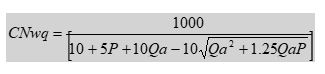
Calculating the volumetric runoff coefficient for subareas A, B and C yields: Rv (subarea A) = 0.05+0.009(80) = 0.77 Rv (subarea B) = 0.05+0.009(75) = 0.73 Rv (subarea C) = 0.05+0.009(77) = 0.74 The water quality volumes for these three areas are then calculated as: WQv (subarea A) = (1”)(Rv)(A)/12 = 0.77(7.5)/12 = 0.47 acre-feet WQv (subarea B) = 0.73(4.3)/12 = 0.26 acre-feet WQv (subarea C) = 0.74(6.0)/12 = 0.37 acre-feet
Note that this example assumed no offsite sources of discharge through the water quality BMPs. If there were significant sources of off-site runoff (sometimes called runon for upstream areas draining to the site), the designer would have the option of bypassing off-site runoff around the on-site systems, or the detention BMP should be sized to treat the on-site channel protection volume plus the water quality volume for the off-site sources.
(b) Water Quality Treatment Flow Rate (Qwq) The following procedure should be used to estimate peak discharges for flow through BMPs (adopted from Maryland, 2000). It relies on the volume of runoff computed using the Small Storm Hydrology Method (Pitt, 1994) and utilizes the NRCS, TR-55 Method. Using the WQv methodology, a corresponding Curve Number (CNwq) is computed utilizing the following equation:
where: CNwq = curve number for water quality storm event P = 1” (rainfall for water quality storm event) Qa = runoff volume, in inches = 1”×Rv = Rv (inches) Rv=volumetric runoff coefficient (see previous section)
Due to the complexity of the above equation, the water quality curve number is represented as a function of percent imperviousness in Figure 1. The water quality curve number, CNwq, is then used in conjunction with the standard calculated time-of-concentration, tc, and drainage area as the basis input for TR-55 calculations. Using the SCS Type II distribution for 1 inch of rainfall in 24-hours, the water quality treatment rate, Qwq, can then be calculated.

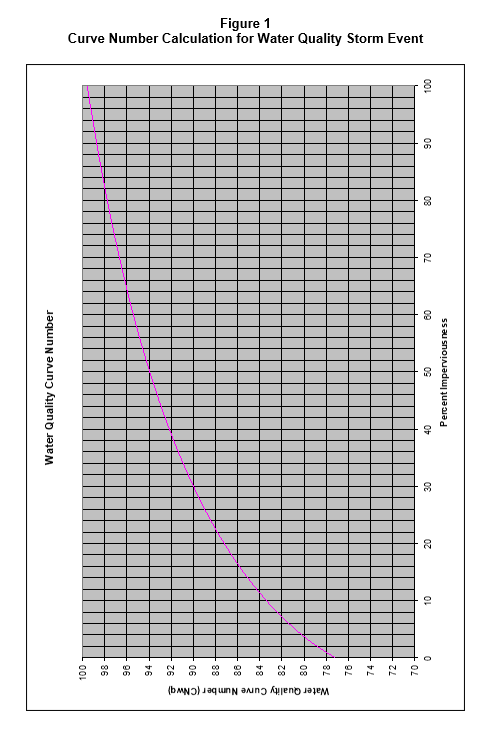
(2) All storm water runoff generated from new development shall not discharge untreated storm water directly into a jurisdictional wetland or local water body without adequate treatment. Where such discharges are proposed, the impact of the proposal on wetland functional values shall be assessed using a method acceptable to the City. In no case shall the impact on functional values be any less than allowed by the Army Corp of Engineers (ACE) or the Indiana Department of Natural Resources (IDNR). (3) All sites shall preserve buffer strips and riparian zones, create filter strips, minimize land disturbance, minimize surface imperviousness, minimize directly connected impervious areas, maximize open space, direct growth away from sensitive areas and toward areas that can support it without compromising water quality, have storage, have infiltration, in any combination, where appropriate to reduce the impact of pollutants in storm water run-off on receiving waters. (4) Infiltration practices will not be allowed in wellhead protection areas, as defined by IDEM.
(5) Discharges from areas within the City of Bluffton will not be allowed directly into sinkholes or fractured bedrock without treatment that results in the discharge meeting Indiana ground water quality standards as referenced in 327 IAC 2-11.
(6) Any stormwater practice that is a Class V injection well must ensure that the discharge from such practices meets Indiana ground water quality standards as referenced in 327 IAC 2-11.
(7) As site conditions allow, the rate at which water flows through the City of Bluffton’s conveyances shall be regulated to reduce outfall scouring and stream bank erosion. Where necessary, channel protection shall be provided to protect stream channels from degradation.
(8) As site conditions allow, a vegetated filter strip of appropriate width shall be maintained along unvegetated swales and ditches.
(9) New retail gasoline outlets, new municipal, state, federal, or institutional refueling areas, or outlets and refueling areas that replace their existing tank systems shall be required to design and install appropriate practices to reduce lead, copper, zinc, and polyaromatic hydrocarbons in storm water run-off, regardless of their size.
(10) Storm water discharges to critical areas with sensitive resources (i.e., wellhead protection areas, cold water fisheries, shellfish beds, swimming beaches, recreational waters, recharge areas, water supply reservoirs) may be subject to additional performance criteria, or may need to utilize or restrict certain stormwater management practices.
(11) Certain industrial sites are required to prepare and implement a storm water pollution prevention plan in accordance with 327 IAC 15-6 or the Industrial Storm Water General Permit, which will replace 327 IAC 15-6, and shall file a notice of intent (NOI) under the provisions of the National Pollutant Discharge Elimination System (NPDES) general permit. The storm water pollution prevention plan requirement applies to both existing and new industrial sites.
(12) Storm water management practices that are part of a pollution prevention plan shall have a landscape detail showing both the vegetation to be in the practice and how and who will manage and maintain this vegetation.
(13) For those projects involving land uses considered to be high pollutant producers or stormwater Hot Spots (see Table 2), additional water quality requirements may be imposed by the Board in addition to those included in water quality criteria in order to remove potential pollutant loadings from entering either groundwater or surface water systems. These pre-treatment options are included in Tables 2 and 3.
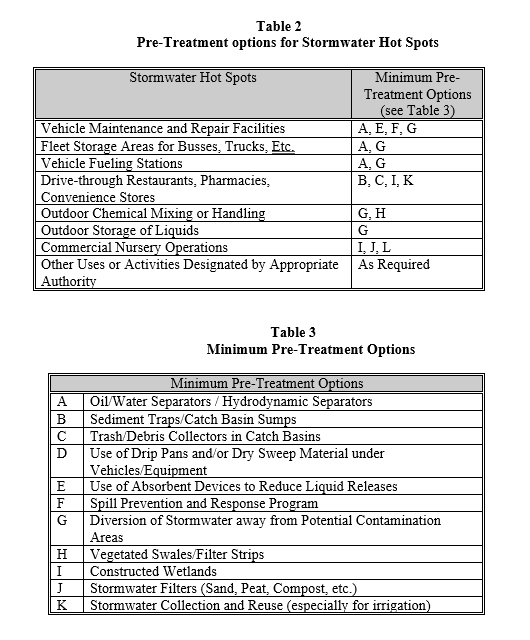
iii. Inspection and Maintenance Requirements: Subsequent to successful installation of Post-construction BMPs, they need to be inspected and maintained regularly in accordance with the Operation and Maintenance Manual required to be prepared for each BMP. An operations and maintenance (O&M) manual for all MS4-owned or private infrastructure, including but not limited to pipes, ponds, ditches, and BMPs (when required), shall be submitted for the final plan approval and permit process. The manual will become a maintenance guide for the drainage infrastructure once development is complete. The final O&M manual will be provided to the Board in both hard copy and digital formats. The O&M manual maintenance agreement along with a site map showing the BMP locations shall be recorded with the final plat. The O&M manual will include the following:
(1) Name, address, business phone number, home phone number, email address, cellular phone number, pager number of owner;
(2) Site drawings (8½” by 11” or 11” by 17”), showing both plan and cross-section views, showing the infrastructure and applicable features, including dimensions, easements, outlet works, forebays, signage, etc., as well as an overall site map of the development showing all structures;
(3) Guidance on owner-required periodic inspections;
(4) Requirement of owner to perform maintenance specified by Board inspection, if any;
(5) Guidance on routine maintenance, including mowing, litter removal, woody growth removal, signage, etc.;
(6) Guidance on remedial maintenance; such as inlet replacement, outlet works maintenance, etc.;
(7) Guidance on sediment and trash removal, both narrative and graphical, describing when sediment removal should occur in order to ensure that BMPs and other infrastructure remain effective as water quality and/or quantity control devices;
(8) A statement that the Board’s representatives have the right to enter the property to inspect the infrastructure;
(9) A tabular schedule showing inspection and maintenance requirements; and
(10) Identification of the property owner and all future owners, such as the Homeowners Association, as the party responsible for all maintenance, including cost.
(11) Identification of the planned future owners or the Homeowners Association, if applicable, for eventual transfer of BMP ownership and maintenance responsibilities. (12) Inspection checklists for various types of BMPs are provided in the appendices provided in the Indiana Office of Community and Rural Affairs (OCRA) Green Infrastructure Curriculum and Training web resources (Appendix-H-Maintenance-Inspection-Checklists.pdf). A sample of the required Stormwater Management Maintenance Agreement is provided in Appendix A. This agreement will need to be further customized, signed, notarized, and recorded so that it can be a part of the property’s deed. The maintenance agreement and the O&M Manual shall be transferred to the new owner as the ownership and BMP maintenance responsibilities change hands.
iv. Maintain natural drainage for any portion of the real estate not served by a constructed drainage system. v. Keep all natural features such as wetlands protected from stormwater runoff pollutants.
13.18.070 SENSITIVE AREAS In the event that a project site is determined to impact or discharge to a sensitive area as defined by the City’s Water Quality Characterization Report (WQCR), the Board may require more stringent stormwater quantity and quality measures.
13.18.080 COMPLIANCE AND ENFORCEMENT
A. Compliance of This Ordinance To secure compliance with the requirements of this Ordinance, violations thereof shall be subject to the enforcement provisions set forth under (B) following. Additionally, compliance with all applicable ordinances of the City of Bluffton as well as with applicable State of Indiana statutes and regulations shall also be required. Unless otherwise stated, all other specifications referred to in this Ordinance shall be the most recent edition available.
i. Definitions
(1) Violation. Any action or inaction which violates the provisions of this Ordinance, the requirements of an approved stormwater management design plan or permit, and/or the requirements of a recorded stormwater maintenance agreement are subject to the enforcement actions outlined in this Section. Any such action or inaction is deemed to be a public nuisance and may be abated by injunctive or other equitable relief, in addition to and separate from the imposition of any of the enforcement actions described below.
(2) Compliance. The act of correcting a violation or violations within the time frame specified by the Board.
(3) Offense. Both a violation and a failure of compliance on a particular project constitute an “offense.” If there are multiple violations or multiple failures of compliance on the same project, each shall be considered a separate offense as further stated in section C.iii.
ii. Warning Notice When the Board finds that any person has violated, or continues to violate, any provision of this ordinance, or any order issued hereunder, the Board may serve upon that person a written Warning Notice, specifying the particular violation believed to have occurred and requesting the discharger to immediately investigate the matter and to seek a resolution whereby any offending discharge will cease. Investigation and/or resolution of the matter in response to the Warning Notice in no way relieves the alleged violator of liability for any violations occurring before or after receipt of the Warning Notice. Nothing in this subsection shall limit the authority of the Board to take any action, including emergency action or any other enforcement action, without first issuing a Warning Notice.
B. Right to Enter Premises.
i. The City shall have the right to enter on any premises for any of the following reasons:
(1) Investigate a suspected spill or discharge into the stormwater or City’s storm drain system; (2) To carry out routine or investigative inspections; (3) To carry out routine or investigative sampling; (4) To verify compliance with any agreed order, order of the Board or order of any court of competent jurisdiction.
ii. If the Board has been refused access to any part of the premises from which stormwater is discharged and the Board is able to reasonably demonstrate to a court of competent jurisdiction within Wells County that there may be a violation of this ordinance, or that there is a need to inspect or sample as part of the Board’s inspections or sampling program, the court may grant an order allowing City access to all relevant parts of a premises.
Any written notice of violation shall be issued upon the responsible party by regular U.S. mail or delivered personally to the responsible party unless the applicable ordinance or statute requires different written notice.
C. Enforcement of This Ordinance
i. Notice of Violation/Citation If the Board determines that an applicant or other responsible person has failed to comply with the terms and conditions of a permit, an approved stormwater management design plan, a recorded stormwater management maintenance agreement, or the provisions of this ordinance, it may issue a written Notice of Violation to such applicant or other responsible person and the owner of the property. Where a person is engaged in activity covered by this ordinance without having first secured a permit therefore, the notice of violation shall be served on the owner or the responsible person in charge of the activity being conducted on the site. The notice of violation can be in the form of a citation ticket and/or a written letter that would contain detailed inspection findings, conclusions of law, disposition of warning or fines assessed, stipulated remedial actions as discussed with the responsible party representative, reasonable deadlines for those remedial actions, and the date of re-inspection. ii. Compensatory Action In lieu of enforcement proceedings, penalties, and remedies authorized by this ordinance, the Board may impose upon a violator alternative compensatory actions such as storm drain stenciling, attendance at compliance workshops, creek cleanup, public education, etc. iii. Civil Penalties for Violations Any person who commits an offense under this Ordinance commits a civil infraction subject to a fine not to exceed $2,500 for each offense, plus costs, damages, and expenses. Each day such violation occurs or continues without a compliance action that is satisfactory to the Board may be deemed a separate offense and shall make the violator liable for the imposition of a fine for each day. The rights and remedies provided for in this section are cumulative and in addition to any other remedies provided by law. An admission or determination of responsibility shall not exempt the offender from compliance with the requirements of this Ordinance. Any person who aids or abets a person in a violation of this Ordinance shall be subject to the penalties provided in this section. The Board has established an Enforcement Response Schedule as noted in the table below that standardizes the approach that the Board may, in its discretion, employ in dealing with stormwater regulations offenses subject to this Ordinance and the associated Technical Standards document. When so employed, this Schedule shall apply separately to each offense in the following manner: The first offense is the underlying violation itself, while the subsequent offenses 2 through 8 (as necessary) are failures of compliance.
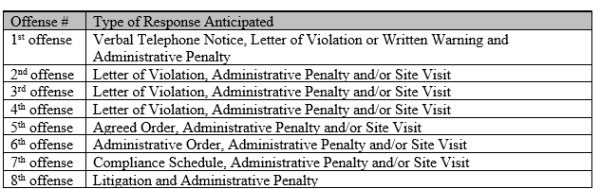
Likewise, in order to standardize the approach that the Board may, in its discretion, employ in the imposition of Administrative Penalties, the Board has established the following Schedule of Administrative Penalties. Again, the penalty for the 1st offense would apply to the violation itself, while the subsequent penalties 2 through 4 (as necessary) would apply to failures of compliance. In its discretion, the Board may impose penalties up to the amount specified in this Schedule.

iv. Stop Work Order In addition to the penalties listed above, if land disturbance activities are conducted contrary to the provisions of this Ordinance or accepted final stormwater management plans, the Board may order the work stopped by notice in writing served on any person engaged in the doing or causing of such work to be done, and any such persons shall forthwith stop such work until authorized by the Board to proceed with the work. Note that per IC 13-18-27-18, if the Board has made a conclusive favorable determination concerning a construction plan (including SWPPP) and work on the construction project has begun, the Board may not order work on the construction project to stop on the grounds that the erosion and sediment control measures included in the construction plan are not adequate unless the project site owner is notified in writing of the inadequacies that the Board perceives in the erosion and sediment control measures and the perceived inadequacies are not resolved within seventy-two (72) hours after the project site owner receives the written notice. However, this limitation does not prohibit the Board from ordering work on a construction project to stop immediately if the project site owner is creating a public health hazard or a safety hazard. A Stop Work Order will be posted on the site by the Board and it is unlawful for any person to remove the notice or continue any work on the site without permission from the Board. The Board may also undertake or cause to be undertaken, any necessary or advisable protective measures to prevent violations of this Ordinance or to avoid or reduce the effects of noncompliance herewith. The cost of any such protective measures shall be the responsibility of the owner of the property upon which the work is being done and the responsibility of any person carrying out or participating in the work. The Board may bring an action under IC 34-28-5-1 (b), to be read together with IC 34-6-2-86(1)(B) and 13-21-3-12(4), to enforce a stop work order against any person who neglects or fails to comply with a stop work order. For construction projects that are operating under a SWPPP approved by the Board, if a Stop Work Order is issued on the grounds that the erosion and sediment control measures included in the construction plan are not adequate, the project site owner shall be notified in writing of the inadequacies in the erosion and sediment control measures and the project site owner has seventy-two (72) hours after receiving written notice to resolve the identified inadequacies before the Stop Work Order can take effect. The seventy-two (72) hour period to resolve identified inadequacies on a construction project does not apply if the Stop Work Order is issued to a construction project where the project site owner is creating a public health hazard or safety hazard. v. Withhold Certificate of Occupancy The Board may refuse to issue a certificate of occupancy for the building or other improvements constructed or being constructed on the site until the applicant or other responsible person has taken the remedial measures set forth in the notice of violation or has otherwise satisfied the requirements of this ordinance as determined by the Board. vi. Suspension, Revocation, or Modification of Permits The Board may suspend, revoke, or modify any existing permit that the violator may also have been previously granted. A suspended, revoked, or modified permit may be reinstated after the applicant or other responsible person has taken the remedial measures set forth in the notice of violation or has otherwise cured the violations described therein, provided such permit may be reinstated upon such conditions as the Board may deem necessary to enable the applicant or other responsible person to take the necessary remedial measures to cure such violations.
vii. Suspension of Access to the Stormwater Drainage System
(1) Emergency Cease and Desist Orders. When the Board finds that any person has violated, or continues to violate, any provision of this ordinance, or any order issued hereunder, or that the person’s past violations are likely to recur, and that the person’s violation(s) has (have) caused or contributed to an actual or threatened discharge to the MS4 or waters of the United States which reasonably appears to present an imminent or substantial endangerment to the health or welfare of persons or to the environment, the Board may issue an order to the violator directing it immediately to cease and desist all such violations and directing the violator to immediately comply with all ordinance requirements and take such appropriate preventive action as may be needed to properly address a continuing or threatened violation, including immediately halting operations and/or terminating the discharge. Any person notified of an emergency order directed to it under this Subsection shall immediately comply and stop or eliminate its endangering discharge. In the event of a discharger’s failure to immediately comply voluntarily with the emergency order, the Board may commence court action against such person under IC 34-28-5-1 (b), to be read together with IC 34-6-2-86(1)(B) and 13-21-3-12(4), to enforce a stop work order. The Board may allow the person to recommence its discharge when it has demonstrated to the satisfaction of the Board that the period of endangerment has passed, unless further termination proceedings are initiated against the discharger under this ordinance. A person that is responsible, in whole or in part, for any discharge presenting imminent endangerment shall submit a detailed written statement, describing the causes of the harmful discharge and the measures taken to prevent any future occurrence, to the Board within 5 days of receipt of the emergency order. Issuance of an emergency cease and desist order shall not be a bar against, or a prerequisite for, taking any other action against the violator. (2) Suspension Due to Illicit Discharges in Emergency Situations. The Board may, without prior notice, suspend stormwater drainage system discharge access to a person when such suspension is necessary to stop an actual or threatened discharge which presents or may present imminent and substantial danger to the environment, or to the health or welfare of persons, or to the stormwater drainage system or waters of the state if the violator fails to comply with a suspension order issued in an emergency, the Board may take such steps as deemed necessary to prevent or minimize damage to the stormwater drainage system or waters of the state, or to minimize danger to persons. (3) Suspension Due to the Detection of Illicit Discharge. Any person discharging to the stormwater drainage system in violation of this ordinance may have their stormwater drainage system access terminated if such termination would abate or reduce an illicit discharge. The Board will notify a violator of the proposed termination of its stormwater drainage system access. The violator may petition the Board for a reconsideration and hearing. A person commits an offense if the person reinstates stormwater drainage system access to premises terminated pursuant to this Section, without the prior approval of the Board.
D. Cost of Abatement of the Violation In addition to any other remedies, should any owner fail to comply with the provisions of this ordinance, the Board may, after giving notice and opportunity for compliance, have the necessary work done, and the owner shall be required to promptly reimburse the Board for all costs of such work. Nothing herein contained shall prevent the Board from taking such other lawful action as may be necessary to prevent or remedy any violation. All costs connected therewith shall accrue to the person or persons responsible. Costs include, but are not limited to, repairs to the stormwater drainage system made necessary by the violation, as well as those penalties levied by the EPA or IDEM for violation of the City of Bluffton’s NPDES permit, administrative costs, attorney fees, court costs, and other costs and expenses associated with the enforcement of this Ordinance, including sampling and monitoring expenses. If the amount due for abatement of the violation is not paid within a timely manner as determined by the decision of the Board or by the expiration of the time in which to file an appeal, the Board may commence a court action to recover the costs assessed under IC 34-28-5-1 (b), to be read together with IC 34-6-2-86(1)(B) and 13-21-3-12(4).
E. Appeals
i. Appeal of Notice of Violation Any person to whom any provision of this Ordinance has been applied may appeal in writing, not later than 30 days after the action or decision being appealed from, to the Board of Public Works and Safety of the City of Bluffton the action or decision whereby any such provision was so applied. Such appeal shall identify the matter being appealed, and the basis for the appeal. The Board of Public Works and Safety of the City of Bluffton shall consider the appeal and make a decision whereby it affirms, rejects or modifies the action being appealed. In considering any such appeal, the Board of Public Works and Safety of the City of Bluffton may consider the recommendations of the City of Bluffton Staff and the comments of other persons having knowledge of the matter. In considering any such appeal, the Board of Public Works and Safety may grant a variance from the terms of this Ordinance to provide relief, in whole or in part, from the action being appealed, but only upon finding that the following requirements are satisfied:
(1) The application of the Ordinance provisions being appealed will present or cause practical difficulties for a development or development site; provided, however, that practical difficulties shall not include the need for the developer to incur additional reasonable expenses in order to comply with the Ordinance; and (2) The granting of the relief requested will not substantially prevent the goals and purposes of this Ordinance, nor result in less effective management of stormwater runoff. (3) Any person who has appealed a violation to the Board of Public Works and Safety may appeal an adverse decision of the Board to the Wells Circuit Court within 60 days of the Boards order, all pursuant to IC 36-1-6-9 (e) & (f).
ii. Enforcement Measures After Appeal If the violation has not been corrected pursuant to the requirements set forth in the Notice of Violation, or, in the event of an appeal, within 5 days of the decision of the Board of Public Works and Safety upholding the decision of the Board, then representatives of the Board shall enter upon the subject private property and are authorized to take any and all measures necessary to abate the violation and/or restore the property, including the commencing of a court action under IC 34-28-5-1 (b),to be read together with IC 34-6-2-86(1)(B) and 13-21-3-12(4), to enforce the order of the Board of Public Works and Safety.
CHAPTER 15.02 UNSAFE BUILDING
CHAPTER 15.03 SMOKE DETECTORS IN CERTAIN LIVING UNITS
CHAPTER 15.04 ADOPTION OF FIRE PREVENTION CODES
CHAPTER 15.05 MINIMUM STANDARDS FOR RENTAL HOUSING
CHAPTER 15.08 ADDRESSING STANDARDS FOR THE CITY OF BLUFFTON
CHAPTER 15.10 BUILDING CODE OF BLUFFTON, INDIANA
Adopted by Ordinance 1113, 7/5/2000
15.01.020 DEFINITIONS
15.01.030 UNLAWFUL PRACTICE
15.01.040 DISCRIMINATION IN THE SALE OR RENTAL OF HOUSING
15.01.050 DISCRIMINATION IN RESIDENTIAL REAL ESTATE-RELATED TRANSACTIONS
15.01.060 DISCRIMINATION IN THE PROVISION OF BROKERAGE SERVICES
15.01.070 INTERFERENCE, COERCION OR IMTIMIDATION
15.01.080 PREVENTION OF INTIMIDATION IN FAIR HOUSING CASES
15.01.090 EQUAL ACCESS TO HOUSING IN HUD PROGRAMS
15.01.100 EXEMPTIONS
15.01.110 ADMINISTRATIVE ENFORCEMENT OF ORDINANCE
It shall be the policy of the City of Bluffton to provide, within constitutional limitation, for fair housing throughout its corporate limits as provided for under the federal Civil Rights Act of 1968, as amended, the federal Housing and Community Development Act of1974, as amended, and Indiana Code 22-9.5-1 et. seq.
The definitions set forth in this Section 2 shall apply throughout this Ordinance:
Dwelling: means any building, structure, or part of a building or structure that is occupied as, or designed or intended for occupancy as, a residence by one (1) or more families; or any vacant land which is offered for sale or lease for the construction or location of a building, structure, or part of a building or structure that is occupied as, or designed or intended for occupancy as a residence by one (1) or more families (I.C. 22-9.5-2-8).
Family: includes a single individual (LC. 22-9.5-2-9), with the status of such family being further defined in subsection H of this Section 2.
Person: (I.C. 22-9.5-2-11) includes one (1) or more individuals, corporations, partnerships, associations, labor organizations, legal representatives, mutual companies, joint-stock companies, trusts, non-incorporated organizations, trustees, trustees in cases under Title 11 of the United States Code, receivers, and fiduciaries.
To Rent: (I.C. 22-9.5-2-13), includes to lease, to sublease, to let and otherwise to grant for consideration the rights to occupy the premises owned by the occupant.
Discriminatory Housing Practice: means an act that is unlawful under BCC 15.01.040, 050, 060, 070 or 080 of this Ordinance or I.C. 22-9.5-5.
Handicap: means, with respect to a person:
A. a physical or mental impairment which substantially limits one or more of such person's major life activities.
B. a record of having such an impairment, or
C. being regarded as having such an impairment,
D. an impairment described or defined pursuant to the federal Americans with Disabilities Act of 1990.
E. Any other impairment defined in 910 IAC 2-3. The term 'Handicap' shall not include current illegal use of or addictions to a controlled substance as defined in Section 802 of Title 21 of the United States Code 910 IAC 2-3-2(14); nor does the term 'Handicap' include an individual solely because that individual is a transvestite 910 IAC 2-3-2(14).
Aggrieved Person: includes any person who (I.C. 22-9.5-2-2):
A. claims to have been injured by a discriminatory housing practice; or
B. believes that such person will be injured by a discriminatory housing practice that is about to occur.
Familial Status: means one or more individuals who have not attained the age of 18 years being domiciled with a parent or another person having legal custody of such individual or the written permission of such parent or other person. The protections afforded against discrimination on the basis of familial status shall apply to any person who is pregnant or is in the process of securing legal custody of any individual who has not attained the age of18 years.
A. Commission: (I.C. 22-9.5-2-3) means the Indiana Civil Rights Commission created pursuant to LC. 22-9-1-4, et. Seq.
Subject to the provisions of subsection B of this BCC 15.01.030, 090 of this Ordinance and Title 22-9.5-3 of Indiana Code, the prohibitions against discrimination in the sale or rental of housing set forth Title 22-9.5-5-1 of Indiana Code and in BCC 15.01.040 of this Ordinance shall apply to:
A. All dwellings except as exempted by subsection B of this BCC 15.01.030 and Title 22-9.5-3 of Indiana Code.
B. Other than the provisions of subsection C of this BCC 15.01.030, nothing in BCC 15.01.040 shall apply to:
1. Any single-family house sold or rented by an owner where the private individual owner does not own more than three such single-family houses at any one time; provided that in the sale of such single family house by a private individual owner not residing in the house at the time of sale or exemption shall apply only to one such sale within any twenty-four (24) month period. The private individual owner may not own any interest in, nor have owned or reserved on his behalf, title to or any right to all or a portion of the proceeds from the sale or rental of more than three such single-family houses at any one time. The sale or rental of any such single-family house shall be exempted from application of this section only if such house is sold or rented:
a. without the use in any manner of the sales or rental facilities or services of any real estate broker, agent or salesman, or any person in the business of selling or renting dwellings, or of any employee or agent of any such broker, agent or salesman, or person and
b. without the publication, posting or mailing, after notice of advertisement or written notice in violation of BCC 15.01.040 C of this Ordinance, but noting in this provision shall prohibit the use of attorneys, escrow agents, abstracters, title companies and other such professional assistance as necessary to perfect or transfer this title, or
2. Rooms or units in dwellings containing living quarters occupied or intended to be occupied by no more than four families living independently of each other, if the owner actually maintains and occupies one of such living quarters as his residence.
C. For the purposes of subsection B, a person shall be deemed to be in the business of selling or renting dwellings if:
1. They have, within the preceding twelve (12) months, participated as principal in three or more transactions involving the sale or rental of any dwelling or any interest therein, or
2. They have, within the preceding twelve (12) months, participated as agent, other than in the sale of his own personal residence, in providing sales or rental facilities or services in two or more transactions involving the sale or rental of any dwelling or any interest therein, or
3. They are the owner of any dwelling unit designed or intended for occupancy by, or occupied by, five (5) or more families.
As made applicable by BCC 15.01.030 and except as exempted by BCC 15.01.030 Paragraph B and BCC 15.01.090, it shall be unlawful:
A. To refuse to sell or rent after the making of a bona fide offer, or to refuse to negotiate for the sale or rental of, or otherwise make unavailable or deny, a dwelling to any person because of race, color, religion, sex, handicap, familial status or national origin.
B. To discriminate against any person in the terms, conditions, or privileges of sale or rental of a dwelling or in the provision of services of facilities in connection therewith, because of race, color, religion, sex, handicap, familial status or national origin.
C. To make, print, or publish, or cause to be made, printed, or published any notice, statement, or advertisement, with respect to the sale or rental of a dwelling that indicates any preference, limitation, or discrimination based on race, color, religion, sex, handicap, familial status or national origin, or an intention to make any such preference, limitation, or discrimination.
D. To represent to any person because of race, color, religion, sex, handicap, familial status, or national origin that any dwelling is not available for inspection, sale or rental when such dwelling is in fact so available.
E. For profit, to induce or attempt to induct any person to sell or rent any dwelling by representations regarding the entry or perspective entry into the neighborhood of a person or persons of a particular race, color, religion, sex, handicap, familial status or national origin.
F. To discriminate in the sale or rental, or to otherwise make unavailable or deny, a dwelling to any buyer or renter because of a handicap of:
1. that buyer or renter;
2. a person residing in or intending to reside in that dwelling after it is so sold, rented, or made available; or
3. any person associated with that person.
G. To discriminate against any person in the terms, conditions, or privileges of sale or rental of a dwelling, or in the provision of services or facilities in connection with such dwelling, because of a handicap of:
1. that person; or
2. a person residing in or intending to reside in that dwelling after it is so sold, rented, or made available; or
3. any person associated with that person.
H. For purposes of this subsection, discrimination includes:
1. a refusal to permit, at the expense of the handicapped person, reasonable modifications of existing premises occupied or to be occupied by such person if such modifications may be necessary to afford such person full enjoyment of the premises except that, in the case of a rental, the landlord may where it is reasonable to do so condition permission for a modification on the renter agreeing to restore the interior of the premises to the condition that existed before the modifications, reasonable wear and tear excepted;
2. a refusal to make reasonable accommodations in rules, policies, practices, or services when such accommodations may be necessary to afford such person equal opportunity to use and enjoy a dwelling; or
3. in connection with the design and construction of covered multi-family dwellings for first occupancy after the date that is 30 months after September 13, 1998, a failure to design and construct those dwellings in such a manner that;
a. the public use and common use portions of such dwellings are readily accessible to and usable by handicapped persons;
b. all the doors designed to allow passage into and within all premises within such dwellings are sufficiently wide to allow passage by handicapped persons in wheelchairs; and
c. all premises within such dwellings contain the following features of adaptive design:
i. an accessible route into and through the dwelling;
ii. light, switches, electrical outlets, thermostats, and other environmental controls in accessible locations;
iii. reinforcements in bathrooms such that an individual in a wheelchair can maneuver about the space.
Compliance with the appropriate requirement Americans with Disabilities Act of 1990 and of the American National Standard for Buildings and Facilities providing accessibility and usability for physically handicapped people (commonly cited as ANSI A117.1) suffices to satisfy the requirements of BCC 15.01.040 H 3 c iii.
It shall be unlawful for any person or other entity whose business includes engaging in residential real estate-related transactions to discriminate against any person in making available such a transaction, or in the terms or conditions of such a transaction, because of race, color, religion, sex, handicap, familial status, or national origin.
As used in this section, the term residential real estate-related transaction means any of the following:
1. The making or purchasing of loans or providing other financial assistance:
a. for purchasing, constructing, improving, repairing, or maintaining a dwelling; or
b. secured by residential real estate.
2. The selling, brokering, or appraising of residential real property.
It shall be unlawful to deny any person access to or membership or participation in any multiple-listing service, real estate brokers' organization or other service, organization, or facility relating to the business of selling or renting dwellings, or to discriminate against him in the terms or conditions of such access, membership, or participation, on account of race, color, religion, sex, handicap, familial status or national origin.
It shall be unlawful to coerce, intimidate, threaten, or interfere with any person in the exercise or enjoyment of, or on account of his having exercised or enjoyed, or on account of his having aided or encouraged any other person in the exercise or enjoyment of, any right granted or protected by BCC 15.01.030; 15.01.040; 15.01.050 and 15.01.060 of this Ordinance.
Whoever, whether or not acting under code or law, by force or threat of force willful injures, intimidates or interferes with, or attempt to injure, intimidate or interfere with:
A. any person because of his race, color, religion, sex, handicap, familial status, or national origin and because he is or has been selling, purchasing, renting, financing, occupying, or contracting or negotiating for the sale, purchase, rental, financing or occupation of any dwelling, or applying for or participating in any service, organization, or facility relating to the business of selling or renting dwellings; or
B. any person because he is or has been, or in order to intimidate such person or any other person or any class of persons from:
1. participating, without discrimination on account of race, color, religion, sex, handicap, familial status, or national origin, in any of the activities, services, organizations or facilities described in above subsection A; or
2. affording another person or class of persons opportunity or protection so to participate; or
Pursuant to 24 CFR Part 5.403 and 24 CFR Part 574.3 the definition of "family" is revised to include families regardless of the actual or perceived sexual orientation, gender identity, or marital status of its members.
A. Exemptions defined or set forth under Title 22-9.5-3 et. seq. of Indiana Code shall be exempt from the provisions of this Ordinance to include those activities or organizations set forth under the following subsections B and C.
B. Nothing in this Ordinance shall prohibit a religious organization, association, or society, or any nonprofit institution or organization operated, supervised or controlled by or in conjunction with a religious organization, association, or society, from limiting the sale, rental or occupancy of dwellings which it owns or operates for other than a commercial purpose to persons of the same religion, or from giving preference to such persons, unless membership in such religion is restricted on account of race, color or national origin. Nor shall anything in this Ordinance prohibit a private club not in fact open to the public, which as an incident to its primary purpose or purposes provides lodgings which it owns or operates for other than a commercial purpose, from limiting the rental or occupancy of such lodging to its members or from giving preference to its members.
C. Nothing in this Ordinance regarding familial status shall apply with respect to housing for older persons. As used in this Section, 'housing for older persons' means housing:
1. provided under any state or federal program that the Secretary of the Federal Department of Housing and Urban Development or the state civil rights commission determines is specifically designed and operated to assist elderly person (as defined in the state or federal program) or;
2. intended for, and solely occupied by, person 62 years of age or older; or
A. The authority and responsibility for properly administering this Ordinance and referral of complaints hereunder to the Commissioner as set forth in the following subsection B shall be vested in the Chief Elected Official of the City of Bluffton, Indiana.
B. Notwithstanding the provisions of I.C. 22-9.5-4-8, Bluffton, Indiana, because of lack of financial and other resources necessary to fully administer enforcement proceedings and possible civil actions under the Ordinance, herein elects to refer all formal complaints of violation of the articles of this Ordinance by complainants to the Indiana Civil Rights Commission for administrative enforcement actions pursuant to Title 22-9.5-6 of Indiana Code and the Chief Elected Official of the City of Bluffton, Indiana, shall refer all said complaints to the Commission as provided for under above subsection A to said Commission for purposes of investigation, resolution and appropriate relief as provided for under Title 22-9.5-6 of Indiana Code.
C. All executive departments and agencies of the city of Bluffton, Indiana shall administer their departments, programs and activities relating to housing and urban development in a manner affirmatively to further the purposes of this Ordinance and shall cooperate with the Chief Elected Official and the Commission to further such purposes.
D. The Chief Elected Official of the City of Bluffton, Indiana, or the Chief Elected Official's designee, shall provide information on remedies available to any aggrieved person or complainant requesting such information.
15.02.020
15.02.030
15.02.040
15.02.050 DEFINITIONS - UNSAFE BUILDING
15.02.060
15.02.070 PENALTY
Indiana Code Statute Unsafe Building Law is hereby incorporated by reference into the City of Bluffton Unsafe Building Law. All proceedings within the City of Bluffton for the inspection, repair and removal of unsafe building shall be governed by said law and the provisions of this ordinance. In the event the provisions of this ordinance conflict with the provisions of I.C. §§ 36-7-9-1 through 36-7-9-28, then the provisions of the state stature shall control.
All buildings or portions thereof within the City of Bluffton which are determined after inspection by the Building Inspector to be unsafe as defined in this ordinance are hereby declared to be public nuisances and shall be abated by repair, rehabilitation, demolition, or removal.
The City Building Inspector shall be authorized to administer and to proceed under provisions of said law in ordering the repair or removal of any buildings found to be unsafe as specified therein or as specified hereafter.
Wherever in the building regulations of the County of Wells or the City of Bluffton Unsafe Building Law, it is provided that anything must be done to the approval of or subject to the direction of the Building Inspector, or any other officer of the City, this shall be construed to give such officer only the discretion of determining whether the rules and standards established by ordinance have been complied with and no such provisions shall be construed as giving any officer discretionary powers as to what such regulations or standards shall be, power to require conditions not prescribed by ordinance, or to enforce ordinance provisions in an arbitrary or capricious manner.
The description of an unsafe building contained in I.C. § 36-7-9-4 is hereby supplemented to provide minimum standards for building condition or maintenance in the City of Bluffton, Indiana, by adding the following definition:
"Unsafe Building" means any building or structure which has any or all of the conditions or defects hereinafter described, provided that such conditions or defects exist to the extent that life, health, property or safety of the public or its occupants are endangered:
- Whenever any door, aisle, passageway, or other means of exit is not of sufficient width or size or is not so arranged as to provide safe and adequate means of exit in case of fire or panic.
- Whenever the walking surface of any aisle, passageway, stairway or other means of exit is so warped, worn, loose, torn or otherwise unsafe as to not provide safe and adequate means of exit in case of fire or panic.
- Whenever the stress in any materials, member or portion thereof, due to all dead and live loads, is more than one and one-half times the working stress or stresses allowed for new buildings of similar structure, purpose or location.
- Whenever any portion thereof has been damaged by fire, earthquake, wind, flood or by any other cause, to such an extent that the structural strength or stability thereof is materially less it was before such catastrophe is and is less than the minimum requirements for new buildings of similar structure, purpose or location.
- Whenever any portion, member or appurtenance thereof is likely to fail, to become detached or dislodged, or to collapse and thereby injure persons or damage property.
- Whenever any portion of a building, or any member appurtenance or ornamentation on the exterior thereof is not of sufficient strength or stability or is not so anchored, attached or fastened in place so as to be capable of resisting a wind pressure of one-half of that specified for new buildings of similar structure, purpose or location without exceeding the working stresses permitted for such buildings.
- Whenever any portion thereof has cracked, warped, buckled or settled to such an extent that walls or other structural portions have materially less resistance to winds or earthquakes than is required in case of similar new construction.
- Whenever the building or structure, or any portion thereof, because of:
- dilapidation, deterioration or decay;
- faulty construction;
- the removal, movement or instability of any portion of the ground necessary for the purpose of supporting such building;
- the deterioration, decay or inadequacy of its foundation; or
- any other cause, is likely to partially or completely collapse.
- Whenever, for any reason, the building or structure, or any portion thereof, is manifestly unsafe for the purpose for which it is being used.
- Whenever the exterior walls or other vertical structural members list, lean or buckle to such an extent that a plumb line passing through the center of gravity does not fall inside the middle one-third of the base.
- Whenever the building or structure, exclusive of the foundation, shows thirty three percent or more damage or deterioration of its supporting member of members, or fifty percent damage or deterioration of its non-supporting members, enclosing outside walls.
- Whenever the building or structure has been so damaged by fire, wind, earthquake or flood or has become so dilapidated or deteriorated so as to become:
- an attractive nuisance to children, or
- freely accessible to persons for the purpose of committing unlawful acts.
- Whenever any building or structure has been constructed, exists or is maintained in violation of any specific requirement or prohibition applicable to such building or structure provided by the building regulations of this City, or of any law or ordinance of this state or City relation to the condition, location or structure of buildings.
- Whenever any building or structure which, whether or not erected in accordance with all applicable laws and ordinances has in any non-supporting part, member or portion less than fifty percent or in any supporting part, member or portion less than sixty-six percent of the:
- strength,
- fire-resisting qualities or characteristics, or
- weather-resisting qualities or characteristics required by law in the case of a newly constructed building of like area, height and occupancy in the same location.
- Whenever a building or structure, used or intended to be used for dwelling purposes, because of inadequate maintenance, dilapidation, decay, damage, faulty construction or arrangement, inadequate light, air or sanitation facilities, or otherwise, is determined by the Wells County Sanitarian to be unsanitary, unfit for human habitation, or in such a condition that is likely to cause sickness or disease.
- Whenever any building or structure, because of obsolescence, dilapidated condition, deterioration, damage, inadequate exits, lack of sufficient fire-resistive construction is determined by the Fire Chief of the City of Bluffton to be a fire hazard.
- Whenever any portion of a building or structure remains on a site after the demolition or destruction of the building or structure or whenever any building or structure is abandoned for a period in excess of six months so as to constitute such building or portion thereof an attractive nuisance or hazard to the public.
"Substantial Property Interest" set forth in I.C. § 36-7-9-2 is hereby incorporated by reference herein.
All work for the reconstruction, repair or demolition of building and other structures shall be performed in a good workmanlike manner according to the accepted standards and practices in the trade. The provisions of the building laws, as defined in I.C. § 22-12-1-3, adopted as rules of the Fire Prevention and Building Safety Commission, shall be considered standard and acceptable practice for all matters covered by this ordinance or orders issued pursuant to this ordinance by the Building Inspector of the City of Bluffton, Indiana.
No person, firm or corporation, whether as owner, lessee sublessee or occupant, shall erect, construct, enlarge, alter, repair, move, improve, remove, demolish, equip, use, occupy or maintain any building or premises, or cause or permit the same to be done, contrary to or in violation of any of the provisions of this ordinance or any order issued by the Building Inspector. Any person violating the provisions of this ordinance or I.C. § 36-7-9-25, commits a Class C infraction for each day such violation continues after being notified and ordered to take corrective action.
BCC 15.03.020 Repealed, by Ordinance 1144, 4/30/2002
The provisions of I.C. §§ 22-11-18-1 through 22-11-18-6 are hereby adopted and incorporated herein by reference as if fully set forth at this Section, and shall include later amendments to that Chapter of the Indiana Code as the same are published in the Indiana Code with effective dates as fixed therein.
BCC 15.04.020 Repealed, by Ordinance 1144, 4/30/2002
The fire safety rules of the Indiana Fire Prevention and Building Safety Commission as set out in Article 22 of Title 675 of the Indiana Administrative Code are hereby adopted and incorporated herein by reference as if fully set forth at this Section, and shall include later amendments to that Article as the same are published in the Indiana Register or the Indiana Administrative Code with effective dates as fixed herein.
15.05.010 DEFINITIONS - MINIMUM STANDARDS FOR RENTAL HOUSING
15.05.020 INSPECTION
15.05.030 ENFORCEMENT
15.05.040 MINIMUM STANDARDS FOR BASIC EQUIPMENT AND FACILITIES
15.05.050 LIGHT, VENTILATION AND HEATING
15.05.060 MAINTENANCE
15.05.070 MINIMUM SPACE, USE AND LOCATION
15.05.080 RESPONSIBILITIES OF OCCUPANTS AND OWNERS
15.05.090 HOTELS AND ROOMING HOUSES
15.05.100 PENALTIES
15.05.110 OTHER PROVISIONS
Repealed and Replaced by Ordinance 1339, 2/24/2012
This chapter articulates the commitment of the city to protect, preserve and promote the physical and mental health and social well-being of the people, to prevent and control in the incidence of communicable diseases, to reduce environmental hazards to health and safety and to regulate privately and publicly owned dwellings for the purpose of maintaining adequate sanitation and public health by establishing legislation which provides for the administration and enforcement of, and cites minimum standards for the following:
- Basic equipment and facilities with respect to light, ventilation and thermal conditions;
- Safety from fire and accidents;
- The use, location and amount of space for human occupancy; and
- The determination of the responsibilities of owners, operators and occupants of dwellings.
The following definitions shall apply in the interpretation and enforcement of this ordinance:
"Apartment" shall mean a room or group of rooms in an apartment house designed for and occupied exclusively as a residence for only one family.
"Apartment House" shall mean a building designed for and occupied exclusively by two or more families living independently of one another.
"Approved" shall mean approved by the enforcement authority under the provisions of this chapter, or approved by other appropriate authority designated by law to give approval in the matter in question.
"Basement" shall mean a portion of a building located partly underground, and having half or more than half of its clear floor-to-ceiling height, below the average grade of the adjoining ground.
"Cooking" shall mean the preparation of food using an open flame or electrical device which is designed to heat food. Preparation of food using microwaves or hot beverage makers are excluded from this definition.
"Dwelling" shall mean any building which is wholly or partly used or intended to be used for living or sleeping by human occupants; provided that temporary housing as hereinafter defined shall not be regarded as a dwelling.
- "Single-Family Dwelling” shall mean a building containing one dwelling unit.
- "Multi-Family Dwelling" shall mean a building or portion thereof containing two or more dwelling units.
"Dwelling Unit" shall mean any room or group of rooms located within a dwelling and forming a single habitable unit with facilities which are used or intended to be used for living, sleeping, cooking and eating.
"Egress" shall mean an arrangement of exit facilities to assure a safe means of exit from a building to ground level.
"Enforcement Authority” shall be the Board of Public Works and Safety of the City.
"Enforcement Officer” shall mean the official designated herein or otherwise charged with the responsibilities of administering this chapter.
"Extermination" shall mean the control and elimination of insects, rodents, or other pests by eliminating their harborage places; by removing or making inaccessible materials that may serve as their food; by poisoning, spraying, fumigating, trapping; or by any other recognized and legal pest elimination methods approved by the Wells County Board of Health.
"Family” shall mean one individual living alone or two or more individuals living together, whether related by birth or not, and having common housekeeping facilities.
"Floor Area" shall mean the area included within the surrounding wall of a structure exclusive of vents, shafts and courts.
"Garbage" shall mean the animal and vegetable waste resulting from the handling, preparation, cooking and consumption of food.
"Habitable Room" shall mean a room or enclosed floor space used or intended to be used for living, sleeping, cooking or eating purposes, excluding bathrooms, water closets, toilet compartments, laundries, pantries, foyers or hallways, closets and storage spaces.
"Habitable Space” shall mean the space in structure for living, sleeping, eating or cooking. Bathrooms, toilet compartments, closets, halls, storage or utility space and similar areas not considered habitable space.
"Hot Water” shall mean water drawn at every required bathtub or shower, sink and lavatory basin at a temperature of not less than 120 degrees F.
"Infestation" shall mean the presence, within or around a dwelling, of any insects, rodents or other pests.
"Inspection Officer" or "Inspection Officers" shall mean any persons, designated by the mayor of the City of Bluffton, working separately or together, who shall enforce the provisions of this chapter.
"Let” shall mean to permit possession or occupancy of a dwelling or dwelling unit by a person who shall be the legal owner of record or not be the legal owner of record thereof, pursuant to a written or unwritten lease, agreement or licensee, or pursuant to a recorded or unrecorded agreement of contract for the sale of land.
"Multiple Dwelling" shall mean any dwelling containing more than two dwelling units.
"Occupant" shall mean any person, over one (1) year of age, living, sleeping, cooking or eating in, or having actual possession of a dwelling unit or rooming unit.
“Operator” shall mean any person who has charge, care or control of a building, or part thereof, in which dwelling units or rooming units are let.
"Owner" shall mean one or more persons, jointly or severally, in whom is vested all or part of the legal title to property, or all or part of the beneficial ownership and a right to use and enjoyment of the premises and includes the person or persons who were owners of the property prior to any property going through the tax reversion process or being quit-claimed to a person or entity without the knowledge of that person or entity.
- "Owner" shall also include the person or persons who have charge, care or control of any dwelling or dwelling unit, as owner or agent of the owner, or as personal representative, trustee or guardian of the estate of the owner.
- "Owner" shall also include the purchaser under a land contract of any dwelling or dwelling unit whether or not they occupy the same.
- Any such person thus representing the actual owner shall be bound to comply with the provisions of this chapter, and of the rules and regulations adopted pursuant thereto, to the same extent as if he were the owner.
"Person" shall mean and include any individual, firm, corporation, association, partnership or other legal entity.
"Plumbing" shall mean and include all of the following supplied facilities and equipment: gas pipes, gas burning equipment, water pipes, garbage disposal units, waste pipes, water closets, sinks, installed dishwashers, lavatories, bathtubs, shower baths, installed clothes-washing machines, catch basins, building drains, sewer drains, vents and any other similar supplied fixtures, together with all connections to water, sewer or gas lines.
"Plumbing Fixture” shall mean a receptacle or device which is either permanently or temporarily connected to the water distribution system of the premises and demands a supply of water there; or discharges used water, liquid-borne waste materials, or sewage either directly or indirectly to the drainage system of the premises; or which requires both a water supply connection and a discharge to the drainage system of the premises.
"Premises" shall mean a lot, plot or parcel of land including the building or structures thereon.
"Rodentproofing" shall mean a form of construction which will prevent the ingress or egress of rodents to or from a given space or building, or from gaining access to food, water or harborage. It consists of the closing and keeping closed every opening in foundations, basements, cellars, exterior and interior walls, ground or first floors, roofs, sidewalk gratings, sidewalk openings and other places that may be reached and entered by rodents, by the use of materials impervious to rodents and other methods approved by the Board of Health.
"Refuse" shall mean all putrescible and nonputrescible solids (except body wastes) including garbage, rubbish, ashes and dead animals.
"Rental Building" shall mean a building containing one or more rental units.
"Rental Dwelling Unit" shall mean a rented single dwelling unit in residential premises.
"Rental Unit" shall mean a unit of a hotel, motel, rooming house or apartment house, a rental dwelling unit, a dwelling unit, an apartment or other similar designation which is held for lease or rent.
"Rooming House" shall mean any dwelling, or that part of any dwelling containing one or more rooming units.
"Rooming Unit" shall mean any room or group of rooms forming a single habitable unit used or intended to be used for living and sleeping, but not for cooking or eating purposes.
"Rubbish" shall include materials other than garbage resulting from household operation including, but not limited to such items as cans, glass bottles, ashes, papers, magazines, newsprint, boxes, china, crockery and tree trimmings.
"Safe" and "Safety" shall mean the condition of being reasonably free from danger and hazards which may cause accidents or disease.
“Space Heater" shall mean a self-contained heating appliance of either the conventional type or the radiant type and intended primarily to heat only a limited space or area such as one room or two adjoining rooms.
"Stairway" shall mean one or more flights of stairs and the necessary landings and plat forms connecting them to form a continuous and uninterrupted passage from one floor or level to another in a building or structure.
"Substantial Property Interest" shall mean any right in real estate susceptible of being affected in a substantial way by actions authorized by this chapter, including a fee or future interest, life estate interest, present possessory interest or equitable interest of a contract purchaser.
"Supplied" shall mean paid for, furnished or provided by or under the control of the owner or operator.
"Temporary Housing" shall mean any tent, trailer or other structure used for human shelter which is designed to be transportable and which is not attached to the ground, to another structure, or to any utility system on the same premises for more than thirty (30) days.
"Unacceptable" shall mean any violation of this chapter or an applicable state code or statute which violation does not render the building or any portion of the building unsafe.
"Unsafe Building" shall mean a building or structure or any part of a building or structure that is unsafe as defined in BCC 15.02.
"Unsafe Premises" shall mean the tract of real estate on which an unsafe building is located and may include the building(s) located thereon.
"Ventilation" shall mean the proceeds of supplying and removing air by natural or mechanical means to or from any space.
"Water Closet" shall mean a toilet bowl which is flushed with water which has been supplied under pressure and equipped with a water-sealed trap.
Whenever the terms "Dwelling," "Dwelling Unit," "Rooming Unit," "Premises," or "Structures" are used in this chapter they shall be construed as though they were followed by the words or any part thereof: Words used in the singular include the plural, and the plural, singular.
Words not specifically defined in this chapter shall have the common definition set forth in a standard dictionary.
- Inspection Officers shall be appointed by the Mayor and are authorized and directed to make inspections to determine the condition of dwellings, dwelling units, rooming units and premises located within the City of Bluffton in order that they may perform their duties of safeguarding the health and safety of the occupants of the dwelling and the general public. An inspection of a Rental Building or Rental Unit may occur only when an Inspection Officer has a reasonable suspicion that a violation of this chapter is occurring at such Rental Building or Rental Unit.
- Whenever in this chapter it is provided that anything must be done to the approval of or subject to the direction of an Inspection Officer, or any other officer of the City of Bluffton, such authority shall be construed to give such officer only the discretion of determining whether the regulations and standards of this chapter have been complied with, and no provision shall be construed as giving any officer discretionary powers as to what such regulations or standards shall be, power to require conditions not prescribed by this chapter, or power to enforce the provisions of this chapter in an arbitrary or capricious manner.
- If an Inspection Officer has reasonable suspicion that a rental unit or Rental Building is in violation of this Ordinance, the Inspection Officer shall notify the owner and those in possession of the Rental Building or Rental Unit of its intention to inspect the premises and shall make arrangements for entry and said inspection.
- In the event the owners or those in possession of the Rental Building or Rental Unit refuse an inspection, the Inspection Officer may obtain an inspection warrant from any court of record in Wells County, Indiana in order to determine whether a violation of this ordinance is occurring.
- The Court shall issue an inspection warrant subject to the following conditions:
- The Inspection Officer must establish that there is probable cause for believing that a violation of this Ordinance is occurring that legally justifies the inspection;
- An affidavit establishing that one of the conditions set forth in the preceding paragraph must be signed under oath or affirmation by the Inspection Officer;
- The Court must examine the Inspection Officer under oath or affirmation to verify the accuracy of the affidavit.
- An inspection warrant is valid only if it:
- Is signed by the judge of the court and bears the date and hour of its issuance above that signature, with notation that the warrant is valid for only forty-eight (48) hours after its issuance;
- Describes (either directly or by reference to the affidavit), the Rental Building or Rental Unit where the inspection is to occur so that the executor of the warrant and owner or the possessor of the Rental Building or Rental Unit can reasonably determine what property the warrant authorizes an inspection of;
- Indicates the conditions, objects, activities, or circumstances that the inspection is intended to check or reveal; and
- Is attached to the affidavit required to be made in order to obtain the warrant.
- An inspection warrant issued under this section is valid for only forty-eight (48) hours after its issuance, must be personally served upon the owner or possessor of the Rental Building or Rental Unit and must be returned within seventy-two (72) hours.
- An Inspection Officer shall, prior to entry, positively identify himself or herself as a person authorized pursuant to this chapter to enter upon said premises.
- At the time of each inspection, all pets must be controlled so that the Inspection Officer can move about the dwellings and surrounding property without interruption.
- The owner or the person assigned to manage the rental unit shall be entitled to seventy-two (72) hours written notice from the Inspection Officer prior to conducting the inspection as set forth in the preceding section of this chapter. The landlord shall be responsible for notifying the occupant of the rental unit of the inspection when he or she receives notice of the intent to inspect from the Inspection Officer.
- This provision shall not be construed to limit or restrain the right of the Inspection Officer to make an inspection pursuant to any of the provisions of I.C. § 36-7-9-1 et seq.
- Every rental unit operated and maintained in the City shall be subject to inspection under provisions of this chapter. The inspection shall be made to ascertain that the facility conforms to all requirements of this chapter.
- Every occupant of the rental unit shall give the owner thereof or his/her agent or employee access to any part of such dwelling or rental unit or its premises at all reasonable times for the purpose of making such repairs or alterations as are necessary to effect compliance with the provisions of this chapter.
- The Inspection Officer shall issue to the owner of every inspected rental dwelling unit an inspection certificate as proof that the unit is in compliance with this chapter.
- If an Inspection Officer finds that a rental unit fails to comply with any standard set forth in this chapter the Inspection Officer shall give notice of the violation to the owner and Occupant of the rental unit. The notice shall be in writing and shall describe the violation found. The notice shall be provided pursuant to the provisions of this chapter to:
- The owner at the address as contained in the records of the Treasurer of Wells County, Indiana, and
- The occupant of the rental unit at the address of the unit.
- The person or persons responsible for correcting violations under this chapter shall correct such violations within thirty (30) days of:
- Receipt of the notice described herein; or
- The date the notice is returned to the Inspection Officer as undeliverable.
- If an owner has fewer than ten Rental Buildings, not more than one can be required to be brought into compliance with standards as set forth in the chapter within any thirty (30) day period. If an owner has more than ten Rental Buildings, no more than two or ten percent of the Rental Buildings, whichever is greater, shall be required to be brought into compliance with standards set forth in this code within any thirty (30) day period. A Rental Building shall not be counted in the above limits after thirty (30) days from its first inspection.
- If a cited violation is not corrected within the designated time and the Inspection Officer finds that the Rental Building or Rental Unit is not in compliance with this chapter, the Inspection Officer may issue an order requiring any of the following:
- Vacating of the Rental Building or Rental Unit;
- Sealing of the Rental Building or Rental Unit against intrusion by unauthorized persons;
- Extermination of vermin in and about the premises;
- Removal of trash, debris or hazardous material in or about the unsafe premises;
- Repair of an unsafe condition to bring the Rental Building or Rental Unit into compliance with standards for building condition or maintenance prescribed by this chapter;
- Sealing against the effects of weather;
- An order issued pursuant to this section shall contain the following:
- The name of the person to whom the order is issued;
- The description or address of the premises that is the subject of the order;
- The action required by the order;
- The deadline for completion of the remedial action;
- A statement briefly indicating what action may result if the order is not obeyed;
- A statement that hearing may be requested by any person affected by the Notice and that such request must be made in writing to the Hearing Authority within ten (10) days after the order is received
- A statement that if a hearing is requested, any person with a substantial property interest may appear with or without legal counsel, present evidence or witnesses, cross-examine opposing witnesses, and present argument.
- The address to which the request for hearing must be made.
- An order issued under provisions of this section supersedes any permit relating to the building or land use, whether that permit is obtained before or after the order is issued.
- Notice of the order shall be given to the violator and other known holders of a substantial property interest and shall be deemed sufficient if the notice is given pursuant to the provisions of I.C. § 36-7-9-25.
- The order must allow a sufficient time of at least thirty (30) days from the time when the notice of order is given pursuant to I.C. § 36-7-9-25 to accomplish the required action.
- If the Inspection Officer finds it necessary to take emergency action concerning unsafe premises in order to protect life, public safety or property, he may take the action without issuing an order or giving notice to any person having substantial property interest. However, this emergency action must be limited to removing any immediate danger. Such action shall be taken only when it is not feasible to give notice and hold hearings as provided by this section.
- Any person affected by any notice or order issued under any provision of this chapter may request and shall be granted a hearing on the matter before the hearing authority, provided that such person shall file in the office of the hearing authority a written petition requesting such hearing and setting forth a brief statement of the grounds therefore within ten (10) days after the day the notice or order was served.
- The hearing shall be commenced not earlier than ten (10) days and not later than twenty (20) days after the day on which the petition was filed, provided, that upon application of the petitioner, the Hearing Authority may postpone the date of the hearing for a reasonable time beyond such period and accordingly, extend the time period for compliance with any order of the Inspection Officer, if, in its discretion, the petitioner has submitted a good and sufficient reason for such postponement.
- Upon receipt of such petition the hearing authority shall set a time and place for such hearing and shall give the petitioner written notice thereof. At such hearing the petitioner shall be given an opportunity to be heard and to show why such notice should be modified or withdrawn.
- At the conclusion of any hearing at which a continuance is not granted, the hearing authority may make findings and take action to:
- Affirm the order;
- Rescind the order; or
- Modify the order.
- The City of Bluffton may recover the costs incurred as the result of taking emergency action, by filing a civil action in the Circuit or Superior Court of Wells County, Indiana against persons who held a fee interest, life estate interest, or equitable interest of a contract purchaser in the unsafe premises at the time the Inspection Officer found it necessary to take the emergency action.
- No person shall let to another for occupancy any dwelling or dwelling unit, for the purpose of living, sleeping, cooking or eating therein, which does not comply with the following requirements:
- Every dwelling unit shall contain a kitchen sink in good working condition which is properly connected to a water system and sewer system.
- Every dwelling unit shall contain a room or space for the preparation and cooking of food which shall include space and connections for stoves or other cooking facilities and a space for refrigerated food storage.
- The use of gasoline stoves or other similar fuel burning appliances using highly flammable liquids and the use of portable kerosene stoves or other similar fuel burning portable appliances for cooking is prohibited inside any dwelling or on any balcony.
- Hoods and ducts over kitchen ranges shall be reasonably free of grease or other flammable residues that collect therein.
- Every dwelling unit shall contain a room which affords privacy to a person within said room and which is equipped with a flush toilet, a lavatory basin, and a bathtub (or shower) in good working condition, all of which shall be properly connected to a water and sewer system.
- The occupants of not more than two (2) dwelling units may share a single flush toilet, a single lavatory basin, and a single bathtub or shower if:
- Neither of the two (2) dwelling units contains more than two (2) rooms. For the purposes of this paragraph B,1, a kitchenette or an efficiency kitchen with less than 60 square feet floor area shall not be counted as a room; and
- The habitable area of each of such dwelling units equal not more than 250 square feet of floor area; and
- Such toilet, lavatory basin and bathtub or shower shall be in good working condition and properly connected to water and sewer systems.
- Every kitchen sink, lavatory basin and bathtub or shower required by this chapter shall be properly connected with both hot and cold water lines when used for rental or lease occupancy.
- Every dwelling unit shall contain water heating facilities which are properly installed, operated and maintained in safe and good working condition and are properly connected to the bathtub or shower, sink and lavatory basin. Such water heating facilities shall be capable of automatically heating water to such a temperature as to permit water to be drawn at every required bathtub or shower, sink and lavatory basin at a temperature of not less than 1200 degrees F. All gas-fired water heaters shall be vented to the outside.
- Every dwelling unit shall have at least one safe, unobstructed means of egress leading to a public way.
- Every door available as an exit from an occupied dwelling shall be capable of being opened from the inside and without the use of a key, unless there is an alternate means of egress leading to a safe and open space at ground level in case of fire.
- Every dwelling unit shall have the correct house or apartment number(s) displayed in numerals that are at least two and one-half inches high and placed in such a manner that they are reasonably visible at the ground-level entrance to the dwelling unit. The entrance to each dwelling unit shall also bear similar identification.
- No person shall let to another for occupancy any dwelling or dwelling unit, for the purpose of living therein, which does not comply with the following requirements:
- Every habitable room, except the bathroom, shall have at least one (1) window or skylight facing outside.
- The Inspection Officer shall approve such other devices or arrangements as will adequately light a habitable room where provision for a window or windows is not reasonably possible.
- Every habitable room, except the bathroom, shall have at least one window or skylight which can be opened without the use of undue force to at least 45% of the window area size, except where there is supplied some other device affording ventilation and approved by the enforcement authority.
- Locking window hardware. Every window accessible within 12 feet of the adjacent ground shall be supplied with an adequate locking device except for windows that open with a cranking device.
- Every habitable room, except the bathroom, shall have at least one (1) window or skylight facing outside.
- Every dwelling shall have heating facilities which are properly installed, maintained, and are capable of safely and adequately heating all habitable rooms, bathrooms, and toilet compartments in every dwelling unit located therein to a temperature of at least sixty-five (65) degrees Fahrenheit under ordinary minimum winter conditions.
- No habitable room, dwelling or dwelling unit shall contain any flame producing device or appliance for the purpose of providing the required heat in such space or spaces unless such device or appliance shall be provided with a permanent, proper and safe means for the supplying of combustion air and for the venting to the outdoors of all products of combustion.
- The enforcement authority shall approve the use of unvented space heaters operated and maintained according to Underwriters' Laboratory Standards or other approved standards of operation specified for such units.
- No portable space heater unit shall be used as the primary source for the required heat to a habitable room.
- If the heat in each dwelling unit cannot be controlled by the tenant, the temperature of every occupied dwelling unit shall be maintained to a temperature of at least sixty-five (65) degrees Fahrenheit.
- Where the heating facilities of any dwelling are under the control of the occupant thereof, it shall be the responsibility of the occupant to operate the heating facilities in order to maintain above-freezing temperature at all times in all portions of the dwelling and the premises he occupies and controls so as to prevent damage to water pipes and plumbing.
- Every common hall and stairway in every multiple dwelling containing three or more dwelling units shall be adequately lighted at all times. Every public hall and stairway in structures devoted solely to dwelling occupancy and containing less than three (3) dwelling units shall be supplied with conveniently located light switches controlling and adequate lighting system which may be turned on as needed.
- Between May 1 and October 31 each year, every window or other device with opening to outdoor space, used or intended to be used for ventilation, shall have screens, provided by either or owner or occupant as set out in lease. If the entire apartment is adequately air conditioned, this requirement does not apply.
- No person shall let to another for occupancy any dwelling or dwelling unit, for the purpose of living therein, which does not comply with the following requirements.
- Ceilings, windows, floors, floor coverings and other walking surfaces shall be free of filth, garbage, human and animal wastes, litter, refuse and any other unsanitary matter.
- Walls, ceilings, windows and doorways shall be free of dirt, greasy film, soot and any other unsanitary matter;
- Every foundation, floor, wall, ceiling and roof shall be reasonably weathertight and rodentproof and shall be kept in good repair.
- Every window, exterior door and basement hatchway shall be reasonably weathertight and rodentproof and shall be kept in sound working condition and good repair.
- Windows shall have panes without major cracks or holes.
- Every inside and outside stair, every porch, and every appurtenance thereto shall be so constructed as to be safe to use and capable of supporting the load that normal use may cause to be placed thereon; and shall be kept in sound condition and good repair. Metal fire escapes shall be maintained in a working condition.
- Roofing shall be provided and maintained to prevent the entrance of moisture. All roofing, sheathing and structural components shall be maintained to render each structurally sound.
- Existing gutters, leaders and downspouts shall be maintained in operable condition on all dwellings.
- Every plumbing fixture and water and waste pipe shall be properly installed and maintained in good sanitary working condition, free from defects, leaks and obstruction.
- Every toilet compartment floor and bathroom floor surface shall be constructed and maintained so as to be reasonably impervious to water and so as to permit such floor to be easily kept in a sanitary condition.
- Ceilings, walls and floors shall be maintained free of holes, large cracks or loose and deteriorated materials so that parts which become defective do not constitute a hazard to the occupants nor a harborage for insects or vermin. Split, splintered or badly worn floor boards shall be replaced.
- Doors to habitable rooms, bathrooms and water closet compartments must fit the opening in which they are hung and be properly equipped with hardware.
- All equipment which is required under this chapter shall be so constructed or installed that it will function safely and effectively and shall be maintained in working condition.
- Except as authorized by judicial order, no owner or operator shall interrupt, reduce, shut off, or cause termination of electricity, gas, water, or other essential services to an occupied dwelling or dwelling unit unless the interruption, shutting off, or termination results from an emergency, good faith repairs, or necessary construction; provided however, nothing in this section requires an owner or operator to pay for the services described in this section if the owner or operator has not agreed by a written rental agreement to do so.
- No occupant may interrupt, reduce, shut off, or cause termination of electricity, gas, water or other essential services to the dwelling or dwelling unit if the interruption, reduction, shutting off, or termination of the service will result in serious damage to the dwelling or dwelling unit.
- Each dwelling unit shall have its own metering system for natural gas, water, electricity or any other utility provided in the dwelling. If separate meters are not provided, the owner of the building shall be responsible for providing utilities, but may recover the cost of such utilities from the Occupant(s) in accordance with the terms of the parties' lease.
- Any addition or improvement to a Rental Building or Rental Unit shall comply with the Rules of the Indiana Fire Prevention and Building Safety Commission as they now read or may be amended from time to time.
- No person shall occupy or let to another for occupancy any dwelling or dwelling unit, for the purpose of living therein, which does not comply with the following requirements.
- Every dwelling unit shall contain as least 150 square feet of floor space for the first occupant thereof and at least 100 additional square feet of floor space for every additional occupant thereof over one year of age. The floor space shall be calculated on the basis of total habitable room area.
- No room used for sleeping purposes shall have a floor area of less than 70 square feet. No room shall be used for sleeping purposes by two or more Occupants unless there is at least 50 square feet of floor area for each Occupant 12 years of age and over and at least 35 square feet of floor area for each Occupant over one year of age and less than 12 years of age.
- Kitchens and non-habitable or public spaces shall not be used for sleeping purposes.
- No basement space shall be used as a habitable room or dwelling unit unless the floor and walls are impervious to leakage of underground and surface run-off water and are insulated against dampness.
- A person who lets for occupancy any Dwelling or Dwelling Unit shall have no liability for a violation of this Section if that person produces a written form of lease or rental agreement in which the tenant or Occupant has represented and agreed the Dwelling or Dwelling Unit will be occupied by a number of persons not exceeding that permitted by this Section.
- Every owner of a dwelling containing two (2) or more dwelling units shall be responsible for maintaining the shared or public areas of the dwelling and premises thereof in a sanitary condition.
- Every occupant of a dwelling unit shall keep that part of the dwelling, dwelling unit, and premises thereof which he occupies and controls in a sanitary condition.
- Every occupant of a dwelling or dwelling unit shall dispose of all his/her rubbish, appliances, furniture and bulky items in a sanitary manner. This provision does not relieve the owner responsibility to maintain his/her property in a sanitary condition.
- Every occupant of a dwelling or dwelling unit shall dispose of all his/her garbage and any other organic waste which might provide food for rodents in a sanitary manner.
- Every occupant of a dwelling or dwelling unit shall be responsible for seasonal installation of all screens and double doors, storm doors, and window whenever the same are required under the provisions of this chapter, except where the owner has agreed in writing to supply such service.
- Every occupant of a dwelling or dwelling unit shall be responsible for the extermination of any insects, rodents, or other pests therein or on the premises; and every occupant of a dwelling unit in a dwelling containing more than one dwelling unit shall be responsible for such extermination whenever his/her dwelling unit is the only one infested.
- Whenever infestation is caused by failure of the owner to maintain a dwelling in a rodentproof or reasonably insectproof condition, extermination shall be the responsibility of the owner. Whenever infestation exists in two or more of the dwelling unit in any dwelling or in the shared or public parts of any dwelling of two (2) or more dwelling units, extermination thereof shall be the responsibility of the owner.
- Every occupant of a dwelling unit shall keep all plumbing fixtures therein in a sanitary condition and shall be responsible for the exercise of reasonable care in the proper use and operation thereof.
- The occupant of any dwelling or dwelling unit shall not have or store flammable or combustible liquids or gas within the dwelling or dwelling unless said liquid or gas is stored in a proper container manufactured for such purposes.
- At least one flush water closet, lavatory basin, and bathtub or shower properly connected to the water and sewer systems of the City and in good working condition shall be supplied for each six persons or fractions thereof residing within a hotel or rooming house including members of the operator's family whenever they share the use of such facilities. All facilities shall be so located within the building as to be reasonably accessible from the common hall or passage way to all persons sharing such facilities and provided that such facilities are not located more than one floor above or below the rooming unit(s) served.
- Every lavatory basin and bathtub or shower shall be supplied with hot and cold water at all times.
- Cooking in dormitory rooms and rooming units is prohibited.
- No such facilities shall be located in a basement.
- The operator of every hotel or rooming house shall change supplied bed linen and towels therein at least once each week and prior to the letting of any room to an occupant, the operator shall be responsible for the maintenance of all supplied bedding in a sanitary manner.
- Every room occupied for sleeping purposes by one person shall contain at least 80 square feet of floor space and every room occupied for sleeping purposes by more than one person shall contain at least 60 square feet of floor space for each occupant thereof.
- Separation of rooming units. Access to or egress from each rooming unit shall be provided without passing through any other rooming unit.
- Access doors to rooming units and dormitory rooms shall have operating locks to ensure privacy.
- Every rooming unit shall have immediate access to two or more approved means of egress, with minimum head room of six feet and six inches, appropriately marked, leading to a safe and open space at ground level or as required by the appropriate statutes, ordinances and regulations of the city and the state.
- The operator of every hotel or rooming house shall be responsible for sanitary maintenance of all walls, floors and ceilings and the maintenance and sanitary condition of every common part of the hotel or rooming house.
Any person who refuses to correct a violation cited in accordance with this chapter shall be subject to a fine as provided by Indiana Law. Each day that a violation of this order continues shall constitute a separate offense.
- Notices required by this chapter shall be given by:
- Sending a copy of the order or statement by United States mail (return receipt requested) to the residence, place of business or employment of the person to be notified;
- Delivering a copy of the order or statement personally to the person to be notified; or
- Leaving a copy of the order or statement at the dwelling or usual place of abode of the person to be notified.
- In the event that an attempt to serve the order by the foregoing method is unsuccessful, the alternate means of service described in I.C. § 36-7-9-25 may be used.
- If any phrase, sentence or portion hereof is declared invalid by any court of competent jurisdiction, the remainder of this chapter shall nevertheless be enforced as if the same had been passed without such invalid portion.
- This chapter shall be known under the name of "An Ordinance To Establish And Enforce Minimum Standards For Rental Housing In The City Of Bluffton, Indiana.”
- All chapters and parts of chapters inconsistent with the terms of this ordinance are hereby repealed. It is provided, however, that such repeal shall be only to the extent of such inconsistency, and in all other respects said ordinances and parts of ordinances are hereby ratified, re-established and confirmed.
- This ordinance shall be in full force and effect from June 1, 2002.
15.08.02 USE OF EVEN AND ODD NUMBERS; WHOLE NUMBERS
15.08.03 DETERMINATION OF ADDRESS NUMBER
15.08.04 INTERNAL ADDRESSING FOR MULTI-UNIT DEVELOPMENTS OR STRUCTURES
15.08.05 NEW STRUCTURES WITHIN EXISTING NEIGHBORHOODS
15.08.06 REPLACEMENT STRUCTURES
15.08.07 ADMINISTRATION OF ADDRESSING ASSIGNMENTS
Adopted by Ordinance 1161, 10/29/2002
The City shall be divided by designating a line through the City east to west which shall mark the beginning point for addresses to be assigned to structures erected on street which run north and south. This line shall be defined as beginning at the east corporate boundary of the City where it intersects with State Road 124 (Division Road) and extending westerly to a point where it would intersect with a line extending north from Mulberry Street; thence south along said line and on and along Mulberry Street to where Mulberry street intersects with Market Street; thence Westerly along Market Street and extending westerly beyond the termination of Market Street to a point where it would intersect with a line extending north from Merchant Street; thence northerly to a point where said line would intersect with Lancaster Street; thence westerly to the west corporate boundary of the City. Numbering on the north side of this line shall ascend south to north and numbering on the south side of this line shall ascent north to south.
The City shall further be divided by designating a line through the City north to south which shall mark the beginning point for addresses to be assigned to structures erected on street which run east to west. The line shall be defined as beginning at the north corporate boundary of the City where it intersects with State Road 1 (Main Street) and extending southerly on and along State Road 1 to a point where it intersects with the south corporate boundary of the City. Numbering on the east side of this line shall ascend west to east and numbering on the west side of this line shall ascent east to west.
When numbers are assigned to a new structure;
- Even numbers shall be used on the south and west sides of roads/street, and odd numbers shall be used on the north and east sides of roads/streets.
- Only whole numbers shall be used to designate a street address. Apartment or suite numbers shall use either whole numbers or letters.
When determining what number shall be assigned to a new structure;
- Addresses shall be based on a mile grid, there being 1000 digits per mile.
- Every one-tenth (1/10) of a mile shall constitute a new block of 100 digits.
- As a standard but not absolute in assigning addresses, every 5.28 feet shall represent another digit.
Addresses for a property with one structure that is owned by one property owner, but that has more than one tenant shall use one designated street address. If the property is business, “suite” letters or numbers shall designate separate tenancies. If the property is residential, “apartment” letters or numbers shall designate separate tenancies. The property owner shall be responsible for designating suite or apartment assignments and reporting such designations to Area Planning Commission. The Area Planning Commission shall notify developer and/or property owner that such designations shall be submitted for approval by the Area Planning Commission and the Post Office prior to issuance of a “Improvement Location Permit.” Separate Street addresses may be used for duplexes or triplexes if the Area Planning Commission, Post Office and property owner agree such addresses are more practical.
Internal addressing for developments with only one point of ingress and egress may utilize a divergent addressing system if the Area Planning Commission, Post Office and Developer agree that it is more practical.
Addresses for a property that is owned by one property owner, consisting of more than one structure, and in which there are more multiple tenants shall be assigned as deemed appropriate by the Area Planning Commission, Post Office and property owner as most practical.
Addresses for new structures within existing neighborhoods established prior to 2001 shall be consistent with existing adjacent addresses and shall conform to these Addressing Standards to the extent that it is practicable.
When a new structure is erected in a location where a prior structure had already been assigned an address:
- The prior structure’s address shall be used if the new structure’s main entry opens to the street used in the prior address and if the prior address conforms to the standards set forth in this Chapter and is consistent with adjacent addresses.
- A prior address shall be changed when a new structure replaces and existing structure if the prior address doesn’t conform to these standards set forth in this Chapter or is deemed inconsistent with adjacent addresses.
- If the new structure is on a corner lot, a new address shall be assigned based upon the street onto which the new structure’s front entry opens.
The City of Bluffton shall administer its addressing system. The Mayor shall designate the person who shall represent and advise on City’s interests for address assignments or issues.
Any discrepancies, disputes, or disagreements shall be resolved through the Area Planning Commission.
15.10.020 PURPOSE
15.10.030 DEFINITIONS - BUILDING CODE OF BLUFFTON, INDIANA
15.10.040 SCOPE
15.10.050 AUTHORITY
15.10.060 SEVERABILITY
15.10.070 BUILDING PERMIT REQUIRED
15.10.080 BUILDING PERMIT APPLICATION PROCESS
15.10.090 ISSUANCE OF BUILDING PERMIT
15.10.100 CERTIFICATE OF OCCUPANCY
15.10.110 GENERAL AUTHORITY TO MAKE INSPECTIONS AND INVESTIGATIONS
15.10.120 INSPECTIONS BY FIRE DEPARTMENT
15.10.130 WITHHOLDING THE ISSUANCE OF PERMIT
15.10.140 PERMIT REVOCATION
15.10.150 ISSUANCE OF STOP-WORK ORDER
15.10.160 CONTENT AND MANNER OF SERVICE OF STOP-WORK ORDER
15.10.170 CIVIL ACTIONS
15.10.180 MONETARY PENALTY
15.10.190 RIGHT OF APPEAL
15.10.200 ADOPTION OF RULES BY REFERENCE
15.10.210 LIFTING DEVICES LOCATED WITHIN A PRIVATE RESIDENCE
15.10.220 USE OF ENGINEERED ROOF TRUSSES AND FLOOR JOISTS
15.10.230 CONFLICTS OF INTEREST PROCEDURE
15.10.240 EFFECTIVE DATE
Adopted by Ordinance 1383, 9/30/2014
This Chapter and all material included herein by reference shall be known as the “Building Code of Bluffton, Indiana” and may be referenced herein as “the Building Code”.
The purpose of this ordinance is to protect the life, public safety, health and general welfare of the citizens of Bluffton, Indiana, and shall be construed in such a manner to effectuate this purpose.
Unless otherwise clearly indicated by its context, the words and terms used in this Chapter shall have the specified meanings set forth as follows:
“Building Commissioner” shall mean the individual appointed to such position by the Board of Public Works and Safety and/or any persons employed by the Building Department that are authorized to represent the Building Commissioner.
“Class 1 Structure” shall have the meaning set forth at I.C. § 22-12-1-4 as it now reads or may be amended in the future.
“Class 2 structure” shall have the meaning set forth at I.C. § 22-12-1-5 as it now reads or may be amended in the future.
“Commission” shall have the meaning set forth at I.C. § 22-12-1-6 as it now reads or may be amended in the future.
“Construction” shall have the meaning set forth at I.C. § 22-12-1-7 as it now reads or may be amended in the future.
"Industrialized Building System" shall have the meaning set forth at I.C. § 22-12-1-14 as it now reads or may be amended in the future.
"Manufactured Home" shall have the meaning set forth at I.C. § 22-12-1-16 as it now reads or may be amended in the future and 42 USC 5402 (as it existed on January 1, 2013).
"Mobile structure" shall have the meaning set forth at I.C. § 22-12-1-17 as it now reads or may be amended in the future.
“Person” shall have the meaning set forth at I.C. § 22-12-1-18 as it now reads or may be amended in the future.
“Residential Dwelling” shall mean a structure consisting of at least one (1) but not more than five (5) units, each designed for occupancy by a single family, whether the units are occupied or unoccupied.
“Structure” shall mean both Class 1 and Class 2 structures, unless specifically stated otherwise, and pursuant to I.C. § 22-12-1-24, shall include a swimming pool.
“Substantial Property Interest” shall mean any right in real estate susceptible of being affected in a substantial way by actions authorized by this chapter, including a fee or future interest, life estate interest, present possessory interest or equitable interest of a contract purchaser.
“Vehicular Bridge” shall have the meaning set forth at I.C. § 22-12-1-26 as it now reads or may be amended in the future.
All construction shall be accomplished in compliance with the provisions of this Building Code; provided however, pursuant to I.C. § 22-13-2-6, this Building Code shall not apply to industrialized building systems or mobile structures certified under I.C. § 22-15-4; however, the provisions of this Building Code and the rules promulgated by the Fire Prevention and Building Safety Commission do apply to any construction related to an industrialized building system or mobile structure not certified under I.C. § 22-15-4 and pursuant to I.C. § 22-13-2-9, this Building Code shall not apply to regulated amusement devices, regulated boilers, regulated pressure vessels, or regulated lifting devices.
The Building Commissioner is hereby authorized and directed to administer and enforce the following:
- All provisions of this Building Code;
- Variances granted in accordance with I.C. § 22-13-2-11; and
- Orders issued under I.C. § 22-12-7.
Should any provision (section, clause, phrase, word, or any other portion) of this ordinance be declared by a court of competent jurisdiction to be invalid for any reason, the remaining provisions shall not be affected, if and only if such remaining provisions can, without the invalid provision or provisions be given the effect intended in adopting this ordinance. To this end, the provisions of this ordinance are severable.
A Building Permit shall be obtained prior to commencing construction with respect to any of the following:
- Construction of new Class 1 structures and new residential dwelling units;
- Construction of a new addition to a Class 1 structure or a residential dwelling unit, including but not limited to rooms, porches, decks, patios, and attached garages;
- The enclosure of any existing Class 1 structure or any part of an existing residential dwelling unit;
- The erection or placement of an accessory structure to a Class 1 or Class 2 structure, including but not limited to, garages, carports, and storage buildings in excess of one hundred (100) square feet;
- Construction of a new roof projection or construction which results in structural changes to an existing roof;
- Placement of a manufactured home outside of a licensed mobile home park;
- Any construction which requires the issuance of a state design release (this includes most work to be performed on a Class 1 Structure);
- Construction of a new swimming pool which cannot be readily disassembled for storage and reassembled to its original integrity. (See 675 IAC 20-1.8-18)
- The replacement of any existing structure which, if new, would require a building permit under this section.
Construction is prohibited unless performed in conformity with a valid building permit obtained from the Building Commissioner prior to commencement of construction.
Any person required to have a building permit shall submit a complete application to the Building Commissioner. The application shall be submitted on a form prepared by the Building Commissioner, and shall contain the following:
- Information that the Building Commissioner determines to be necessary to locate and contact the applicant;
- A clear and understandable copy of detailed plans and specifications drawn to scale which indicate in a precise manner the nature and location of all work to be accomplished.;
- A plot plan drawn to scale; provided, however, such plot plan shall not be required in the instance where all such construction is to occur entirely within an existing structure. This plot plan shall reflect the location of the structure in relation to existing property lines and show streets, curbs and sidewalks and proposed changes or additions to such streets, curbs and sidewalks;
- If required by Indiana law or any rule of the Fire Prevention and Building Safety Commission, a copy of a Design Release for the work to be done that has been issued by the State Building Commissioner and the State Fire Marshal pursuant to I.C. § 22-15-3;
- Any additional information that the Building Commissioner finds to be necessary to determine that the construction will conform to all applicable building laws and will not violate any other applicable ordinances or laws.;
- The fee established by the Board of Public Works and Safety of the City of Bluffton.
Application for a building permit may be made by any person having a substantial property interest in the real estate where the construction is to occur, or the authorized agent or employee of such a person. The Building Commissioner may require that such an employee or agent provide written authority to apply for a permit.
The Building Commissioner shall issue a building permit to a person after the person has submitted a complete application, including any applicable fee, provided that the proposed construction will conform to all applicable building laws and will not violate any other applicable ordinances or laws.
No certificate of occupancy for any building or structure shall be issued unless such building or structure was constructed in compliance with the provisions of this Building Code. It shall be unlawful to occupy any such building or structure unless a full, partial, or temporary certificate of occupancy has been issued by the Building Commissioner.
All construction shall be subject to periodic inspections by the Building Commissioner irrespective of whether a building permit has been or is required to be obtained.
The Building Commissioner may at any reasonable time go in, upon, around or about the premises where any structure subject to the provisions of this Building Code or to the rules of the Fire Prevention and Building Safety Commission is located for the purposes of inspection and investigation of such structure. Such inspection and investigation may be made before and/or after construction on the project is completed for the purposes of determining whether the structure meets building standards and procedures, and ascertaining whether the construction and procedures have been accomplished in a manner consistent with this Building Code and the rules of the Fire Prevention and Building Safety Commission.
The Building Commissioner and the Fire Department shall work cooperatively to conduct inspections and investigations to promote compliance with fire safety laws (the Fire Department has independent authority to conduct inspections and take enforcement actions under I.C. § 36-8-17).
Whenever a person which is either an applicant for a building permit or the recipient of a building permit owes fees (including checks returned for insufficient funds, permit fees owed pursuant to the Board of Public Works and Safety or inspection fees owed pursuant to the Board of Public Works and Safety) to the Building Commissioner the Building Commissioner may withhold the issuance of subsequently requested permits until such time that the debt is satisfied. Whenever a person applies for a building permit for a structure that is not being used or constructed in conformance with applicable provisions of an applicable zoning ordinance or other ordinance relating to land use, the Building Commissioner is authorized to withhold the issuance of requested permits until such time that the property is brought into conformance with applicable ordinances.
The Building Commissioner may revoke a building permit when any of the following are applicable:
- The application, plans or supporting documents contain a false statement or misrepresentation as to a material fact;
- The application, plans or supporting documents reflect a lack of compliance with building standards and procedures;
- There is failure to comply with the Building Code;
- The structure for which the building permit has been issued is not being used or constructed in conformance with an applicable zoning ordinance or other ordinance relating to land use.
The Building Commissioner may issue a stop-work order when any of the following are applicable:
- Construction is proceeding in an unsafe manner, including, but not limited to, in violation of any standard set forth in this Building Code or any state law pertaining to safety during construction.
- Construction is occurring in violation of this Building Code or in such a manner that if construction is allowed to proceed, there is a reasonable probability that it will substantially difficult to correct the violation.
- Construction for which a building permit is required is proceeding without a building permit being in force.
The issuance of a stop-work order shall in no way limit the operation of penalties provided elsewhere in this Building Code.
A stop-work order issued under this Chapter shall:
- Be in writing;
- State with specificity the construction to which it is applicable and the reason for its issuance;
- State the conditions under which construction may be resumed;
- Be posted on the property in a conspicuous place; and
- When practicable, be delivered to:
- The person actually performing the construction at the site; and
- The owner of the property or the owner’s agent.
Pursuant to I.C. § 36-1-6-4, the City may initiate a civil action in a court of competent jurisdiction to restrain any person from violating a provision of this Building Code.
Any person violating any provision of this Building Code may be subject to a fine in any amount provided by law for each day that the violation continues. The assessment of a monetary penalty shall in no way limit the operation of the penalties provided elsewhere in this Building Code.
Any person aggrieved by an order issued under this Chapter shall have the right to petition for review of any order of the Building Commissioner. Such a person may file a petition using either, or both, of the following procedures:
- Appeal to the Fire Prevention and Building Safety Commission:
- A person aggrieved by an order issued under this Building Code may appeal to the Fire Prevention and Building Safety Commission, in accordance with I.C. § 22-13-2-7;
- The Commission may modify or reverse any order issued by the City that covers a subject governed by I.C. 22-12, I.C. 22-13, I.C. 22-14, I.C. 22-15, a fire safety, or a building rule;
- The Fire Prevention and Building Safety Commission must review orders that concern a Class 2 Structure if the person aggrieved by the order petitions for review under I.C. § 4-21.5-3-7 within thirty (30) days after the issuance of the order;
- The Fire Prevention and Building Safety Commission may review all other orders issued under this Building Code;
- The review of an order by the Fire Prevention and Building Safety Commission does not toll the time period under any statute in which a person must petition a court for judicial review of the order.
- Appeal to a Court:
- A person aggrieved by a decision of the Building Department may appeal to a court of competent jurisdiction for judicial review of the Building Department’s decision. The appellant must, by registered mail, give to the City a fifteen (15) day written notice of his or her intent to appeal. This notice must concisely state the appellant’s legal and/or factual basis for the appeal.
- A person aggrieved by a decision of the Building Department may appeal to a court of competent jurisdiction for judicial review of the Building Department’s decision. The appellant must, by registered mail, give to the City a fifteen (15) day written notice of his or her intent to appeal. This notice must concisely state the appellant’s legal and/or factual basis for the appeal.
Pursuant to I.C. § 22-13-2-3(b), the rules of the Indiana Fire Prevention and Building Safety Commission as set out in the following Articles of Title 675 of the Indiana Administrative Code are hereby incorporated by reference in this code and shall include any later amendments to those rules.
- Article 13 – Building Codes
- Fire and Building Safety Standards
- Indiana Building Code
- Article 14 – Indiana Residential Code
- Article 16 – Indiana Plumbing Code
- Article 17 – Indiana Electrical Code
- Article 18 – Indiana Mechanical Code
- Article 19 – Indiana Energy Conservation Code
- Article 20 – Indiana Swimming Pool Code
- Article 22 – Indiana Fire Code
- Article 25 – Indiana Fuel Gas Code
- Article 28 – NFPA Standards
Two copies of the above-referenced building rules incorporated by reference herein are on file in the office of the Clerk-Treasurer of the City of Bluffton for public inspection as required by I.C. § 36-1-5-4.
The Building Commissioner and the Fire Prevention and Building Safety Commission may grant a variance to the fire safety laws and building laws adopted in this Chapter. Pursuant to I.C. § 22-13-2-7(b), a variance granted by the Building Commissioner is not effective until it has been approved by Fire Prevention and Building Safety Commission.
Pursuant to I.C. § 22-12-1-22(b)(12), lifting devices, such as elevators and wheelchair lifts, located within a private residence are not regulated lifting devices. Therefore, the following standards applicable to lifting devices located within a private residence are incorporated by reference:
- Part 5.3, Private Residence Elevators, ANSI/ASME A17.1-2000, Safety Code for Elevators and Escalators published by the American Society of Mechanical Engineers, Three Park Avenue, New York, New York, 10016.
- Part 5.4, Private Residence Inclined Elevators, ANSI/ASME A17.1-2000, Safety Code for Elevators and Escalators published by the American Society of Mechanical Engineers, Three Park Avenue, New York, New York, 10016.
- Section 5, Private Residence Vertical Platform Lifts, ASME A18.1a, 2001 (Addenda to ASME 18.1-1999), Safety Standard for Platform and Stairway Chair Lifts, published by the American Society of Mechanical Engineers, Three Park Avenue, New York, New York 10016.
- Section 6, Private Residence Inclined Platform Lifts, ASME A18.1a, 2001 (Addenda to ASME 18.1-1999), Safety Standard for Platform and Stairway Chair Lifts, published by the American Society of Mechanical Engineers, Three Park Avenue, New York, New York 10016.
- Section 7, Private Inclined Stairway Lifts, ASME A18.1a, 2001 (Addenda to ASME 18.1-1999), Safety Standard for Platform and Stairway Chair Lifts, published by the American Society of Mechanical Engineers, Three Park Avenue, New York, New York 10016.
Two (2) copies of the above lifting device standards incorporated by reference are on file in the office of the clerk for the legislative body for public inspection as required by I.C. § 36-1-5-4.
- This Section applies only to new construction of either a Class 1 structure or a Class 2 structure in which engineered roof trusses and/or floor joists are used.
- As used in this Section, "Engineered Lumber Roof Trusses And/or Floor Joists" refers to a structural assembly that:
- Is fabricated from:
- Wood;
- Light gauge metal;
- Other component materials; or
- Any combination of materials described in paragraphs B,1,a through B,1,c;
- Has less mass cross sectional area than sawn lumber members that would be used in an equivalent application;
- Is assembled from combustible or noncombustible materials, or both; and
- Is not a vertical member and supports a roof or floor, or both.
- Is fabricated from:
- As used in this Section, "Engineered Lumber Roof Trusses and/or Floor Joists" does not include a structural assembly that provides a minimum of one (1) hour fire resistance when tested in accordance with ASTM Standard E119.
- As used in this Section, "Owner" means a person having control or custody of any structure to which this chapter applies.
- A structure that contains engineered lumber roof trusses and/or floor joists must have a yellow placard affixed to the structure with distinctive lettering that identifies itself:
- The types of engineered lumber roof trusses and floor joists used in the structure, including truss or engineered lumber;
- The location of engineered lumber roof trusses and/or floor joists used in the structure including floor joists or truss roof systems.
- The placard may not be:
- Smaller than three and one-half (3 1/2) inches by four and one-half (4 1/2) inches; and
- Larger than five (5) inches by five and one-half (5 1/2) inches.
- The placard must be permanently affixed:
- Below the structure's electrical meter, if the structure has electrical service; or
- On the left side of the front entrance four (4) to six (6) feet above the ground, if the structure does not have electrical service.
- An applicant for a building permit must indicate on the application:
- The types of engineered lumber roof trusses and/or floor joists used in the structure;
- The location of the engineered lumber roof trusses and/or floor joists used in the structure.
- The application form for a building permit must include a place on the form for providing the information required by the preceding paragraph.
- An applicant for a building permit shall not be issued a building permit unless the individual at the time of the application is issued a placard by the Building Commissioner.
- A fee, not to exceed five dollars ($5.00), shall be charged for each placard issued.
- The Building Commissioner shall not:
- Approve a structure on final inspection; or
- Issue a certificate of occupancy for a structure; unless a placard is affixed to the structure that meets the requirements of this section.
- Not later than ten (10) business days after issuing a building permit, the Building Commissioner shall send written notification to the local fire department and the 911 telephone call center that has jurisdiction in the area where the structure is located that engineered roof trusses and/or floor joists are being used in the construction. The notification shall be sent by certified mail, return receipt requested.
- The notification must include the following information:
- The street address of the property;
- The name of the municipality and county in which the structure is located;
- The types of engineered lumber roof trusses and/or floor joists used in the structure;
- The location of the engineered lumber roof trusses and/or floor joists by area within the structure.
- Upon receiving a copy of the notification under paragraphs M and N, the chief of the fire department or the chief's designee shall:
- Post the information in a conspicuous place for all emergency personnel;
- Provide the information to any fire department providing mutual aid; and
- For Class 1 structures only, add the structure to the inspection file for follow up on a timely basis for inspection.
- Upon receiving a notification under paragraphs M and N, the 911 telephone call center shall maintain the information on each property, by the address of the property, that uses engineered lumber roof trusses and/or floor joists. When dispatching to the listed address, the dispatcher shall notify the responding units of the information.
- An owner of a structure shall ensure that the placard remains affixed to the structure during the life of the structure.
- If:
- The Building Commissioner provides written notice to an owner that the owner has failed to install or maintain a placard on the structure in violation of this Section; and
- The owner fails to correct the violation not later than ten (10) business days after receiving the written notice; the owner is liable for a civil penalty of not more than one hundred dollars ($100) per day during the period beginning ten (10) business days after the owner receives written notice of the violation from the unit and until the date the violation is corrected. A penalty imposed under this code may not exceed three thousand dollars ($3,000) per structure per year.
This Building Code shall not be in effect until after the date on which both of the following have occurred:
- The purpose of this section is to satisfy the requirements of I.C. § 36-1-27-4.
- As used in this section “conflict of interest” means a direct or indirect financial interest in the issuance of a permit pursuant to I.C. § 36-1-27-1.
- As used in this section “permit” has the meaning set forth in II.C. § 36-7-4-1109(b).
- A building commissioner, building code official or inspector of the City may not issue a permit or oversee the issuance of a permit through a subordinate, if the building commissioner, building code official, or inspector has a conflict of interest.
- A building commissioner building code official inspector or other employee of the City shall report a conflict of interest to the Board of Public Works and Safety (“Board”) and the City Attorney. Promptly upon receipt of a conflict of interest report made under this paragraph the Board, in consultation with the City Attorney, shall appoint a qualified temporary replacement building commissioner, building code official or inspector with the limited authority to process under this title the permit which is the basis for the conflict of interest and the subject of the report.
Amended by Ordinance 1499, 8/13/2019
This Building Code shall not be in effect until after the date on which both of the following have occurred:
- City Council has adopted this ordinance and
- The Fire Prevention and Building Safety Commission of Indiana has approved of this ordinance as required by I.C. § 22-13-2-5.
CHAPTER 16.08 SUBDIVISION CONTROL ORDINANCE OF WELLS COUNTY
Adopted by Ordinance 703, 9/13/1983
The terms and provisions established in the City of Bluffton, Indiana Comprehensive Zoning Ordinance are hereby adopted by reference as if fully set out herein. Two (2) copies of said references are on file in the office of the Clerk-Treasurer for inspection.
The Subdivision Control Ordinance for Wells County, Bluffton, Markle, Ossian, Poneto, Uniondale and Vera Cruz, as certified to the Common Council of the City of Bluffton, Indiana by the secretary of Wells County Area Plan Commission, is hereby adopted by the City of Bluffton, Indiana which hereby elects to be subject to all of the provisions of said Ordinance.
Amended by Ordinance 835, 6/20/1989
17.01.030 PILOTS
17.01.040 PILOT AGREEMENT
17.01.050 APPROVAL OF PROPERTY TAX EXEMPTION
As used in this Title, the following terms shall have the meanings ascribed to them in this section:
City Council means the Common Council of the City of Bluffton, Wells County, Indiana.
Clerk-Treasurer means the duly elected Clerk-Treasurer of the City of Bluffton, Indiana.
Mayor means the duly elected Mayor of the City of Bluffton, Indiana.
Board of Public Works And Safety, or BOW, means the Board of Public Works And Safety of the City of Bluffton, Indiana.
Auditor means the duly elected Auditor for Wells County, Indiana.
Assessor means the duly elected Assessor for Wells County, Indiana.
Treasurer means the duly elected Treasurer for Wells County, Indiana.
Affordable Housing Fund means the affordable housing fund identified in IC 5-20-5-15.5 and as established by resolution of the City Council.
PILOT Agreement means an agreement entered into voluntarily by and among the City and a property owner for a PILOT pursuant to this Title.
PILOT means payments in lieu of taxes as determined in the manner prescribed by this Title.
Property owner means the owner of real property described in IC 6-1.1-10-16.7 that is located within the limits of the City of Bluffton, Indiana.
Property tax exemption means a property tax exemption as described in IC 6-1.1-10-16.7.
Qualified property has the meaning ascribed to it in IC 36-1-8-18.
The City, Assessor and Auditor may calculate a PILOT to be paid by a property owner. The PILOT must be calculated so that it is in an amount that is:
A. Agreed upon by the property owner and the City;
B. A percentage of the property taxes that would have been levied by the City Council upon the real property if the property were not subject to an exemption from property taxation; and
C. Not more than the amount of property taxes that would have been levied by the City Council upon the real property if the property were not subject to a property tax exemption.
PILOTS shall be imposed as property taxes and shall be based on the assessed value of the real property which is the subject of the PILOT. The Assessor shall assess the real property as though the property was not subject to an exemption.
The City may enter into a PILOT agreement with real property owners.
The PILOT Agreement must include the following:
A. The annual amount of the PILOT.
B. The commencement date of the PILOT.
C. The term of the PILOT agreement, which term shall be for such period of time as determined by the City.
D. That the PILOT shall be treated in the same manner as property taxes for purposes of all procedural and substantive provisions of law and that, if unpaid, the PILOT shall accrue all penalties, interest, etc., applicable to unpaid property taxes.
E. That the PILOT is payable to the Treasurer in two (2) equal installments due and payable on or before May 10 and November 10 of each successive calendar year.
F. The property owner must file and receive a property tax exemption on the property.
The PILOT agreement shall contain a provision directing the Clerk-Treasurer to deposit all of the PILOT in the Affordable Housing Fund established by the City pursuant IC 5-20-5-15.5.
The PILOT agreement may contain additional terms and conditions as the City deems necessary or advisable.
Approval of property tax exemption.
A PILOT Agreement entered into under this Title does not confer any property tax exemption on the property owner's property located in the City of Bluffton, Indiana. If the property owner fails to receive a property tax exemption as provided in IC 6-1.1-10-16.7, the PILOT agreement shall automatically become null and void.
CHAPTER 18.02 BOUNDARIES AND MAPS
CHAPTER 18.03 SIGNAGE
CHAPTER 18.04 DESIGNATED DISTRICT CUP
CHAPTER 18.05 DESIGNATED PERMITTEE APPLICANTS
18.06 TEMPORARY VENDORS
18.07 BUSINESS PARTICIPATION
18.08 CITY CONTROL OF RIGHT-OF-WAY
18.09 DESIGNATED OUTDOOR REFRESHMENT AREA OPERATING RULES AND REGULATIONS
18.10 ENFORCEMENT
18.11 FEES
18.12 SEVERABILITY
CHAPTER 18.13 PRIOR ORDINANCES
CHAPTER 18.14 EFFECTIVE DATE
All definitions in Indiana Code § 7.1-3-31, as amended, shall apply to this Title 18, including, but not limited to the following:
A. Craft Manufacturer – IC 7.1-3-31-1.
B. Designated Permittee – IC 7.1-3-31-2.
C. Refreshment Area – IC 7.1-3-31-4
D. Vendor – IC 7.1-3-31-5.
The Parlor City Refreshment Area is created and identified in the map immediately following and incorporated into this Section, which may be updated from time to time by an amendment to this Section. The DORA is identified in the map by the boundaries outlined by rights-of-way and parcels as follows:
A. PARLOR CITY REFRESHMENT DISTRICT 1 –
1. DESCRIPTION
Beginning at the northeast corner of the rights-of-way of the platted alleyway and E. Wabash St. (Point of Beginning)
Then West along the north right-of-way of E. Wabash St. and W. Wabash St. to the northeast corner of the rights-of-way of W. Wabash St. and N. Johnson St.
Then North along the east right-of-way of N. Johnson St. to the southeast corner of the rights-of-way of N. Johnson St. and Water St.
Then East along the north right-of-way of Water St six (6) feet to include the designated pedestrian crossing at the intersection N. Johnson St. and Water St.
Then North along the east side of the pedestrian crossing to the north right-of-way line of Water St.
Then East along the north right-of-way of Water St to the northwest corner of the rights-of-way of Water St. and N. Main St.
Then North along west right-of-way of N. Main St. to the northeast corner of parcel number 90-08-04-539-404.000-004.
Then West along the south bank of the Wabash River to the northwest corner of parcel number 90-08-04-539-402.000-004.
Then South along the west property line of parcel number 90-08-04-539-402.000-004 to the southwest corner of parcel number 90-08-04-539-402.000-004.
Then East along north right-of-way line of Water St. to a point 8 feet west of northwest corner of the rights-of-way of Water St. and N. Johnson St.
Then South along the west side of the pedestrian crossing to the south right-of-way line of Water St.
Then East along the right-of-way of N. Johnson St. to the southwest corner of the rights-of-way of Water St and N. Johnson St.
Then South along the right-of-way of N. Johnson St. to the northwest corner of the rights-of-way of N. Johnson St. and W. Wabash St.
Then West along the right-of-way of W. Wabash St. to the northwest corner of the rights-of-way of W. Wabash St. and S Marion St.
Then South along the west right-of-way of N. Marion St. to the northwest corner of the rights-of-way of N. Marion St. and W. Market St.
Then West along the north right-of-way of W. Market St. to the northeast corner of the rights-of-way of N. Morgan St and W. Market St.
Then South along the east right-of-way of N. Morgan St and S. Morgan St. to the southeast corner of the rights-of-way of S. Morgan St. and W. Market St.
Then east along the south right-of-way of o W. Market St. to the southwest corner of the rights-of-way of W. Market St. and S. Marion St.
Then south along the west right -of-way of S. Marion St. to the southwest corner of the rights-of-way of S. Marion St. and W. Washington St.
Then East along the south right-of-way of W. Washington St. to the southwest corner of the rights-of-way of W. Washington St. and S. Johnson St.
Then South along the west right-of-way of S. Johnson St. to the northwest corner of the rights-of-way of S. Johnson St. and W. Elm St.
Then West along the north right-of-way of W. Elm St. to the northwest corner of the rights-of-way of W. Elm St. and platted alleyway.
Then South along the north south running platted alleyway to the southwest corner of the rights-of-way of the platted alleyway and W. Cherry St.
Then East along the south right-of-way of W. Cherry St. to the southeast corner of the rights-of-way of W. Cherry St and S. Johnson St.
Then North along the east right-of-way of S. Johnson St. to the southeast corner of the rights-of-way of S. Johnson St. and W. Elm St.
Then East along the south right-of-way of W. Elm St. to the southwest corner of the rights-of-way of W. Elm St. and the west right-of-way of the platted alleyway.
Then South along the west right-of-way of the platted alleyway to the southwest corner of the rights-of-way of the platted alleyway and W. Cherry St.
Then East along the south right-of-way of W. Cherry St. and E. Cherry St. to the southeast corner of the rights-of-way of E. Cherry St. and S. Main St.
Then North along the east right-of-way of S. Main St. to the southeast corner of the rights-of-way of S. Main St. and E. Elm St.
Then East along the south right-of-way of E. Elm St. to the southwest corner of the rights-of-way of E. Elms St and S. Scott St.
Then North along the west right-of-way of S. Scott St. to the northwest corner of the rights-of-way of S. Scott St. and E. Washington St.
Then West along the north right-of-way of E. Washington St. to the northeast corner of the rights-of-way of E. Washinton St. and the plated alleyway.
Then North along the east right-of-way of the platted alleyway to the southeast corner of the rights-of-way of the platted alleyway and E. Market St.
Then East along the south right-of-way of E. Market St. to the southeast corner of the rights-of-way of E. Market St. and S. Scott St.
Then North along the east right-of-way of S. Scott St and N. Scott St. to the northeast corner of the rights-of-way of N. Scott St. and E. Perry St.
Then West along the north right-of-way of E. Perry St. to the northeast corner of the rights-of-way of E. Perry St. and the platted alleyway.
Then North along the east right-of-way of the platted alleyway to the northeast corner of the rights-of-way of platted alleyway and E. Wabash St. (Point of Beginning)
2. PARCELS
90-08-04-539-400.000-004 | 90-08-04-539-359.000-004 | 90-08-04-539-304.000-004 |
90-08-04-539-401.000-004 | 90-08-04-539-394.000-004 | 90-08-04-539-339.000-004 |
90-08-04-539-402.001-004 | 90-08-04-539-340.000-004 | 90-08-04-539-374.000-004 |
90-08-04-539-403.000-004 | 90-08-04-539-406.000-004 | 90-08-04-539-373.000-004 |
90-08-04-539-405.000-004 | 90-08-04-539-331.000-004 | 90-08-04-539-021.000-004 |
90-08-04-539-408.000-004 | 90-08-04-539-241.000-004 | 90-08-04-539-291.000-004 |
90-08-04-539-365.000-004 | 90-08-04-539-308.000-004 | 90-08-04-539-090.000-004 |
90-08-04-539-380.000-004 | 90-08-04-539-053.000-004 | 90-08-04-539-089.000-004 |
90-08-04-539-099.000-004 | 90-08-04-539-218.000-004 | 90-08-04-539-110.000-004 |
90-08-04-539-014.000-004 | 90-08-04-539-191.000-004 | 90-08-04-539-234.000-004 |
90-08-04-539-122.000-004 | 90-08-04-539-197.000-004 | 90-08-04-539-181.000-004 |
90-08-04-539-025.000-004 | 90-08-04-539-361.000-004 | 90-08-04-539-183.000-004 |
90-08-04-539-105.000-004 | 90-08-04-539-093.000-004 | 90-08-04-539-038.000-004 |
90-08-04-539-365.000-004 | 90-08-04-539-272.000-004 | 90-08-04-539-165.000-004 |
90-08-04-539-271.000-004 | 90-08-04-539-030.000-004 | 90-08-04-539-135.000-004 |
90-08-04-539-216.000-004 | 90-08-04-539-317.000-004 | 90-08-04-539-256.000-004 |
90-08-04-539-352.000-004 | 90-08-04-539-277.000-004 | 90-08-04-539-225.000-004 |
90-08-04-539-352.000-004 | 90-08-04-539-012.000-004 | 90-08-04-539-108.000-004 |
90-08-04-539-273.000-004 | 90-08-04-539-270.000-004 | 90-08-04-539-178.000-004 |
90-08-04-539-102.000-004 | 90-08-04-539-043.000-004 | 90-08-04-539-042.000-004 |
90-08-04-539-362.000-004 | 90-08-04-539-044.000-004 | 90-08-04-539-103.000-004 |
90-08-04-539-109.000-004 | 90-08-04-539-045.000-004 | 90-08-04-539-133.000-004 |
90-08-04-539-121.000-004 | 90-08-04-539-280.000-004 | 90-08-04-539-366.000-004 |
90-08-04-539-414.000-004 | 90-08-04-539-007.000-004 | 90-08-04-539-413.000-004 |
90-08-04-539-369.000-004 | 90-08-04-539-367.000-004 | 90-08-04-539-412.000-004 |
90-08-04-539-145.000-004 | 90-08-04-539-236.000-004 | 90-08-04-539-224.000-004 |
90-08-04-539-372.000-004 | 90-08-04-539-024.001-004 | 90-08-04-539-109.000-004 |
90-08-04-539-381.000-004 | 90-08-04-539-024.000-004 | 90-08-04-539-271.000-004 |
90-08-04-539-027.000-004 | 90-08-04-539-416.000-004 | 90-08-04-539-238.000-004 |
90-08-04-539-130.000-004 | 90-08-04-539-197.000-004 | 90-08-04-539-238.000-004 |
90-08-04-539-036.000-004 | 90-08-04-539-093.000-004 | 90-08-04-539-402.000-004 |
90-08-04-539-029.000-004 | 90-08-04-539-108.000-004 | 90-08-04-539-402.000-004 |
90-08-04-539-231.000-004 | 90-08-04-539-225.000-004 | 90-08-04-539-183.000-004 |
90-08-04-539-002.000-004 | 90-08-04-539-256.000-004 | 90-08-04-539-270.000-004 |
90-08-04-539-409.000-004 | 90-08-04-539-256.000-004 | 90-08-04-539-270.000-004 |
90-08-04-539-238.000-004 | 90-08-04-539-380.000-004 | 90-08-04-539-270.000-004 |
90-08-04-539-404.000-004 | 90-08-04-539-122.000-004 | 90-08-04-539-270.000-004 |
90-08-04-539-402.000-004 | 90-08-04-539-256.000-004 | 90-08-04-539-352.000-004 |
90-08-04-539-038.000-004 | 90-08-04-539-362.000-004 | 90-08-04-539-025.000-004 |
90-08-04-539-197.000-004 | 90-08-04-539-362.000-004 | 90-08-04-539-036.000-004 |
90-08-04-539-197.000-004 | 90-08-04-539-362.000-004 | 90-08-04-539-105.000-004 |
90-08-04-539-362.000-004 | 90-08-04-539-362.000-004 | 90-08-04-539-027.000-004 |
90-08-04-539-109.000-004 | 90-08-04-539-362.000-004 | 90-08-04-539-372.000-004 |
90-08-04-539-236.000-004 | 90-08-04-539-236.000-004 | 90-08-04-539-014.000-004 |
90-08-04-539-236.000-004 | 90-08-04-539-236.000-004 | 90-08-04-539-317.000-004 |
90-08-04-539-236.000-004 | 90-08-04-539-236.000-004 | 90-08-04-539-236.000-004 |
90-08-04-539-236.000-004 | 90-08-04-539-029.000-004 | 90-08-04-539-126.000-004 |
3. STREET ADDRESSES
numb | prefix | street | suffix | numb | prefix | street | suffix |
| |||||||
204 | W | Wabash | ST | 112 | N | Main | ST |
| |||||||
126 | N | Main | ST | 211 | W | Water | ST |
| |||||||
120 | N | Main | ST | 112 | S | Johnson | ST |
| |||||||
116 | N | Main | ST | 110 | S | Johnson | ST |
| |||||||
118 | N | Main | ST | 108 | S | Johnson | ST |
| |||||||
125 | N | Johnson | ST | 202 | W | Market | ST |
| |||||||
122 | N | Johnson | ST | 204 | W | Market | ST |
| |||||||
217 | W | Market | ST | 206 | W | Market | ST |
| |||||||
221 | W | Market | ST | 208 | W | Market | ST |
| |||||||
225 | W | Market | ST | 212 | W | Market | ST |
| |||||||
229 | W | Market | ST | 210 | W | Market | ST |
| |||||||
213 | W | Market | ST | 214 | W | Market | ST |
| |||||||
211 | W | Market | ST | 218 | W | Market | ST |
| |||||||
209 | W | Market | ST | 216 | W | Market | ST |
| |||||||
207 | W | Market | ST | 222 | W | Market | ST |
| |||||||
205 | W | Market | ST | 224 | W | Market | ST |
| |||||||
203 | W | Market | ST | 113 | S | Johnson | ST |
| |||||||
201 | W | Market | ST | 111 | S | Johnson | ST |
| |||||||
123 | W | Market | ST | 107 | S | Johnson | ST |
| |||||||
121 | W | Market | ST | 130 | W | Market | ST |
| |||||||
135 | W | Market | ST | 128 | W | Market | ST |
| |||||||
127 | W | Market | ST | 124 | W | Market | ST |
| |||||||
115 | W | Johnson | ST | 122 | W | Market | ST |
| |||||||
111 | W | Johnson | ST | 118 | W | Market | ST |
| |||||||
107 | W | Johnson | ST | 102 | W | Market | ST |
| |||||||
113 | W | Market | ST | 124 | S | Main | ST |
| |||||||
numb | prefix | street | suffix | numb | prefix | street | suffix | ||||||||
109 | W | Market | ST | 116 | S | Main | ST | ||||||||
107 | W | Market | ST | 114 | S | Main | ST | ||||||||
105 | W | Market | ST | 112 | S | Main | ST | ||||||||
110 | N | Main | ST | 111 | W | Washington | ST | ||||||||
114 | N | Main | ST | 123 | W | Washington | ST | ||||||||
110 | E | Walnut | ST | 214 | W | Perry | ST | ||||||||
112 | E | Walnut | ST | 205 | W | Washington | ST | ||||||||
205 | S | Main | ST | 205 | W | Walnut | ST | ||||||||
213 | S | Main | ST | 224 | W | Market | ST | ||||||||
211 | W | Cherry | ST | 224 | W | Market | ST | ||||||||
105 | W | Cherry | ST | 131 | W | Market | ST | ||||||||
228 | W | Market | ST | 133 | W | Market | ST | ||||||||
218 | S | Main | ST | 129 | W | Market | ST | ||||||||
220 | N | Main | ST | 117 | W | Market | ST | ||||||||
120 | N | Johnson | ST | 215 | W | Market | ST | ||||||||
100 | W | Washington | ST | 220 | W | Market | ST | ||||||||
101 | W | Market | ST | 109 | W | Washington | ST | ||||||||
125 | W | Walnut | ST | 116 | E | Perry | ST | ||||||||
123 | W | Walnut | ST | 224 | W | Wabash | ST | ||||||||
217 | W | Washington | ST | 117 | N | Main | ST | ||||||||
107 | W | Water | ST | 125 | E | Market | ST | ||||||||
125 | S | Johnson | ST | 107 | N | Main | ST | ||||||||
123 | S | Johnson | ST | 105 | N | Main | ST | ||||||||
121 | S | Johnson | ST | 101 | N | Main | ST | ||||||||
119 | S | Johnson | ST | 107 | E | Market | ST | ||||||||
117 | S | Johnson | ST | 109 | E | Market | ST | ||||||||
128 | W | Walnut | ST | 111 | E | Market | ST | ||||||||
203 | W | Washington | ST | 115 | E | Market | ST | ||||||||
118/122 | S | Johnson | ST | 114 | E | Perry | ST | ||||||||
116 | S | Johnson | ST | 117 | E | Market | ST | ||||||||
223 | W | Washington | ST | 121 | E | Market | ST | ||||||||
123 | S | Marion | ST | 101 | S | Main | ST | ||||||||
127 | N | Main | ST | 117 | S | Main | ST | ||||||||
125 | N | Main | ST | 119 | S | Main | ST | ||||||||
121 | N | Main | ST | 127 | S | Main | ST | ||||||||
110 | E | Wabash | ST | 108 | E | Walnut | ST | ||||||||
113 | N | Main | ST | 109 | N | Main | ST | ||||||||
13.03.020 SIGNAGE DESIGNAGED PERMITTEE
13.03.030 EXIT SIGN OF DESIGNATED PERMITTEE
18.03.040 MINIMUM SIGNAGE
Signage designating the Parlor City Refreshment District boundary shall include the following logo:
In a Parlor City Refreshment District, a Designated Permittee who desires to sell beverages or allow beverages to enter the premises must display signage near the entrance of the premises.
The following sign must be posted at each exit of a Designated Permittee and on the licensed permises of a Vendor.
The minimum signage that shall be installed designating the boundary of the Parlor City Refreshment District area is represented in the following map showing location of sidewalk deals or metal signs with post.
The Designated District Cup shall be approved by the City’s Board of Public Works and Safety (“BOW”), and shall include the following logo, and any other information approved or required by the BOW. The City Board of Public Works may amend the logo.
The following retailers have submitted a completed application to the City to participate in the Parlor City Refreshment District as a “Designated Permittee.”
1. American Legion – 111 W. Washington St.
2. Hideaway Beer & Bourbon – 121 S. Johnson St.
3. Mt. Fuji – 121 N. Main St.
4. The Parlor City Brewing Company – 212 W. Market St.
5. Unique Blue – 205 W. Market St.
6. Billy Ann’s Supper Pub – 113 N. Main St.
7. Hunt Club – 218 S. Main St.
8. Elks – 213 S. Main St.
9. Moose – 120 N. Main St.
10. Pitties Dog House – 211 W. Market St.
11. The Bourbon MD – 209 W. Market St.
Each applicant’s location within the DORA is named and shaded light blue as depicted on the follow map.
A. Any permittee operating at a licensed premises, located within the Parlor City Refreshment Districts, and not specifically listed in this Section as a “Designated Permittee”, but who desires to be designated as a “Designated Permittee” and granted a “Refreshment Area Designation” must request an amendment to this Section and submit a “Designated Permittee Application” to the City prior to the submission of the City’s application to the Alcohol & Tobacco Commission (“Commission”) for approval of the City’s DORAs.
18.06.020 TEMPORARY VENDOR LOCATION
Any person holding a temporary beer or wine permit or a supplemental catering permit pursuant to Indiana Code § 7.1-3-31-5, or a craft manufacturer’s permit, and desires to be designated as a “Vendor” and granted “temporary vendor designation” to participate in a special event or festival held within a DORA, must submit a Special Event Permit Application and State Designated Outdoor Refreshment Area Designation Form for each event, together with the required fee established under this Chapter 18.
The BOW has the authority to approve or decline an application of a vendor for the DORAs. Upon approval, a Vendor may locate at any or all of the available Temporary Vendor Locations within the DORAs as shown on the following map. Each available Vendor Location is shaded red and numbered as follows.
1. Parlor City Plaza – 118 W. Market St.
Nothing in this chapter prohibits a business, landlord, or other establishment from refusing to allow open containers of alcoholic beverages in or on their premises
The City of Bluffton has full authority and control over the sidewalks and common areas and no one may prohibit or limit open containers in accordance with § 7.1-3-31 within the DORAs, except for the BOW and. Council.
- The Parlor City Refreshment District’s daily hours are all day, every day, following the establishment’s liquor license.
- A person may consume an alcoholic beverage purchased from a Designated Permittee or Vendor anywhere within the DORA, subject to the right of any retailer permittee or business within the refreshment area to refuse to allow individuals to enter the licensed premises or business with an alcoholic beverage.
- All Designated Permittees and Vendors may allow a person to exit the designated permittee’s or vendor’s licensed premises with not more than two (2) open containers of alcoholic beverages at a time. The contents of an open container may not exceed the following:
- Beer or flavored malt beverage of not more than sixteen (16) ounces.
- Wine, cider, or hard seltzer of not more than twelve (12) ounces.
- A mixed drink of not more than ten (10) ounces containing not more than two (2) ounces of liquor.
- Beer or flavored malt beverage of not more than sixteen (16) ounces.
- A person may not consume an alcoholic beverage within the refreshment area that was purchased outside of the refreshment area.
- Alcoholic beverages subject to this Title 18 must be contained in a designated Parlor City Refreshment District cup.
The Bluffton Board of Public Works and Safety and the City’s Common Council have authority to enforce this Chapter 18. In an emergency, the Mayor may take action to enforce this Chapter 18, which action must be presented to the next meeting of the Board of Public Works and Safety or Common Council for confirmation, modification and confirmation, or termination.
The Common Council for the City of Bluffton, Indiana has the sole authority to establish by Ordinance or Resolution any fee to be assessed or charged under this Chaper 18.
If any section, subsection, sentence, clause, phrase, or portion of this Ordinance shall for any reason be held invalid or unconstitutional by any court of competent jurisdiction, such portion shall be deemed a separate, distinct, and independent provision and such holding shall not affect the validity of the remaining portions thereunder.
Any City ordinance or parts of a City ordinance in conflict with this Ordinance is hereby repealed.
This Ordinance shall be effective after passage by the Council, approval by the Mayor, and approval by the Indiana Alcohol and Tabacco Commission, all in the manner as provided by law.
CHAPTER 19.20 DEFINITIONS
CHAPTER 19.30 ADOPTION OF OFFICIAL CIVIC IDENTITY AND BRAND STANDARDS MANUAL
CHAPTER 19.40 ADMINISTRATIVE UPDATES AND MATERIAL CHANGES
CHAPTER 19.40 APPLICATION TO CITY OPERATIONS
CHAPTER 19.50 GATEWAY AND COMMUNITY-IDENTIFICATION SIGNAGE
CHAPTER 19.60 SIGN INVENTORY AND COORDINATED SIGNAGE MANAGEMENT
CHAPTER 19.70 HISTORICAL AND LEGACY SIGNS
CHAPTER 19.80 NATIONAL LEAGUE OF CITIES INCLUSIVE-COMMUNITY HISTORY
CHAPTER 19.90 AUTHORIZED USE OF OFFICIAL CITY MARKS
CHAPTER 19.100 POLITICAL AND CAMPAIGN USE
CHAPTER 19.110 ADMINISTRATION
CHAPTER 19.120 NO MANDATORY PRIVATE USE
CHAPTER 19.130 LEGAL NAME AND CORPORATE SEAL
CHAPTER 19.140 CONFLICTS
A. Establish the official civic identity of the City of Bluffton.
B. Formally adopt the City of Bluffton Brand Standards Manual, including the official logo, emblem, wordmark, colors, typography, and municipal flag identified within it.
C. Establish policy for consistent municipal use of the civic identity.
D. Provide a framework for gateway, directional, facility, and wayfinding signage.
E. Protect the integrity of the City’s official marks while allowing reasonable administrative implementation.
F. Preserve the historical record of prior City symbols, signs, programs, and civic initiatives.
A. “Manual” means the City of Bluffton Brand Standards Manual, Version 1.0, adopted as Exhibit A, together with administrative updates made in accordance with this Ordinance.
B. “Core Identity Elements” means the principal City logo, emblem, wordmark, official flag design, and principal brand colors designated as Core Identity Elements in the Brand Standards Manual.
C. “Administrative Standards” means technical, production, application, accessibility, template, file-format, departmental, signage, and implementation guidance that does not materially alter a Core Identity Element.
D. “Material Change” means a change that substantially alters the appearance, meaning, composition, or public recognition of a Core Identity Element.
A. The document entitled “City of Bluffton Brand Standards Manual, Version 1.0,” attached to and incorporated into this Ordinance as “Exhibit A”, is adopted as the official Brand Standards Manual of the City of Bluffton, Indiana (“Manual”).
B. The logo, emblem, wordmark, principal color palette, typography, flag, and other Core Identity Elements identified in the Manual, as amended, are adopted as the official civic identity of the City of Bluffton.
C. The Manual governs authorized reproduction, application, and use of the City’s civic identity in City communications, facilities, signage, equipment, digital media, public spaces, and other municipal applications.
D. The official civic identity does not replace the City’s legal name, corporate seal, or any symbol or form required by state or federal law.
A. The Mayor, or the Mayor’s designee, may approve administrative updates to the Manual that do not materially alter a Core Identity Element.
B. Permitted administrative updates may include file formats; print, paint, vinyl, fabric, embroidery, and production equivalents; minimum reproduction sizes; clear-space standards; accessibility and contrast guidance; templates and examples; departmental and program lockups; vehicle, uniform, facility, and signage applications; vendor requirements; and corrections or clarifications.
C. Administrative updates must be dated, recorded in the Manual’s change log, and maintained with the official copy of the Manual.
D. A Material Change to a Core Identity Element requires approval of the Common Council by an ordinance amending this.
E. Administrative authority does not include replacement of the official logo, emblem, wordmark, flag design, or principal brand colors without Common Council approval.
A. The official civic identity shall be applied prospectively and as reasonably practicable to official correspondence, websites, digital communications, public notices, reports, presentations, publications, vehicles, equipment, employee identification, uniforms, municipal facilities, public spaces, signage, event materials, banners, and other City applications.
B. Existing materials, signs, equipment, uniforms, and printed inventories need not be immediately replaced solely for cosmetic consistency.
C. Implementation may occur through normal replacement cycles, scheduled maintenance, capital projects, procurement cycles, or as funding becomes available.
D. Immediate replacement may be authorized when necessary for safety, legal compliance, public clarity, consistency with an approved project, condition, efficiency, or another documented municipal purpose.
A. Gateway and community-identification signage installed or replaced by the City shall clearly identify the City of Bluffton, present a welcoming message, substantially conform to the Manual, and be designed for visibility, readability, durability, maintenance, accessibility, and safety.
B. Gateway signage may include the words “Welcome to Bluffton,” the official emblem or logo, an approved community identifier or nickname, and approved decorative, landscaping, lighting, or structural features.
C. The Mayor, acting through the appropriate departments, boards, and consultants, may approve reasonable variations in size, orientation, materials, illumination, landscaping, foundation, placement, graphic arrangement, and engineering details, provided the signage remains substantially consistent with the official civic identity.
D. The precise location, engineering, procurement, construction, maintenance, and replacement of individual signs shall be handled through the legally appropriate administrative, fiscal, departmental, or board process.
E. No provision authorizes installation within a state, county, railroad, utility, or private right-of-way without the required consent, permit, easement, or approval.
A. The City department designated by the Mayor shall periodically inventory City-owned or City-maintained signs and may evaluate location, ownership, purpose, condition, visibility, legal or operational necessity, redundancy, branding consistency, historical significance, maintenance requirements, and recommended action.
B. Regulatory and traffic-control signs shall be evaluated separately from civic, gateway, directional, commemorative, and identity signage.
C. No regulatory or traffic-control sign may be removed or altered contrary to law, engineering standards, or another governmental agency’s authority.
A. Before removing or disposing of a City sign having potential historical, commemorative, or cultural significance, the City may photograph and document it, research its history, retain a representative example, offer it to an appropriate museum or archive, and preserve related records.
B. The City may preserve a sign or its history without continuing to display the sign at its original location.
C. Removed signs may be donated, transferred, retained, declared surplus, recycled, or otherwise disposed of through the process applicable to City-owned property.
D. Historical preservation decisions should recognize both the value of an accurate civic record and the City’s continuing authority to update public spaces, signage, communications, and visual identity.
A. The Council acknowledges Bluffton’s historical participation in the National League of Cities’ Partnership for Working Toward Inclusive Communities, as evidenced by historical records, public reporting, and the City’s display of signs associated with that initiative.
B. The City has not located a recorded ordinance or resolution formally authorizing or documenting that participation. Nothing in this Ordinance shall be interpreted as making a finding that such an ordinance or resolution was adopted unless additional official records are later located.
C. Nothing in this Ordinance shall be interpreted as repudiating or diminishing the principles historically associated with that initiative, including equal opportunity, fairness, citizen participation, community engagement, dignity, and respect.
D. The City may preserve and interpret that history through the City website, the Wells County Historical Museum or another appropriate repository, municipal archives, photographs, digital records, historical displays, and other educational or commemorative methods.
E. The Council finds that preserving and recognizing the history and principles associated with the initiative does not require the permanent display of any particular sign, program logo, wording, or physical artifact at a City gateway.
A. City departments, boards, commissions, utilities, officers, and employees may use official City marks for authorized governmental purposes consistent with the Manual.
B. The Mayor or designee may authorize use by governmental partners, nonprofit organizations, contractors, vendors, community organizations, event organizers, grant recipients, or project partners when the use supports an authorized City purpose.
C. Authorization may include conditions concerning design, context, duration, reproduction, quality, and discontinuation.
D. Authorization does not constitute City endorsement of any person, business, product, political candidate, committee, campaign, ideology, or private organization.
E. The City may require correction or discontinuation of uses that misrepresent sponsorship, distort the identity, create confusion, produce unauthorized commercial gain, are associated with unlawful conduct, or otherwise compromise the integrity of official City marks.
A. No candidate, candidate’s committee, political action committee, political party, or campaign organization may use the official City logo, wordmark, seal, flag, or a confusing imitation in a manner suggesting official City endorsement.
B. This restriction does not prohibit photographs of City buildings, flags, signs, or public events; factual references to the City; commentary, criticism, parody, or other legally protected expression; or uses otherwise protected by law.
C. This Section shall be interpreted and enforced consistently with applicable constitutional and statutory protections.
A. The Mayor has general administrative responsibility for implementation of the civic identity and brand standards as specified in the Manual, subject to the lawful authority of the Council, Board of Public Works and Safety, City utilities, departments, boards, and commissions; appropriation and procurement requirements; applicable law; and required permits or third-party approvals.
B. The Mayor may designate a Brand Administrator to maintain approved files, templates, technical specifications, the official change log, and the implementation process.
C. Department heads shall reasonably coordinate new purchases, signs, vehicles, equipment, uniforms, publications, and digital applications with the Manual.
D. Implementation is subject to available appropriations and lawful expenditure authority.
Nothing in this Ordinance requires a private person, resident, business, organization, property owner, or nongovernmental entity to use or display the City’s civic identity, except as voluntarily agreed through a contract, grant, sponsorship, development agreement, license, partnership, or other lawful arrangement.
A. Nothing in this Ordinance changes the legal name of the City of Bluffton.
B. Nothing in this Ordinance abolishes, replaces, or modifies the City’s corporate seal unless expressly stated in a separate ordinance.
C. When law or a legal instrument requires the corporate seal, legal name, or prescribed form of execution, that requirement controls.
A. All ordinances or portions of ordinances in direct conflict with this Title are repealed only to the extent of the conflict.
B. A prior resolution, policy, or practice concerning a former logo, flag, sign, or graphic identity is superseded only to the extent it conflicts with the official identity established by this Title.
C. Nothing in this Title shall be interpreted as repealing or superseding any prior ordinance or resolution relating to the National League of Cities’ Partnership for Working Toward Inclusive Communities, should such a legislative record later be located, except to the extent that a direct conflict is expressly identified and addressed by the Common Council.